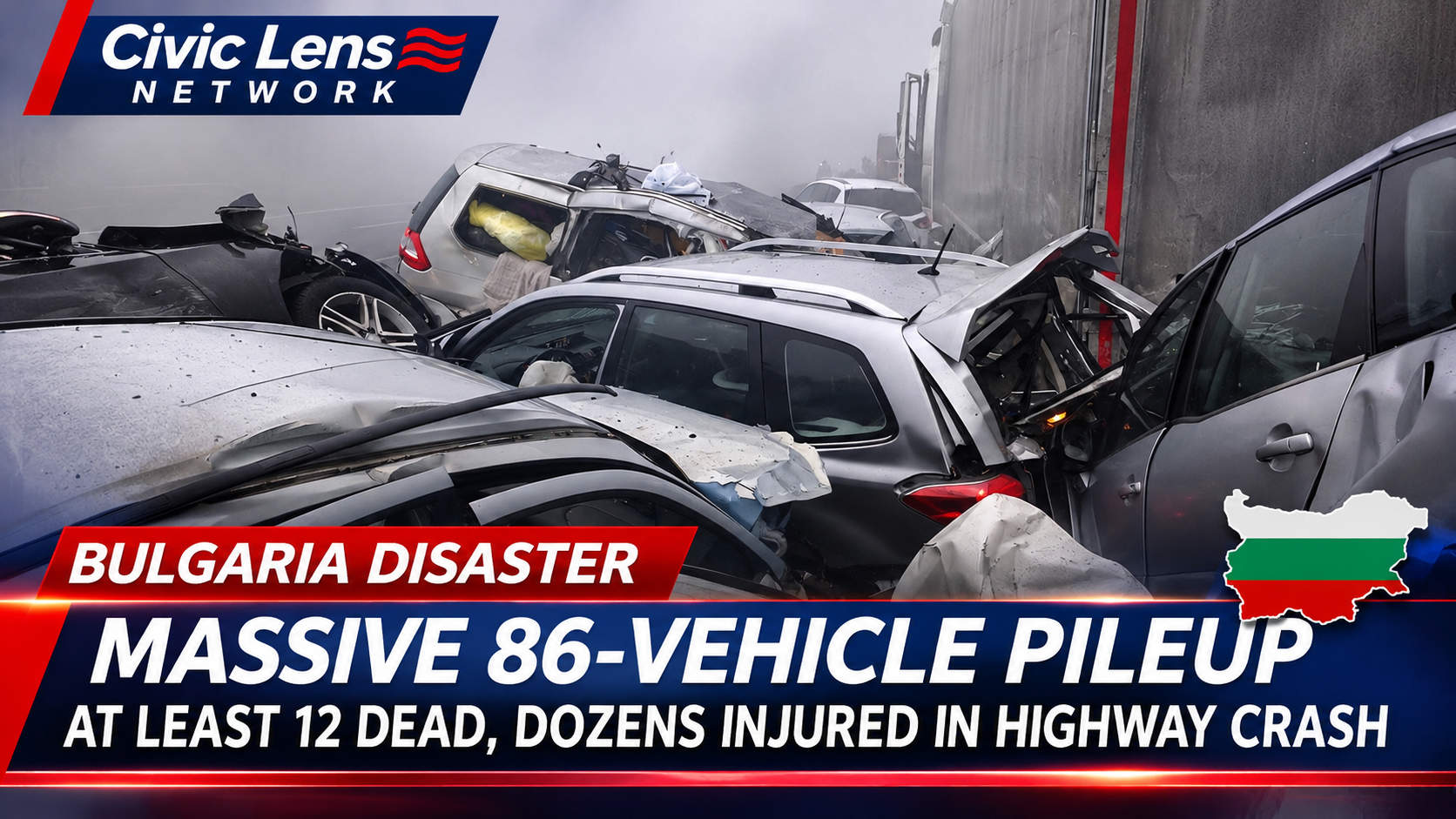
A devastating highway disaster in southeastern Bulgaria has left at least 12 people dead and dozens injured after two enormous chain reaction crashes involving approximately 86 vehicles turned a major motorway into a scene of destruction.
The catastrophe unfolded on the morning of November 10 along Bulgaria’s A1 Trakia Motorway, near the village of Zimnitsa in the Yambol region.
Cars, trucks and other vehicles collided in rapidly developing fog, leaving wreckage scattered across both directions of the highway.
Bulgarian Health Minister Katya Ivkova reported that 10 people died at the scene, while two others died during transport to hospitals. Another 46 people were transported for medical treatment.
The disaster prompted a massive emergency response involving firefighters, police officers, medical personnel and military resources.
Authorities have opened investigations into the collisions as questions mount about visibility, driving conditions and whether additional safety measures could have prevented such an extraordinary loss of life.
A Highway Transformed Into a Disaster Zone
The first emergency reports came shortly after 7 a.m., when motorists encountered extremely dangerous conditions along one of Bulgaria’s most important transportation routes.
The Trakia Motorway connects the capital, Sofia, with Burgas, a major port city on the Black Sea.
The highway carries passenger vehicles, commercial traffic and heavy trucks across the country.
According to Bulgarian authorities, two major pileups occurred on opposite sides of the motorway in approximately the same area.
Officials reported that 63 vehicles were involved in the collisions on the carriageway heading toward Burgas, while another 23 vehicles crashed on the opposite side toward Sofia.
The combined total reached 86 vehicles.
The wreckage stretched across multiple lanes, with damaged cars and trucks blocking the roadway.
Some vehicles were overturned, while others were crushed or forced from their lanes.
Emergency crews faced the difficult task of reaching injured motorists through a massive concentration of wrecked vehicles.
The highway was closed in both directions as rescue operations continued.
The First Collision Triggered a Chain Reaction
Investigators believe the disaster began when a truck and a bus collided on the Burgas-bound side of the motorway.
According to preliminary information released by Interior Ministry officials, a truck obstructed the path of a passenger bus.
Further collisions followed as approaching drivers encountered the developing emergency.
Authorities also described a subsequent crash involving a truck transporting grain and another vehicle.
The situation rapidly escalated into a series of impacts involving dozens of vehicles.
On the opposite carriageway, another major pileup occurred.
Officials are examining whether motorists traveling toward Sofia became distracted by the unfolding disaster across the motorway.
That possibility remains a preliminary investigative theory rather than an established finding.
Authorities have not announced a final reconstruction of the sequence of collisions.
The investigation will need to determine how the initial crashes occurred, how quickly the pileups developed and whether individual driving decisions contributed to the scale of the disaster.
Visibility Reportedly Dropped to Just 10 Meters
One of the most alarming details emerging from the investigation concerns the sudden deterioration of visibility.
Bulgarian Interior Ministry official Lyubomir Nikolov said witness accounts suggested that visibility had initially been approximately 70 to 80 meters.
It then reportedly dropped to just 10 meters as dense fog developed.
Such a sudden change can leave motorists with extremely little time to react to stopped traffic or obstacles ahead.
Investigators also identified wet pavement as a possible contributing factor.
When roads are damp, vehicles can require greater stopping distances, particularly when traveling at motorway speeds.
Heavy trucks present additional challenges because their weight can make emergency braking more difficult.
Authorities have suggested that some vehicles may have been traveling too fast for the conditions.
However, investigators have not established whether particular drivers violated traffic laws or whether any single action caused the entire disaster.
The full sequence remains under examination.
Twelve Lives Lost, Dozens Hospitalized
The human cost of the disaster has been devastating.
Health Minister Katya Ivkova reported that at least 12 people had died, including 10 who were pronounced dead at the crash site.
Two additional victims died while being transported for medical treatment.
Forty-six people were reported transported to hospitals, although other official briefings cited approximately 50 injured people.
These differences reflect figures released at different stages of the emergency response.
Hospitals in Yambol, Sliven and Burgas received injured survivors.
Some patients required intensive care, emergency surgery and other urgent treatment.
Authorities have not released a complete list of victims or a comprehensive account of their injuries.
The identities and circumstances of those who died remain largely unknown in the initial public reporting.
With several people seriously injured, officials are continuing to monitor the medical situation.
Massive Emergency Response Launched
Bulgarian emergency services mobilized substantial resources to respond to the disaster.
Firefighters, police officers and ambulance crews converged on the motorway as rescue workers attempted to locate survivors and reach people trapped inside damaged vehicles.
Officials reported deploying 15 fire engines and hundreds of police personnel alongside medical teams.
The operation required coordination across several neighboring regions.
Rescue personnel worked around damaged trucks, crushed passenger vehicles and debris scattered along the roadway.
Some sections of crash barriers had to be removed to improve access.
The scale of the wreckage created major logistical challenges for emergency workers.
Heavy vehicles blocked portions of the road, while the dangerous weather conditions complicated movement around the scene.
Authorities also arranged aircraft to support the medical response.
A military Spartan transport aircraft was among the resources prepared to assist with transporting injured people.
The government’s response reflected the extraordinary severity of the collisions.
Prime Minister Interrupts Major International Meeting
The tragedy reached the highest levels of Bulgaria’s government.
Prime Minister Rumen Radev interrupted official engagements to respond to the disaster.
At the time, European Commission President Ursula von der Leyen was visiting Bulgaria for meetings with the country’s leadership.
The emergency forced changes to the planned schedule.
Radev traveled toward the disaster area, while von der Leyen shortened her visit and expressed condolences to the victims and their families.
Bulgarian President Iliana Yotova also cut short her participation in the Paris Peace Forum to return home.
The government canceled additional official events as authorities concentrated on the emergency response.
The extraordinary disruption to national and international engagements underscored the seriousness of the disaster.
Investigators Examine Two Separate Crash Scenes
Bulgarian prosecutors have opened two investigations because the collisions occurred on opposite carriageways.
Investigators will examine the crashes separately while considering whether they were connected by the same weather conditions or by drivers reacting to the first disaster.
The inquiry is expected to involve vehicle examinations, witness statements, roadway assessments and reconstruction of the collisions.
Authorities will need to determine whether sudden fog was the primary cause or whether additional factors played significant roles.
Possible areas of examination include vehicle speeds, following distances, driver reactions and the condition of the road surface.
Investigators may also consider whether existing warning signs and road markings provided sufficient guidance in rapidly deteriorating visibility.
No final determination of criminal responsibility has been announced.
Could Better Highway Safety Measures Have Prevented the Disaster?
The scale of the tragedy has prompted discussion about whether additional safety measures are needed along motorway sections vulnerable to dense fog.
Nikolov suggested that authorities should consider improving road markings in areas where visibility frequently deteriorates.
Reflective markings can help motorists identify lane boundaries when ordinary painted lines become difficult to see.
Other possible highway safety measures include variable speed limits, electronic warning signs and systems that notify drivers about sudden changes in weather conditions.
Such measures can reduce risks when properly designed and maintained.
However, no evidence has yet established that missing or defective warning systems caused the Bulgaria collisions.
Investigators must determine the actual circumstances before responsibility can be assigned.
The sudden reduction in visibility reported by witnesses will likely be a central part of that assessment.
Bulgaria’s Wider Road Safety Challenge
The disaster also highlights broader concerns about road safety in Bulgaria.
European road safety figures have placed Bulgaria among the European Union countries with the highest rates of traffic fatalities relative to population.
According to European Commission figures cited in reporting on the disaster, Bulgaria recorded approximately 71 road deaths per million inhabitants in 2025, compared with an EU average of 43.
These figures do not explain the cause of the November 10 crashes.
They do, however, provide context for the country’s ongoing challenges involving traffic enforcement, road conditions and accident prevention.
A disaster involving 86 vehicles is extraordinary even by the standards of major motorway collisions.
Its consequences may lead to renewed scrutiny of how Bulgarian authorities monitor hazardous road conditions and warn motorists of rapidly developing dangers.
Families Await Answers as Investigation Continues
For the families of those killed, the disaster has brought sudden and devastating loss.
A routine morning journey became a deadly emergency within minutes.
Passengers and drivers who expected to reach their destinations instead found themselves caught in a chain of collisions that stretched across both sides of a major highway.
Survivors now face recovery from physical injuries and the trauma of witnessing the destruction.
Emergency workers must continue supporting those affected while investigators reconstruct what happened.
The questions facing Bulgarian authorities are substantial.
How did visibility deteriorate so rapidly?
Were drivers given sufficient warning?
Did excessive speed or inadequate following distances contribute to the collisions?
Could improved road markings or other safety measures have reduced the scale of the disaster?
And how did two enormous pileups develop on opposite sides of the same motorway?
The answers will be essential not only for determining responsibility but also for preventing future tragedies.
For now, Bulgaria is confronting the aftermath of one of its most extraordinary recent motorway disasters.
At least 12 people have lost their lives, dozens have required medical treatment and 86 vehicles were caught in a catastrophe that unfolded in a matter of moments.
The investigation is only beginning, but the tragedy has already demonstrated how quickly a busy highway can become a deadly scene when visibility disappears and approaching vehicles have little room to react.