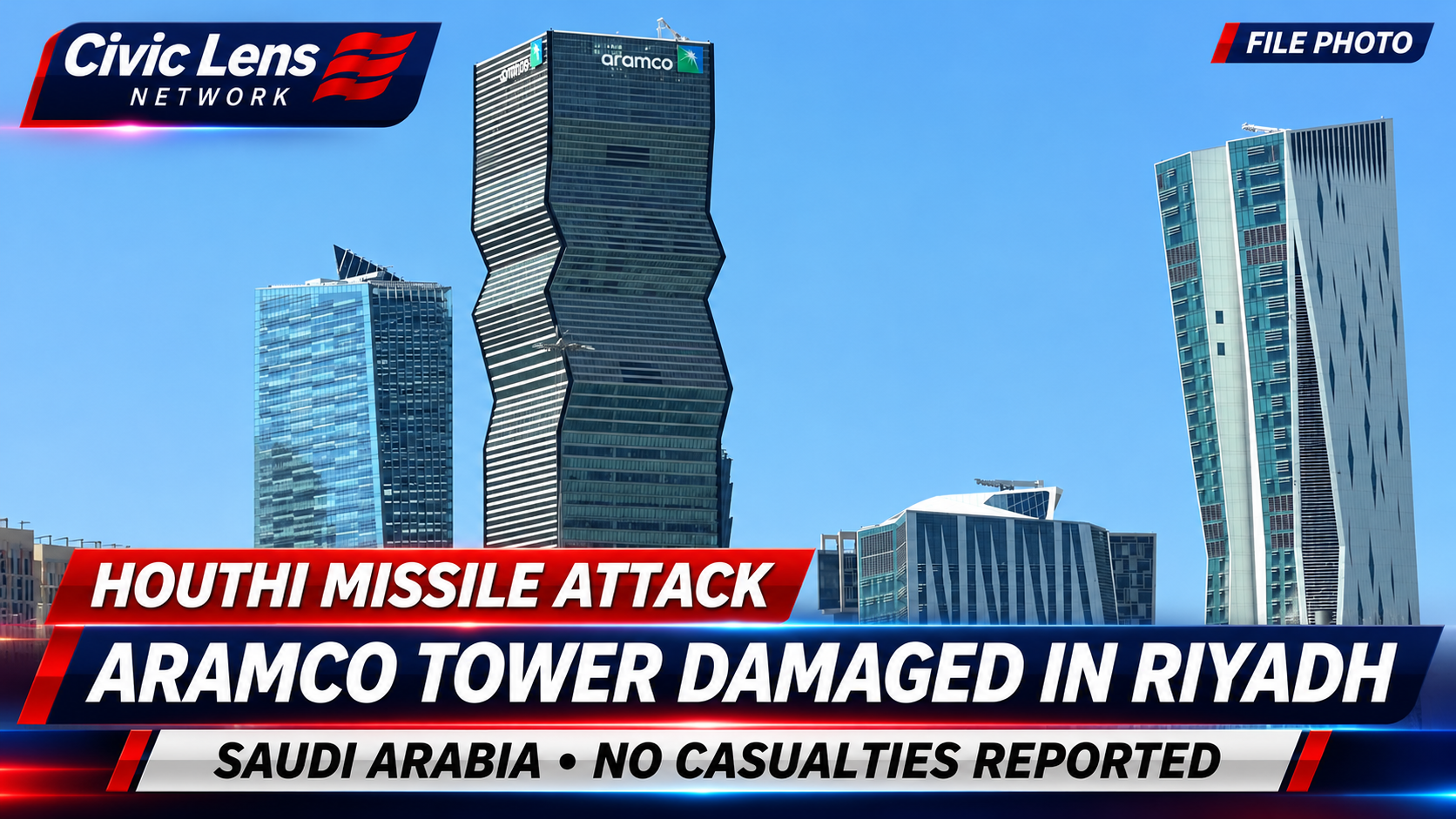
Saudi Arabia’s capital has come under renewed missile attack as Yemen’s Iran-aligned Houthi forces intensify their military campaign against the kingdom, with falling debris damaging a prominent Saudi Aramco skyscraper in Riyadh’s financial district.
The attack shattered windows across several floors of Aramco Tower, one of the most recognizable buildings in the King Abdullah Financial District, a centerpiece of Saudi Arabia’s efforts to transform its economy into a global financial and business hub.
Saudi Arabia’s Ministry of Energy confirmed that the building sustained damage following what it described as an attempted attack. Officials said falling shrapnel caused limited damage and that no injuries or fatalities had been reported.
The incident occurred as Saudi air defenses intercepted multiple missiles launched toward the capital and other parts of the kingdom.
The Houthis claimed responsibility for the attack, adding to growing fears that the conflict between Saudi Arabia and the armed movement controlling much of northern Yemen could develop into a wider regional confrontation.
Although Saudi authorities reported successfully intercepting the incoming missiles, the damage to Aramco Tower demonstrates that even intercepted weapons can pose a serious threat to civilian buildings and critical economic infrastructure.
Missile Debris Strikes Riyadh’s Financial District
The attack unfolded early Sunday as residents of Riyadh reported hearing loud explosions above the city.
Saudi Civil Defense issued emergency warnings about possible incoming threats before later announcing that the immediate danger had passed.
The Saudi-led military coalition reported that its air defense systems intercepted and destroyed two ballistic missiles launched toward Riyadh.
Additional interceptions were reported elsewhere in the country, including cruise missiles targeting the Riyadh and southern regions.
Despite those interceptions, debris struck an administrative building belonging to Saudi Aramco.
A witness at the scene observed shattered windows across several floors of Aramco Tower.
The Saudi Energy Ministry confirmed that the building had sustained damage but characterized it as limited.
Officials said emergency authorities responded and began taking appropriate safety measures.
No casualties were reported at the tower.
The precise sequence connecting the missile interceptions to the debris that struck the building has not been fully established publicly.
Nevertheless, the incident represents a serious breach of security in one of the kingdom’s most prominent business districts.
Why Aramco Tower Matters
Saudi Aramco is one of the world’s largest energy companies and plays a central role in Saudi Arabia’s economy.
The company is responsible for producing and exporting enormous quantities of crude oil and natural gas, making its operations critically important to international energy markets.
Aramco Tower stands in Riyadh’s King Abdullah Financial District, a modern complex of skyscrapers, corporate offices, residential properties and commercial developments.
The district represents a major part of Saudi Arabia’s long-term economic diversification program.
It is intended to attract international businesses, investment firms and financial institutions as the kingdom seeks to expand beyond its traditional dependence on oil revenues.
An attack affecting a building associated with Aramco therefore carries significance beyond the immediate physical damage.
It demonstrates that the conflict can reach prominent economic landmarks in the heart of the Saudi capital.
However, there is no confirmed evidence that Sunday’s incident disrupted Saudi oil production or exports.
The damaged building is an administrative facility, and authorities have not reported damage to production equipment as a result of this particular attack.
Saudi Air Defenses Intercept Multiple Missiles
Saudi military officials reported several interceptions during the latest wave of attacks.
Coalition spokesperson Major General Turki al-Maliki said air defenses destroyed two ballistic missiles heading toward Riyadh.
The coalition also reported intercepting cruise missiles over the Riyadh and southern regions, along with another missile threatening the oil-rich Eastern Province.
Additional reports indicated that a drone was intercepted.
The attacks triggered warnings in multiple areas, including locations near some of Saudi Arabia’s most important energy infrastructure.
The Eastern Province contains much of the kingdom’s oil and gas reserves and is home to Aramco’s principal headquarters in Dhahran.
Authorities issued and later lifted warnings as the immediate threats passed.
The interceptions highlight the importance of Saudi Arabia’s air defense network, which has faced repeated challenges from missiles and drones launched by Houthi forces.
However, intercepting an incoming missile does not necessarily eliminate every danger.
Fragments from destroyed weapons can fall into populated areas, damage buildings and potentially injure civilians.
That appears to be the explanation Saudi authorities have given for the damage to Aramco Tower.
Houthis Claim Responsibility
The Houthi movement, also known as Ansar Allah, claimed responsibility for the attack.
The group has expanded its missile and drone operations against Saudi Arabia as fighting in Yemen has intensified.
Houthi officials also claimed to have targeted Riyadh’s King Khalid International Airport.
Saudi authorities have not confirmed that the airport was targeted during Sunday’s operation, and that particular claim remains unverified.
The Houthis are an armed political and military movement that seized Yemen’s capital, Sanaa, in 2014.
Saudi Arabia subsequently led a military coalition into Yemen in 2015 in support of the country’s internationally recognized government.
The conflict developed into a prolonged war involving regional powers, armed factions and competing political authorities.
The Houthis have received support from Iran, making their confrontation with Saudi Arabia an important part of the wider struggle for influence across the Middle East.
Their ability to launch missiles and drones toward Saudi cities has repeatedly raised concerns about civilian safety and regional security.
A Dangerous Escalation in the Regional Conflict
The latest attack follows months of renewed fighting between Saudi-backed forces and the Houthis.
A United Nations-brokered truce established in 2022 had significantly reduced direct hostilities between the two sides.
However, the ceasefire arrangement collapsed earlier this year as fighting resumed.
Since then, the Houthis have carried out repeated missile and drone attacks against Saudi airports, ports, energy facilities and other infrastructure.
Saudi Arabia has responded with military operations and airstrikes against Houthi positions in Yemen.
The conflict has also become increasingly connected to the wider confrontation involving Iran, Israel and the United States.
The Houthis’ relationship with Iran has raised concerns that attacks against Saudi Arabia could intensify alongside broader regional hostilities.
Saudi Arabia now faces the challenge of defending its territory while attempting to prevent further escalation.
The attack on Aramco Tower demonstrates how quickly military confrontations can threaten civilian and economic centers far from the immediate battlefield.
Previous Airport Attack Killed 13 People
Sunday’s missile attack follows a particularly deadly incident at Riyadh’s King Khalid International Airport on October 10.
Saudi authorities reported that 13 people were killed and more than 300 wounded in that attack.
The incident disrupted aviation operations and forced airlines to reassess security conditions.
International carriers have faced difficult decisions about continuing flights to airports exposed to missile and drone threats.
Air travel disruptions have affected passengers, commercial transportation and business operations.
The airport attack also demonstrated that the conflict was no longer confined to remote military positions or border regions.
Major civilian transportation hubs had become vulnerable.
The latest damage to Aramco Tower reinforces concerns that financial districts and other civilian facilities could face similar dangers.
While Sunday’s incident resulted in no reported casualties at the tower, previous attacks show how devastating the consequences can become when missiles or their debris strike populated areas.
Deadly Airstrikes in Yemen Add to Tensions
The missile attack on Riyadh came shortly after reports of deadly airstrikes near Yemen’s capital, Sanaa.
Yemen’s Houthi-run Health Ministry reported that at least 33 people were killed and 39 wounded in strikes on a village east of the capital.
Houthi officials accused the Saudi-led coalition of carrying out the attacks.
Saudi authorities said they were investigating the reports.
The casualty figures and responsibility for those strikes have not been independently verified.
Nevertheless, the reported deaths have intensified tensions between the two sides.
The latest developments illustrate a dangerous cycle in which attacks and counterattacks threaten to produce additional civilian casualties.
Communities in Yemen have endured years of war, displacement, economic hardship and damage to essential infrastructure.
Saudi residents have also faced missile warnings, attacks on civilian facilities and disruptions to transportation.
Without a diplomatic breakthrough, further military escalation could place additional communities at risk.
Could Saudi Oil Infrastructure Become a Larger Target?
Saudi Arabia’s energy infrastructure has long been considered a strategically important target during regional conflicts.
The kingdom is one of the world’s leading oil exporters, and disruptions to its production or transportation systems can influence international energy prices.
The Houthis have previously attacked or threatened oil installations, refineries and shipping infrastructure.
The latest incident involved an Aramco administrative building rather than a confirmed production facility.
That distinction is important.
No disruption to Saudi crude oil production has been confirmed as a result of Sunday’s attack.
Nevertheless, the damage raises questions about the security of corporate headquarters, financial centers and other facilities associated with the kingdom’s energy industry.
Investors and energy traders closely monitor threats to Saudi infrastructure because of the country’s importance to global supply.
A successful attack against a major refinery, export terminal or processing facility could have consequences far beyond the Middle East.
Sunday’s incident does not establish that such an attack is imminent.
It does, however, demonstrate the continuing ability of Houthi forces to threaten important locations inside Saudi Arabia.
Pressure Mounts on Saudi Arabia’s Leadership
The renewed missile campaign presents a significant challenge for Saudi leaders.
The kingdom has invested heavily in air defense systems, military modernization and infrastructure protection.
Yet repeated attacks require constant surveillance, rapid interception capabilities and coordination among military and civilian authorities.
Protecting Riyadh is especially important because the capital is the country’s political and administrative center.
The King Abdullah Financial District also carries symbolic importance as part of Saudi Arabia’s economic transformation.
Any attack affecting the district could raise questions among international investors about security risks.
Saudi officials must now assess the damage to Aramco Tower while continuing to monitor potential threats from Yemen.
Authorities will also need to determine whether additional protective measures are necessary around major commercial and government buildings.
The challenge extends beyond preventing direct missile impacts.
Falling debris from intercepted weapons can still threaten densely populated areas.
What Happens Next?
The Saudi-led coalition has indicated that it will continue taking measures against missile and drone threats.
Saudi authorities are also investigating the latest incident and assessing damage to the Aramco building.
The Houthis, meanwhile, have shown little indication that they intend to end their military campaign against Saudi targets.
Further attacks remain possible, although no specific future operation can be confirmed.
The international community faces growing pressure to prevent the conflict from escalating further.
For Saudi Arabia, the immediate priority is protecting civilians, securing vital infrastructure and maintaining the operation of essential transportation and economic systems.
For Yemen, the continuing exchange of attacks threatens to deepen an already devastating humanitarian crisis.
Sunday’s incident ended without reported deaths or injuries at Aramco Tower, but its significance should not be underestimated.
Missile debris reached one of Riyadh’s most prominent financial landmarks, damaging a building associated with the country’s largest energy company.
The attack is another warning that the renewed Saudi-Houthi confrontation is increasingly threatening major cities, civilian infrastructure and regional economic stability.
As the conflict continues, the question is no longer simply whether Saudi air defenses can intercept incoming missiles.
It is whether the region can prevent the next attack from causing a far more devastating outcome.