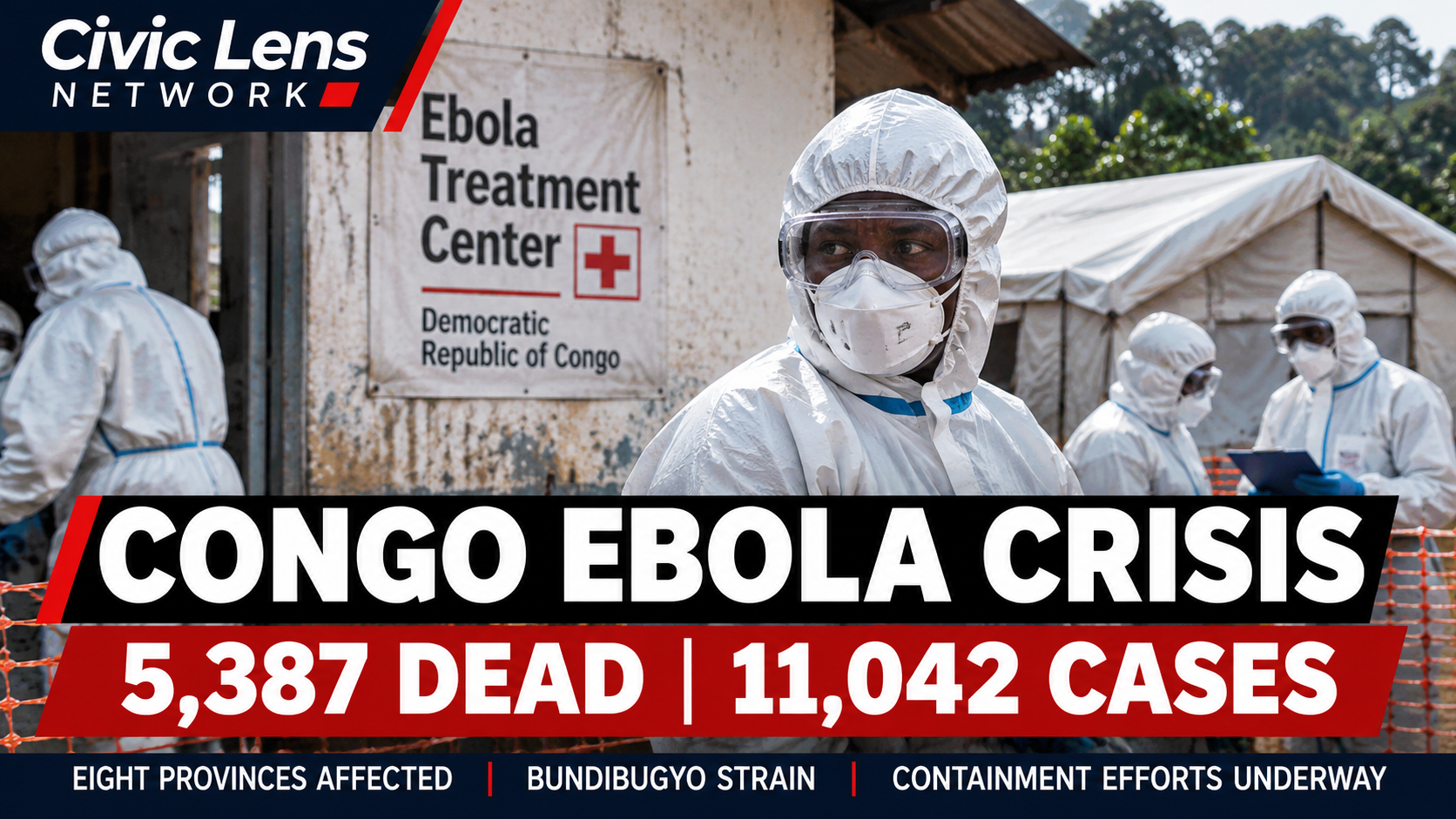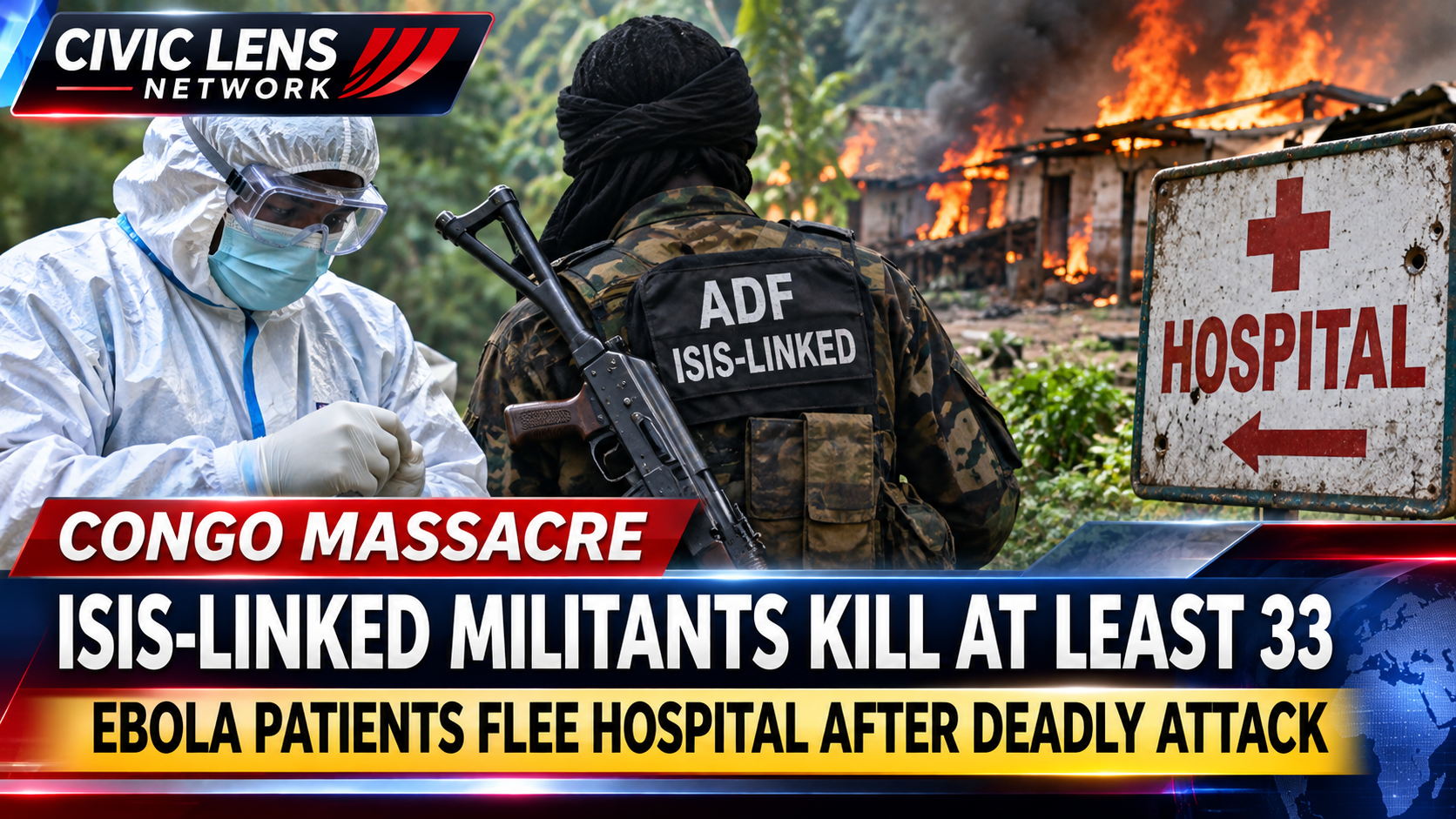
A deadly attack attributed to Islamic State-linked militants has left at least 33 civilians dead in the Democratic Republic of Congo, while a second emergency unfolds after patients infected with or suspected of carrying Ebola fled a nearby hospital during the violence.
The assault struck the village of Cantine-Aloya in North Kivu province, approximately 30 miles west of Beni, late Thursday night.
According to local authorities and civil society representatives, militants associated with the Allied Democratic Forces, commonly known as the ADF, attacked the community around 11 p.m., killing residents, setting homes on fire and forcing terrified families to flee.
The violence reportedly left more than 50 houses burned and disrupted medical operations in a region already struggling with a major Ebola outbreak.
Among those who escaped the nearby Kelekele Hospital Center were patients under observation for the deadly virus, including one confirmed Ebola patient.
The attack has now created two overlapping emergencies: a mass killing of civilians and a potentially dangerous disruption to efforts to contain an infectious disease.
At Least 33 Civilians Reportedly Killed
Local civil society representatives reported recovering 33 bodies following the attack.
Tchetche Aliamini, a civil society leader in the region, said many victims had suffered gunshot wounds, while others showed evidence of severe injuries inflicted during the assault.
Another local civil society leader, Justin Paluku, independently reported the same death toll and described widespread destruction throughout the village.
The reported victims were civilians caught in the attack.
However, authorities have not established a final official death toll.
Beni territorial administrator Colonel Charles Omeonga said heavy rainfall had complicated military operations and efforts to investigate the killings.
The number of wounded residents also remains unclear.
The attack adds to a long history of violence in eastern Congo, where armed groups have repeatedly targeted villages, displaced residents and destroyed essential infrastructure.
More Than 50 Homes Reportedly Burned
The attackers did not limit their assault to killing civilians.
According to local representatives, militants burned more than 50 houses and looted property, leaving families without shelter or possessions.
A local health post was also set on fire.
The destruction forced residents to abandon their homes and seek safety elsewhere in North Kivu province.
For families already struggling with insecurity, displacement and limited access to medical services, the attack has created another devastating crisis.
The burning of homes and health facilities also threatens the community’s ability to recover.
Residents who survive the initial violence may face shortages of food, clean water, shelter and medical treatment.
The full extent of the destruction remains under investigation.
Ebola Patients Flee Hospital During Attack
Perhaps the most alarming development involves the nearby Kelekele Hospital Center.
Medical director Dr. Christian Kakule Vulembera reported that approximately 180 patients fled the hospital as gunfire erupted and homes burned near the medical facility.
Among those who escaped was one patient with a confirmed Ebola infection.
Five suspected Ebola cases were also reported among those who fled, including three individuals identified as high-risk contacts.
Hospital officials warned that patients who were receiving treatment or undergoing monitoring had scattered during the emergency.
The attack unfolded close enough to the hospital that gunfire and burning homes were reported within approximately 50 meters of the facility.
The danger forced medical personnel and patients to confront an immediate threat to their lives while interrupting an essential public-health response.
Authorities now face the difficult task of locating those who fled and determining whether they may have exposed others to the virus.
Importantly, the 180 people who fled were hospital patients overall, not 180 confirmed Ebola cases.
Fears Grow Over Possible Ebola Transmission
Ebola is a serious viral disease that can cause severe illness and death.
The virus spreads through direct contact with the blood or other bodily fluids of infected people, as well as contaminated materials.
Containing an outbreak requires identifying infected patients, isolating cases when appropriate, tracing contacts and ensuring that medical teams can safely provide treatment.
When patients and individuals under monitoring disappear during an armed attack, those containment measures become considerably more difficult.
North Kivu has emerged as one of the most heavily affected areas of Congo’s ongoing Ebola emergency.
Authorities have reported more than 10,000 cases and 5,000 deaths nationwide during the outbreak, with North Kivu accounting for approximately half of new infections.
The outbreak involves the Bundibugyo species of Ebola virus, a rare but dangerous form of the disease.
Medical officials fear that the disruption caused by the militant attack could allow infections to spread beyond the areas where patients were previously being monitored.
However, there has been no confirmed finding that the fleeing patients caused additional transmission as a result of this particular incident.
The immediate priority is locating the missing patients and contacts and restoring interrupted medical care.
Who Are the Allied Democratic Forces?
The Allied Democratic Forces are an armed militant organization with origins in neighboring Uganda.
The group has operated for years in eastern Congo, where it has been accused of repeated attacks against civilians, villages and religious communities.
In 2019, the organization pledged allegiance to the Islamic State, and the international terrorist network subsequently recognized the ADF as an affiliate.
The militants have been linked to massacres, kidnappings, arson and attacks on vulnerable rural communities.
Although the ADF has longstanding local origins, its association with Islamic State has raised broader concerns about extremist networks operating across parts of central and eastern Africa.
The organization has continued conducting deadly attacks despite military operations intended to weaken its capabilities.
The latest killings in Cantine-Aloya demonstrate the persistent threat facing communities in areas where armed groups remain active.
Local officials and civil society representatives have attributed the attack to the ADF.
The group’s direct responsibility for this particular assault has not yet been established through an independently verified claim or completed investigation.
Serious Questions About Security Failures
The massacre has also prompted criticism of security arrangements in North Kivu.
Justin Paluku, a local civil society leader, questioned how militants were able to carry out such a destructive attack despite the presence of government security forces in the wider region.
His criticism reflects a longstanding concern among residents of eastern Congo.
Military deployments have not consistently prevented armed groups from entering villages, killing civilians and escaping into surrounding territory.
The latest attack raises questions about whether adequate intelligence was available, how quickly security forces responded and whether additional measures could have protected residents.
Colonel Charles Omeonga confirmed that investigations and military operations were complicated by severe weather.
Authorities have not publicly established whether specific failures contributed to the attack.
Nevertheless, the deaths of at least 33 civilians and the disruption of a hospital treating Ebola patients will likely intensify demands for stronger protection.
Eastern Congo Remains a Center of Armed Violence
Eastern Congo has endured decades of conflict involving numerous armed organizations, regional rivalries and competition over territory and resources.
The ADF is only one of many militant groups operating in the region.
Other armed organizations, including the Rwanda-backed M23 movement, have contributed to widespread instability in different parts of eastern Congo.
The conflicts have displaced large populations, disrupted agricultural production and weakened essential public services.
Many communities live with the constant threat of armed raids.
Schools, hospitals, markets and places of worship have all been affected by violence across the region.
The combination of persistent insecurity and serious infectious disease outbreaks makes North Kivu particularly vulnerable.
When fighting forces residents to flee, humanitarian organizations can struggle to maintain contact with vulnerable populations.
Medical workers may also be unable to safely reach communities where treatment, vaccination and disease surveillance are urgently needed.
A Humanitarian Emergency With Wider Consequences
The consequences of the Cantine-Aloya attack extend beyond the village itself.
At least 33 families are confronting reported deaths, while many more residents have lost homes or fled in fear.
Medical officials must now attempt to restore disrupted Ebola treatment and locate patients whose health status requires urgent monitoring.
The burning of a health post further complicates efforts to provide essential services.
Humanitarian organizations working in eastern Congo already face difficult operating conditions because of insecurity, damaged infrastructure and displacement.
Another deadly attack creates additional pressure on limited resources.
The possibility of interrupted Ebola containment adds a serious public-health dimension to an already devastating security emergency.
What Happens Next?
Investigators must establish the final number of victims, determine responsibility for the attack and examine how militants were able to strike the village.
Health officials face a separate but equally urgent challenge.
They must locate the confirmed Ebola patient, identify the suspected cases and high-risk contacts who fled, and determine whether additional precautions are necessary.
The success of those efforts could influence whether the disruption remains a localized emergency or contributes to a wider public-health crisis.
For residents of Cantine-Aloya, however, the immediate reality is already devastating.
Families have been killed, homes have been destroyed and a hospital treating patients with a dangerous infectious disease has been disrupted by armed violence.
The attack underscores the continuing danger posed by extremist militant organizations in eastern Congo and the enormous difficulties faced by communities caught between armed conflict and deadly disease.
As authorities search for those responsible and medical workers attempt to restore Ebola containment efforts, the people of North Kivu are once again left confronting the consequences of a crisis that has taken far too many lives.