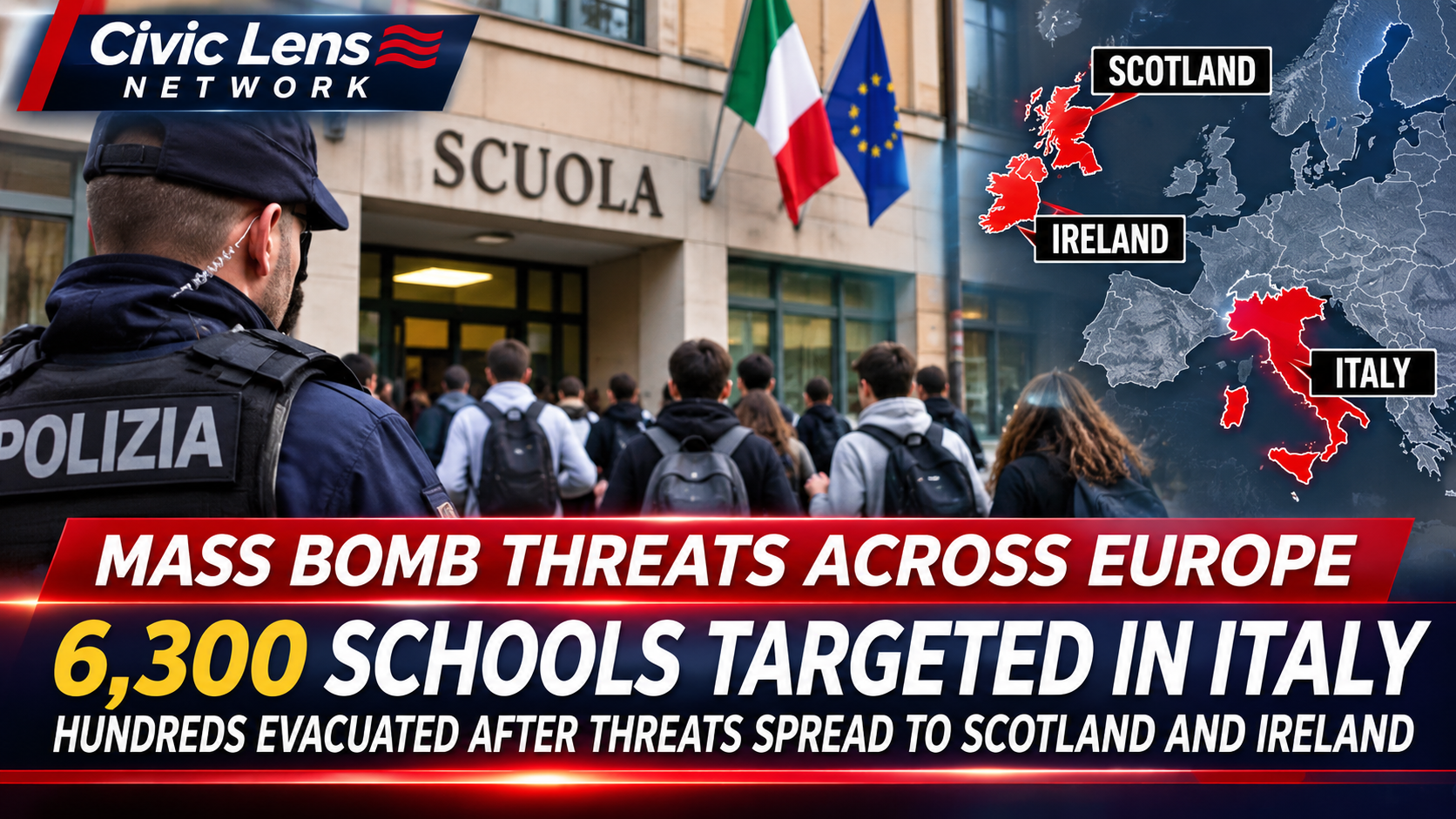
A massive wave of bomb threats targeting thousands of schools across Europe triggered emergency evacuations in Italy on Wednesday, November 11, as police and intelligence agencies launched investigations into an extraordinary campaign of intimidation that also included threats against Italian Prime Minister Giorgia Meloni.
More than 6,300 schools across Italy received threatening emails, according to the country’s Education Ministry. At least 300 schools were evacuated as authorities responded to warnings that explosive devices had allegedly been planted inside educational facilities.
Similar messages reached hundreds of schools in Scotland, Northern Ireland and the Republic of Ireland, creating widespread concern among parents, teachers and government officials.
Despite the extraordinary scale of the threats, authorities reported no discovered explosive devices or injuries connected to the alerts.
Italian officials believe the messages were hoaxes designed to spread fear and disrupt everyday life.
However, investigators have not established who was responsible or whether the campaign was connected to a foreign government, extremist organization or independent individuals.
Thousands of Schools Receive Threatening Emails
The emergency began Wednesday morning when schools across Italy received threatening electronic messages warning of alleged explosive devices.
The emails were distributed on an enormous scale, reaching more than 6,300 educational institutions.
Schools in Rome, Milan, Turin and other Italian cities were among those affected.
Administrators faced an immediate decision about whether to evacuate students and staff while police evaluated the credibility of the threats.
At least 300 schools were evacuated, although the exact number remained subject to updates as authorities gathered information.
Students were directed outside while police officers and emergency personnel examined buildings and surrounding areas.
In Rome, students at Mamiani High School initially believed an evacuation alarm was signaling an ordinary break.
They discovered that the evacuation was connected to a bomb threat only after leaving the building.
Other schools sent messages to parents explaining that students had been moved to safe locations under staff supervision.
The extraordinary number of affected institutions created a major logistical challenge for emergency services.
Police had to assess multiple reports simultaneously while determining whether the messages represented an actual threat or an attempt to overwhelm security resources.
Italian Prime Minister Personally Threatened
The threatening messages went beyond schools.
According to Italian media reports and copies of the emails examined by journalists, the sender also included threats against Prime Minister Giorgia Meloni.
The message reportedly claimed that an explosive device had been placed in the prime minister’s vehicle.
Authorities have not established that any such device existed.
Meloni addressed the situation publicly, emphasizing that investigators had found no indication of a concrete danger to schools.
She described the messages as an apparent effort to generate alarm and concern.
The prime minister also convened a meeting involving government ministers and security officials to evaluate the situation and coordinate the response.
Her intervention demonstrated how seriously Italian authorities regarded the scale of the disruption, even as they sought to reassure the public.
The threats against Meloni have not been attributed to any identified suspect.
A Mysterious Name Appears in the Messages
One of the most unusual details involves the name used to sign the threatening emails.
According to Reuters, the messages were signed by someone identifying himself as Mikhail Andropov, claiming leadership of an organization called the Vilayat of Misoginistan.
The name had previously appeared in threatening messages sent to European news organizations.
The same purported sender claimed responsibility for bomb threats directed at newsrooms in Ireland and Bulgaria during the preceding week.
Investigators are examining whether the repeated use of the name indicates a common source behind the incidents.
However, an email signature does not establish the sender’s real identity.
Individuals carrying out hoax campaigns can impersonate organizations, adopt false names or deliberately include misleading information to complicate investigations.
Authorities have not verified that the person named in the messages exists as described.
Nor have they established that the organization mentioned in the emails was responsible.
The possibility of deliberate misdirection remains an important consideration for investigators.
Scotland and Northern Ireland Also Targeted
The campaign was not limited to Italy.
More than 300 schools in Northern Ireland received similar threatening messages, according to police and education authorities.
Police Scotland also reported widespread distribution of the emails, with approximately 470 Scottish schools receiving threats.
The Republic of Ireland confirmed that several educational institutions had received a similar communication.
Unlike the response in Italy, authorities in Northern Ireland, Scotland and the Republic of Ireland generally advised schools that evacuation was unnecessary.
Police assessed the messages as noncredible.
The Police Service of Northern Ireland opened urgent inquiries while reassuring schools that the available evidence did not indicate an immediate danger.
Assistant Chief Constable Anthony McNally acknowledged the distress the messages caused students, parents and school communities.
Police Scotland similarly determined that the threats did not represent a credible danger.
Its cyber and fraud specialists began working with other law enforcement agencies to identify the origin of the emails.
Authorities in the Republic of Ireland also advised educational institutions to report suspicious communications while continuing normal operations unless additional evidence emerged.
The different responses illustrate the difficult balance facing authorities when dealing with large-scale threats.
Officials must take potentially dangerous warnings seriously without allowing anonymous messages to unnecessarily paralyze public institutions.
Europe Faces a Growing Wave of Security Disruptions
The school threats occurred during a period of unusual security incidents across Europe.
In recent weeks, airlines, television broadcasters and other organizations have received bomb threats that authorities subsequently assessed as hoaxes.
More than 20 commercial flights across Europe were reportedly targeted by false bomb warnings during the preceding week.
Some aircraft were diverted, and others experienced operational disruptions as security personnel investigated.
The incidents created substantial costs for airlines and emergency services despite the absence of confirmed explosives.
European authorities have also been investigating cyberattacks against commercial infrastructure.
Among the most serious incidents were attacks involving supermarket refrigeration systems, in which hackers allegedly manipulated temperatures and disrupted food storage.
France recently accused an Iranian-linked cyber unit of responsibility for attacks affecting hundreds of supermarkets.
Iran has rejected those allegations.
The school threats are being examined against this broader background of disruption.
However, investigators have not demonstrated that the bomb hoaxes and cyberattacks were conducted by the same individuals or organizations.
Officials Warn About Psychological Disruption
Italian Defense Minister Guido Crosetto warned that the threats appeared intended to spread fear and anxiety.
He also cautioned against automatically assuming that foreign governments were responsible.
The ability to send threatening emails to large numbers of recipients makes such campaigns relatively easy to initiate.
A single individual or small group can potentially generate substantial disruption without possessing explosives or other weapons.
Schools must still assess the warnings.
Police must investigate.
Parents may rush to collect their children.
Emergency services can be diverted from other responsibilities.
The resulting disruption can extend far beyond the immediate recipients of the messages.
Education Minister Giuseppe Valditara also suggested that the campaign appeared designed to create alarm rather than carry out an actual bombing.
He emphasized that intelligence services were working to identify those responsible.
The central concern is that anonymous threats can undermine public confidence even when investigators find no physical danger.
Could Foreign Governments Be Involved?
The incidents have renewed concerns about hybrid warfare, a term used to describe efforts to destabilize countries through cyberattacks, sabotage, disinformation and other disruptive activities.
Some European officials have warned that hostile governments may use relatively inexpensive methods to create confusion and strain public institutions.
Russia and Iran have faced accusations involving other security incidents in Europe.
However, neither government has been publicly linked by verified evidence to Wednesday’s school threats.
Authorities have not identified the perpetrators.
The appearance of a Russian name in the threatening messages is not proof of Russian involvement.
Similarly, the timing of the school threats alongside unrelated cyber incidents does not establish coordination.
Investigators will need to examine technical evidence, including email transmission records and infrastructure used to distribute the messages.
Such evidence may help establish whether the campaign originated from a single source or multiple participants.
Until those findings are available, allegations of state involvement remain speculative.
Why Schools Are Particularly Vulnerable
Schools present a difficult challenge for security officials because protecting students must remain the highest priority.
Administrators cannot simply dismiss threatening messages without evaluating the potential danger.
At the same time, evacuating thousands of students can create significant logistical problems.
Teachers must account for pupils, maintain supervision and communicate with families.
Police must assess buildings while avoiding unnecessary panic.
When threats arrive simultaneously at hundreds or thousands of institutions, emergency resources can become stretched.
The disruption can also continue long after investigators determine that the warnings were false.
Parents may remain concerned about sending their children back to school.
Students may experience anxiety about future alerts.
School administrators must review emergency procedures and consider whether additional precautions are necessary.
These consequences help explain why authorities regard mass hoax threats as serious criminal matters even when no explosive devices are discovered.
Investigators Search for the Source
Italian police and intelligence officials are now attempting to determine who organized the campaign.
Investigators are expected to examine the threatening emails, their distribution methods and possible connections to previous incidents.
Law enforcement agencies across Europe are sharing information as they investigate similarities between the messages.
The repeated use of the same purported sender’s name may provide investigators with a lead, although it could also represent an attempt to misdirect authorities.
Police must establish whether the emails were distributed through compromised accounts, automated systems or other electronic infrastructure.
They must also determine whether the campaign involved one person, an organized group or several unrelated actors copying earlier threats.
No arrests connected to Wednesday’s mass school threat campaign had been confirmed in the reporting available at publication.
No Explosives Found as Authorities Urge Calm
Despite the enormous scale of the warnings, authorities reported no suspicious explosive devices or injuries associated with the school threats.
Italian officials said the available evidence did not indicate a concrete danger.
Police in Scotland, Northern Ireland and the Republic of Ireland similarly assessed the messages as hoaxes.
The findings offered reassurance to families after a morning of uncertainty.
Nevertheless, the investigations remain active.
Authorities are seeking to identify those responsible for distributing threats that disrupted education across several countries and required extensive police attention.
The events demonstrate how easily modern communication systems can be exploited to create widespread alarm.
Thousands of schools can receive threatening messages within a short period, forcing governments to respond before investigators have established whether the danger is genuine.
For Italy and its European neighbors, the immediate priority is restoring normal school operations while continuing the search for those responsible.
The unanswered question is whether Wednesday’s extraordinary campaign was the work of isolated hoaxers or part of a broader effort to destabilize public institutions.
Until investigators establish the source, that question remains open.
What is already clear is that anonymous threats were sufficient to disrupt hundreds of schools, mobilize police across multiple countries and prompt an emergency response from Italy’s highest levels of government.
No bombs were found, but the disruption was real.