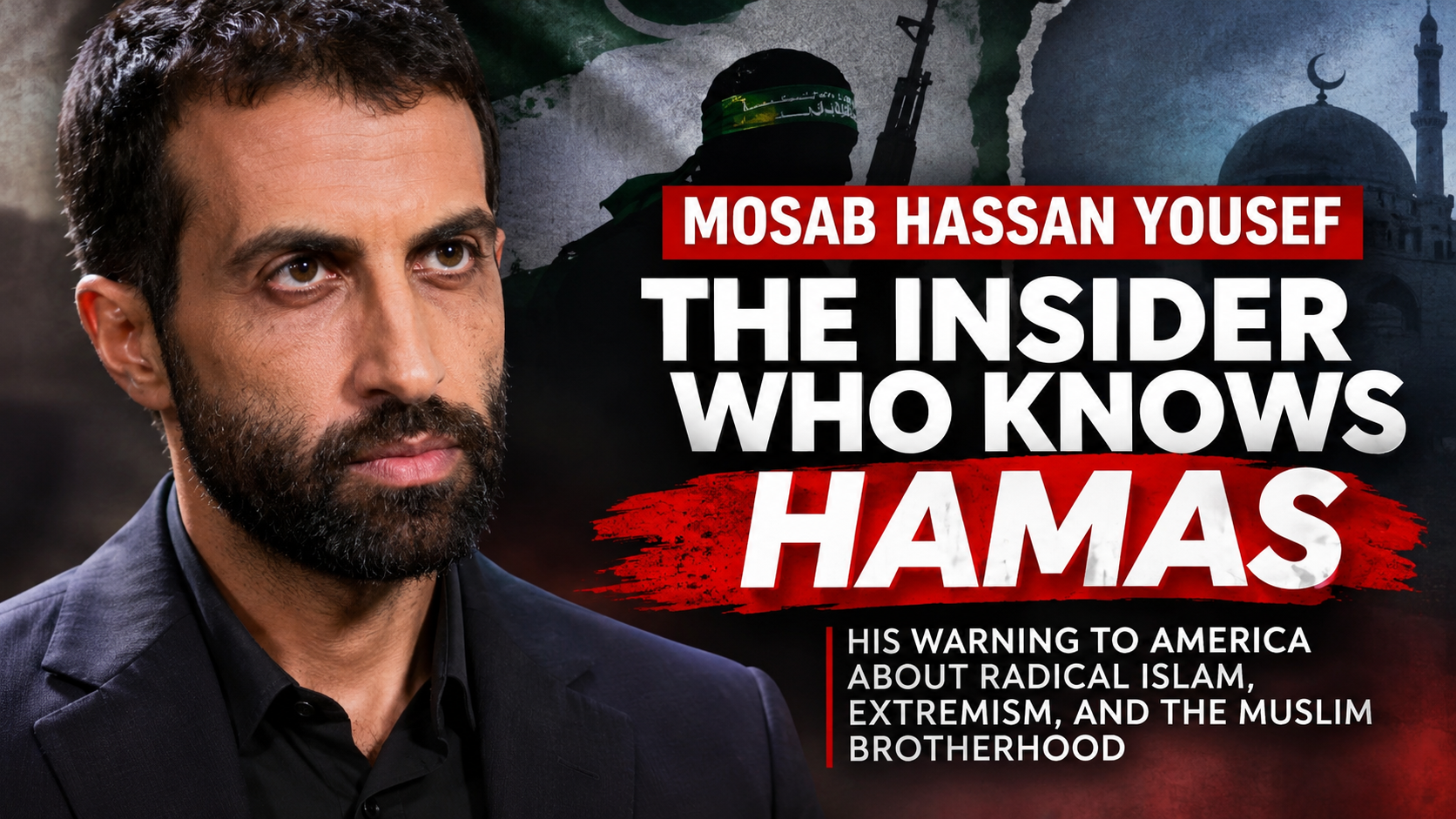
For years, Mosab Hassan Yousef has traveled the world delivering warnings about Hamas, radical Islamic ideology and the dangers he believes Western societies are failing to recognize.
Unlike politicians, television commentators and academic experts who study terrorism from a distance, Yousef grew up inside the very organization he now condemns.
His father helped establish Hamas. He personally witnessed the organization’s internal operations, saw its brutality and eventually became an intelligence source for Israel, helping authorities disrupt terrorist activities.
Today, he is using that extraordinary background to warn Americans about religious extremism, ideological radicalization and what he considers the West’s dangerous misunderstanding of political Islam.
His warnings deserve serious attention.
Born Into Hamas, Then Turned Against It
Mosab Hassan Yousef was born in Ramallah in 1978. His father, Sheikh Hassan Yousef, became one of the founding leaders of Hamas, the Palestinian Islamist organization designated as a terrorist organization by the United States.
From childhood, Mosab was surrounded by the organization’s leadership and ideological teachings.
He was expected to follow the path of his father, but his experiences eventually led him in a radically different direction.
During his imprisonment in the 1990s, Yousef witnessed Hamas members abusing and torturing fellow Palestinians suspected of cooperating with Israel.
In an October 2023 interview, he explained that witnessing such brutality caused him to question the organization and its leadership.
Yousef eventually began secretly cooperating with Israel’s Shin Bet intelligence agency.
Operating under the codename “Green Prince,” he provided information that helped Israeli authorities identify Hamas operatives and disrupt terrorist networks.
He later revealed his extraordinary story in the autobiography Son of Hamas, published in 2010, and the documentary The Green Prince.
His transformation from the son of a Hamas founder into one of the organization’s most outspoken opponents remains one of the most remarkable stories to emerge from the Israeli-Palestinian conflict.
His Warning About Islamic Ideology
One of Yousef’s strongest arguments is that Western governments often misunderstand the ideological motivations behind Islamist terrorism.
He believes political leaders spend too much time discussing territorial disputes, diplomatic negotiations and economic conditions while overlooking the religious beliefs that extremist organizations use to justify their actions.
Yousef argues that the ideological foundations of Hamas cannot be separated from its political and military objectives.
He has repeatedly called attention to religious teachings and interpretations that extremists use to justify violence against Jews, Christians, political opponents and even other Muslims.
In an April 2024 interview, Yousef expressed frustration that organizations were reluctant to invite him to discuss these issues openly.
He said he wanted to educate audiences about Hamas, Palestinian Islamic Jihad, Iran and the ideological forces behind their activities.
His message is that defeating an extremist organization militarily does not necessarily eliminate the beliefs that helped create it.
Unless those beliefs are confronted, he argues, new organizations can emerge to continue the same struggle.
What He Wants Americans to Understand
Yousef has repeatedly warned that Islamist extremism is not exclusively a Middle Eastern security problem.
He believes Western countries, including the United States, must recognize the potential dangers of movements that seek to impose religious authority over secular government and individual freedoms.
His criticism frequently centers on the willingness of Western institutions to confront extremist ideology directly.
He argues that governments, universities, religious institutions and the news media sometimes avoid difficult discussions about Islamic teachings and political Islam because they fear public controversy.
For Yousef, that reluctance creates an environment in which dangerous ideas may go unchallenged.
His broader criticism of Islam is rooted in his personal experiences and his interpretation of religious doctrine. Those interpretations are his own and are not universally shared by Muslims.
The security concerns he raises, however, can be examined through the actions, teachings and organizational activities of specific extremist movements.
The Muslim Brotherhood and Political Influence
Another major subject of Yousef’s public discussions is the Muslim Brotherhood.
Founded in Egypt in 1928, the Muslim Brotherhood became one of the most influential Islamist political movements of the modern era.
Hamas emerged from its Palestinian branch, giving Yousef a direct connection to the movement’s ideological history.
Yousef has warned about the influence of political Islamist movements that seek to organize society and government around religious authority.
He believes Americans should pay closer attention to how extremist organizations spread their ideology, recruit supporters and develop networks of influence.
His concerns also extend to the ways religious movements can operate within political and educational institutions.
The Brotherhood’s various branches and affiliated movements differ across countries, so allegations of extremist activity must be evaluated individually.
Nevertheless, Yousef’s central argument is that governments cannot effectively confront ideological extremism without understanding the organizations, beliefs and networks involved.
His Decision to Leave Islam
Yousef’s personal journey also includes his decision to leave Islam and embrace Christianity.
That decision separated him not only from Hamas but also from the religious traditions in which he had been raised.
He has spoken about the importance of individual conscience, personal freedom and the right to question religious authority.
His experience has influenced his criticism of religious systems that punish apostasy, restrict freedom of expression or demand obedience through intimidation.
Yousef believes individuals must be free to question religious teachings without facing persecution.
His defense of that principle is particularly relevant to the United States, where freedom of religion includes the right to practice a faith, reject it or adopt another.
A Warning That Predated October 7
Yousef spent years publicly criticizing Hamas before the October 7, 2023, terrorist attacks against Israel.
When Hamas-led attackers killed approximately 1,200 people and abducted around 250 others, Yousef returned to the international spotlight with renewed urgency.
He said the scale of the attacks shocked him, but the brutality did not surprise him because of what he had personally witnessed decades earlier.
In subsequent interviews, he argued that Hamas had demonstrated the dangers he had been warning about for years.
He also accused the organization of exploiting Palestinian suffering to advance its political and ideological objectives.
During a 2025 interview, Yousef warned that Hamas’s ambitions extended beyond Israel. He argued that the organization’s ideology threatened other Arabs, Muslim communities and Western societies.
These are among the reasons his testimony continues to attract attention internationally.
Why America Should Listen
The United States faces the continuing challenge of protecting religious freedom while confronting organizations that use religious extremism to justify terrorism and authoritarian control.
Yousef brings an unusual perspective to that challenge.
He is not simply repeating information from intelligence reports or political speeches. He spent his formative years among Hamas leaders and later helped an intelligence agency investigate the organization.
He has described the internal intimidation, ideological indoctrination and violence he witnessed firsthand.
His experiences offer Americans an opportunity to better understand how extremist organizations operate and why their ideology matters.
Listening to Yousef does not require treating every interpretation he offers as an established fact. His firsthand accounts, documented intelligence work and public arguments can each be examined on their merits.
But ignoring his experience would mean overlooking a perspective that few people can provide.
A Message America Cannot Afford to Dismiss
Mosab Hassan Yousef sacrificed his position within a powerful organization, broke with his family’s political legacy and exposed himself to serious personal danger by turning against Hamas.
He has continued speaking publicly about the ideology he believes threatens freedom and security.
His message is that terrorism cannot be confronted effectively without examining the beliefs, leadership structures and political ambitions that sustain it.
For American policymakers, intelligence officials and ordinary citizens, those concerns deserve thoughtful examination.
The country must remain willing to investigate extremist organizations, protect constitutional freedoms and challenge ideologies that promote violence or religious coercion.
Yousef has spent years explaining what he witnessed and what he believes the world must understand.
His experiences should not be dismissed simply because the subject is politically sensitive.
America should hear his testimony, examine his warnings and take seriously the lessons that can be drawn from a man who once lived inside Hamas and chose to expose it.
His story is a reminder that some of the most important warnings about extremism come from people who have seen it from the inside.