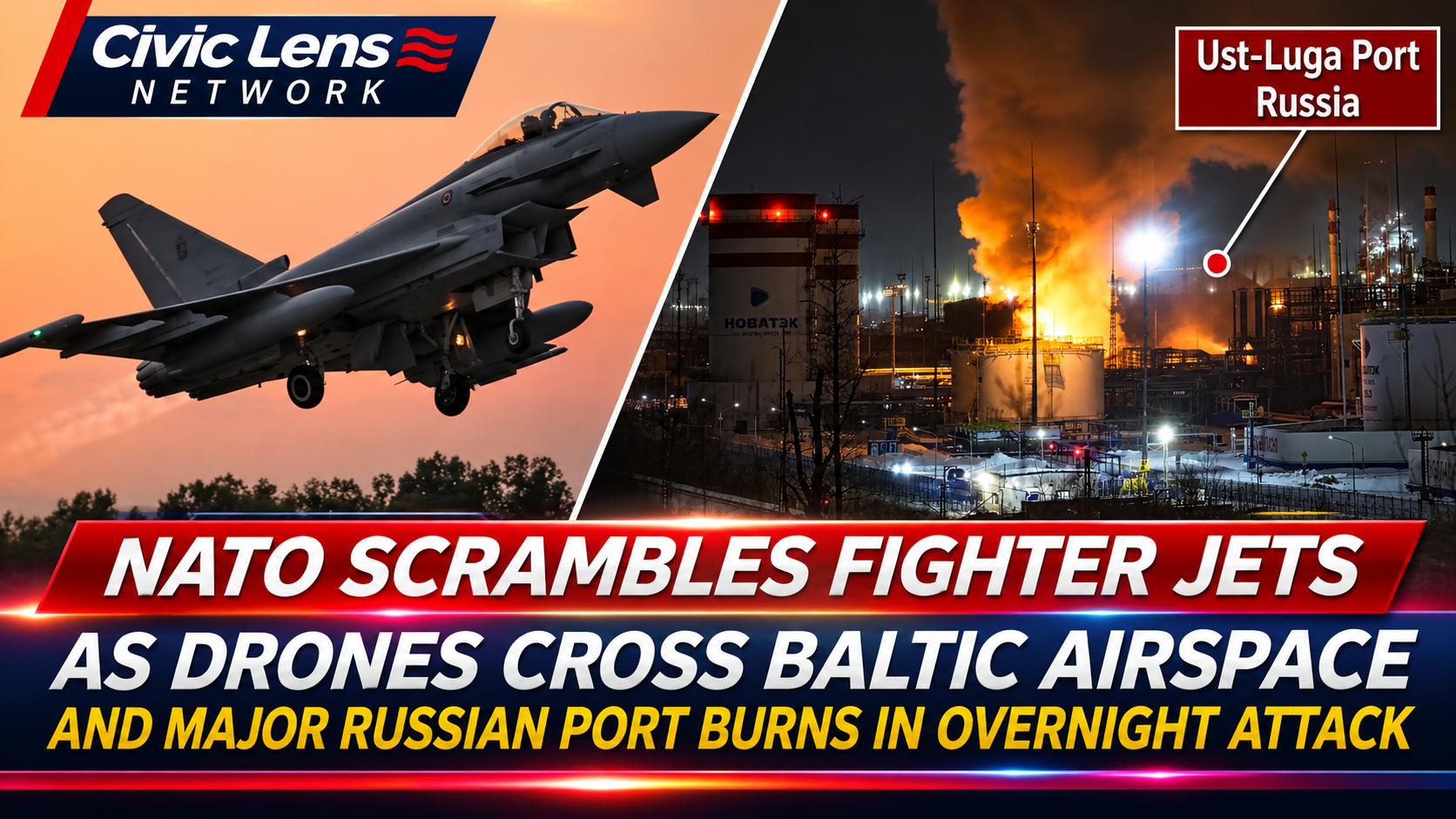
NATO fighter jets were scrambled overnight after unidentified drones crossed into the airspace of several Baltic countries, triggering emergency warnings across northeastern Europe as a major Russian export port erupted in flames following a separate drone attack.
The incidents unfolded late November 10 and into the early hours of November 11, raising fresh concerns that the war between Russia and Ukraine is increasingly affecting neighboring NATO countries.
Authorities in Lithuania, Latvia and Estonia issued warnings as drones approached or entered their airspace. Finland also imposed temporary restrictions on air and maritime activity in the eastern Gulf of Finland.
Meanwhile, Russian officials reported that a drone attack ignited a fire at the strategically important Baltic Sea port of Ust-Luga, injured three workers and disrupted electrical infrastructure.
No injuries were reported in the Baltic NATO countries.
NATO Fighters Respond to Drone Incursions
According to Reuters, at least four drones entered Baltic airspace during the overnight incidents, prompting NATO’s air policing mission to activate fighter aircraft.
Lithuanian authorities issued warnings covering several regions, including the city of Kaunas, home to approximately 300,000 people.
Residents were advised to seek shelter as military personnel monitored unidentified airborne objects.
Lithuanian Chief of Defence Staff Giedrius Premeneckas confirmed that military forces made two unsuccessful attempts to intercept a drone before it crossed into neighboring Latvia.
The aircraft’s origin remained uncertain.
Military officials said electronic warfare systems may have diverted drones from their intended routes, but investigators had not established whether the drone involved was Russian or Ukrainian.
Latvian authorities also activated air defense units and issued warnings in regions near Russia and Belarus.
Estonia’s Defense Forces warned residents in several eastern and southern counties about a potential aerial threat.
The warnings were subsequently lifted.
Major Russian Export Port Catches Fire
While NATO countries responded to the airspace incidents, Russia’s Leningrad region experienced a major overnight drone attack.
Regional Governor Aleksandr Drozdenko reported that drones struck the port area of Ust-Luga, starting a fire and injuring three workers.
A power station was also reportedly knocked out during the attack.
The governor claimed Russian air defenses intercepted as many as 150 drones across the region.
Reuters could not independently verify the Russian government’s interception figures or the full extent of the damage.
Ust-Luga is one of Russia’s most important Baltic Sea export facilities.
The port handles crude oil, refined petroleum products, grain and other commodities, making it a significant component of Russia’s international trade network.
Damage to its facilities could disrupt commercial operations, although the extent of any interruption to shipping remained unclear.
Photographs and video reported by Estonian public broadcaster ERR showed flames visible across the border from parts of northeastern Estonia.
The fire underscored how close the latest attacks have come to NATO territory.
Finland Takes Precautionary Action
Finland’s military announced temporary restrictions affecting portions of the eastern Gulf of Finland.
The measures were intended to protect civilians and allow authorities to respond to possible drone threats.
Finland shares a lengthy border with Russia and has increased its attention to aerial security since joining NATO in 2023.
The restrictions did not indicate that Finland had been attacked directly.
Instead, officials described them as precautionary measures amid the continuing drone activity in the region.
Growing Concerns About NATO Airspace
The latest incidents are part of a broader security problem involving drones crossing international borders during the Russia-Ukraine war.
Ukrainian forces have increasingly targeted Russian military, industrial and energy infrastructure using long-range unmanned aircraft.
Russia has accused Ukraine of exploiting neighboring NATO airspace during these operations.
Ukraine has argued that Russian electronic warfare systems can interfere with drone navigation and redirect aircraft away from their intended targets.
Neither explanation has been conclusively established for every recent incident.
The uncertainty creates a difficult situation for NATO governments.
Military commanders must determine whether an approaching drone represents an immediate threat, whether it can be safely intercepted and whether shooting it down could endanger civilians on the ground.
The November 11 response demonstrated that NATO forces were prepared to deploy aircraft, but it did not amount to a direct military confrontation with Russia.
Attacks Continue During Peace Negotiations
The escalation came as Russian and Ukrainian representatives participated in renewed American-mediated peace negotiations in Abu Dhabi.
The talks were part of a diplomatic effort by President Donald Trump’s administration to bring an end to the war.
Despite those discussions, both countries continued military operations.
Russian strikes reportedly damaged Ukrainian infrastructure, while Ukrainian drone operations continued targeting facilities inside Russia.
The simultaneous military activity highlighted the enormous difficulties facing negotiators attempting to secure a lasting agreement.
The two sides remain divided over territorial control, security guarantees and the conditions necessary to end the fighting.
Could NATO Be Drawn Into the Conflict?
The repeated appearance of drones inside NATO airspace has raised concerns about the possibility of a dangerous miscalculation.
An unidentified aircraft entering a country’s airspace does not automatically trigger NATO’s collective defense provisions.
However, an incident causing substantial casualties or damage could produce a more serious diplomatic and military confrontation.
For Baltic countries bordering Russia and Belarus, the threat is particularly sensitive.
Their governments have repeatedly warned about the risks posed by the continuing war and the possibility of military activity spreading beyond Ukraine.
The latest incidents demonstrate the importance of rapid communication between NATO members, effective air defenses and reliable identification of airborne threats.
Investigation Continues
Authorities across the Baltic region are reviewing radar information and military observations to establish the origins and movements of the drones.
Lithuanian officials have acknowledged that they cannot yet determine whether the drone involved in their interception attempts belonged to Russia or Ukraine.
Russian officials are assessing the damage at Ust-Luga, although independent verification of the reported interception figures remains unavailable.
For now, the immediate danger in the Baltic countries appears to have passed.
No casualties were reported there, and emergency warnings were lifted.
Nevertheless, the events of November 11 exposed an increasingly serious challenge for European security.
As the Russia-Ukraine war continues, long-range drone operations are creating risks far beyond the immediate battlefield.
NATO fighter jets responding to unidentified aircraft, civilian shelter warnings and a burning Russian export port all unfolded within hours of one another.
The incidents did not produce a direct confrontation between NATO and Russia, but they demonstrated how quickly military operations near international borders can create an emergency involving several countries.
With diplomatic negotiations underway and attacks continuing, the danger of further airspace violations remains a major concern for European governments.