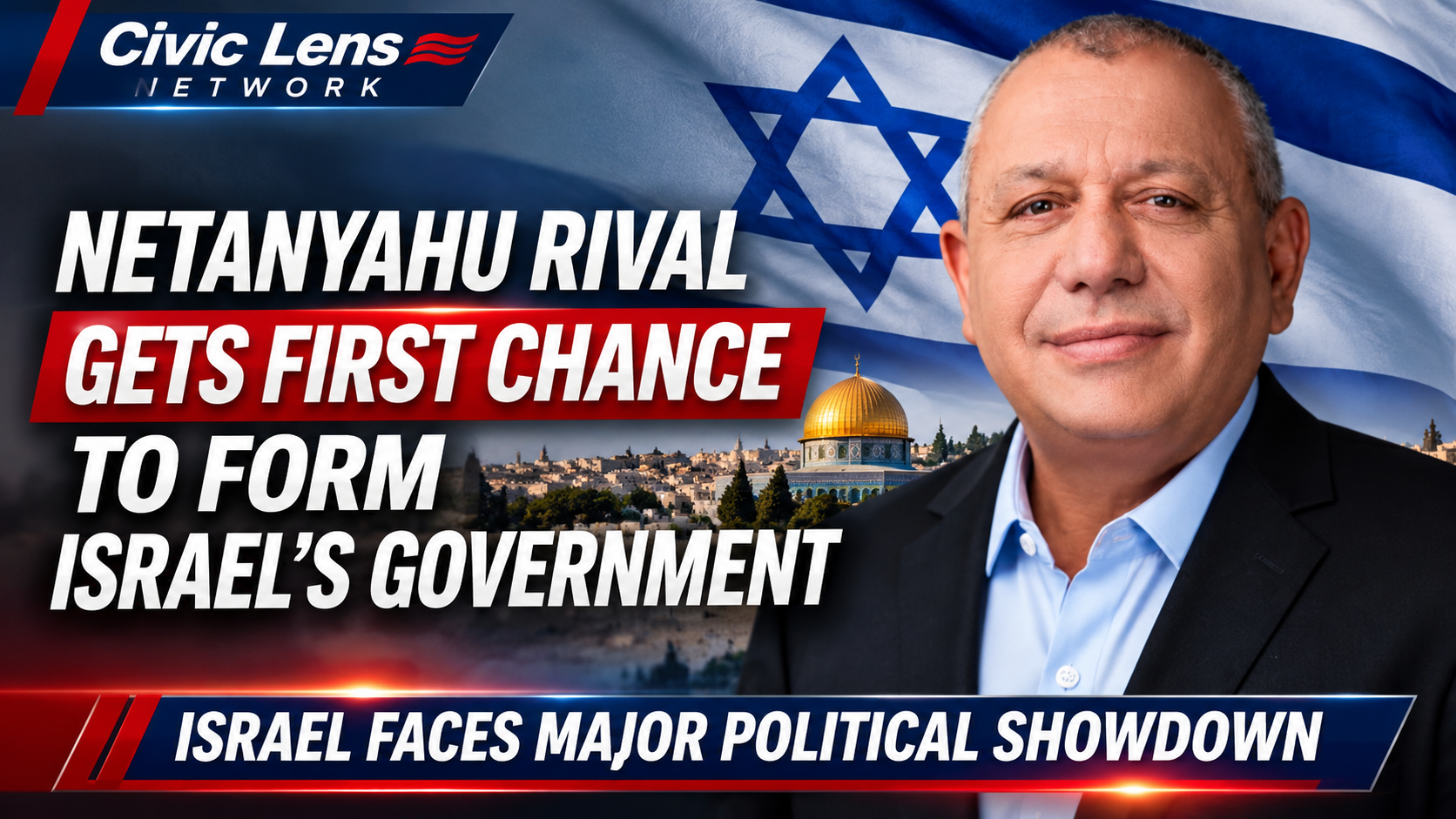
Israel is facing a major political showdown after President Isaac Herzog handed opposition leader Gadi Eisenkot the first opportunity to form the country’s next government, placing Prime Minister Benjamin Netanyahu’s political future in serious uncertainty.
The decision follows a closely contested national election that failed to produce a clear parliamentary majority. Although Netanyahu remains prime minister, the political battle over who will lead Israel has entered a critical new phase.
Eisenkot, a former Israeli military chief and leader of the Yashar party, now has 28 days to negotiate a governing coalition. President Herzog can extend that deadline by another 14 days if necessary.
But securing enough political support could prove extraordinarily difficult.
Netanyahu Loses His Parliamentary Majority
Israel’s October 27 election left Netanyahu’s right-wing and religious bloc with 53 seats in the 120-member Knesset, falling short of the 61 seats required for a parliamentary majority.
Eisenkot’s opposition alliance secured 48 seats, while Arab-led political parties won another 19.
Neither major political bloc emerged with enough seats to govern independently.
Following consultations with political parties, Herzog determined that Eisenkot should receive the first opportunity to assemble a coalition.
According to the Israeli president’s office, parties representing 67 lawmakers recommended Eisenkot for the mandate, compared with 46 who recommended Netanyahu. Another seven lawmakers declined to endorse either candidate.
Those recommendations were sufficient to give Eisenkot the first chance, but they do not guarantee that the same lawmakers will support his proposed government.
That distinction could determine whether Netanyahu remains in power.
Former Military Chief Seeks Emergency Government
Eisenkot served as chief of staff of the Israel Defense Forces from 2015 to 2019 and later participated in Netanyahu’s wartime cabinet.
Despite their previous cooperation, the two men have become political rivals.
During Sunday’s formal ceremony, Eisenkot warned that Israel was approaching a dangerous political moment and called for the formation of a broad national emergency government.
He argued that the country’s security challenges and internal divisions demanded leadership capable of bringing opposing political factions together.
Eisenkot has established several conditions for potential coalition partners.
These include recognizing Israel as a Jewish and democratic state, supporting national or military service obligations, and committing to dismantling Hamas’s military and governing capabilities.
The conditions could attract some parties while creating serious obstacles with others.
Eisenkot has also indicated that members of Netanyahu’s Likud party could participate in a government under his leadership if they accepted the proposed principles.
That raises the possibility of an unusual political arrangement involving politicians who campaigned against one another.
Arab Parties Could Hold the Balance of Power
One of the most controversial questions surrounding the negotiations involves the role of Arab-led political parties.
Together, those parties hold 19 parliamentary seats, potentially giving them considerable influence over the formation of Israel’s next government.
Some Arab political leaders have indicated a willingness to support Eisenkot’s effort to replace Netanyahu.
However, significant disagreements remain over national identity, security policy and the government’s approach toward Hamas.
Eisenkot has demanded that prospective coalition partners recognize Israel as a Jewish state and identify Hamas as a terrorist organization.
Those requirements could prevent cooperation with some Arab-led parties.
Meanwhile, conservative members of Eisenkot’s own opposition alliance have expressed resistance to forming a government dependent on Arab parliamentary support.
This creates a difficult political calculation.
Eisenkot may need support from parties whose policies conflict with the principles he has publicly established.
Without sufficient cooperation, the opposition could remain divided despite having an opportunity to remove Netanyahu from office.
Religious Parties Present Another Major Obstacle
Israel’s ultra-Orthodox political parties could also play a decisive role.
For years, disputes over military conscription exemptions for ultra-Orthodox religious students have divided Israeli politics.
The issue has become increasingly contentious following years of military operations and growing demands on Israel’s armed forces.
Eisenkot has called for broader military or national service obligations, arguing that responsibility for defending the country should be shared.
However, ultra-Orthodox parties have traditionally resisted compulsory military service for religious students.
Some of these parties previously supported Netanyahu, but the election results have placed them in a potentially influential negotiating position.
An agreement with Eisenkot could give him enough seats to govern.
Yet any compromise over military service could anger members of his opposition alliance and voters who supported his campaign promises.
The challenge illustrates the difficulty of assembling a stable coalition from political factions with sharply different priorities.
Netanyahu Is Not Out of the Fight
Despite the president’s decision, Netanyahu has not been removed from office.
He and his cabinet remain in power in a caretaker capacity while negotiations continue.
If Eisenkot fails to form a government within the allotted period, Netanyahu could receive an opportunity to assemble his own coalition.
The prime minister has also advocated a national unity arrangement that would bring rival political factions together.
Such an agreement could preserve a role for Netanyahu in the next government, although the terms of any potential partnership remain uncertain.
Netanyahu’s supporters argue that Israel needs experienced leadership during a period of continuing regional security threats.
His opponents contend that the country needs a political change after years of division and controversy.
Neither position changes the parliamentary reality: a viable government requires sufficient legislative support.
If both Eisenkot and Netanyahu fail to secure that support, Israel could face another national election.
Election Allegations Add to Political Tensions
The coalition negotiations are unfolding amid additional controversy surrounding the election itself.
Netanyahu has alleged that irregularities involving Arab political participation affected the outcome.
However, election authorities have maintained that the results are valid, and the prime minister has not publicly established evidence demonstrating that fraud changed the parliamentary outcome.
Israeli security officials have also examined concerns involving possible foreign interference.
The existence of an investigation does not establish that widespread fraud occurred.
For Israel, maintaining public confidence in its electoral institutions will be important regardless of which political leader ultimately forms the government.
Regional Security Raises the Stakes
The leadership struggle comes at a sensitive moment for Israeli national security.
The next government will confront ongoing challenges involving Iran, Gaza, Lebanon and Israel’s relationships with neighboring countries.
Relations with the United States will also remain central to Israel’s military and diplomatic strategy.
President Herzog has emphasized the importance of political stability as the country faces threats from abroad and disagreements at home.
Any new coalition will need to make difficult decisions involving defense spending, military operations, diplomatic negotiations and domestic political reforms.
A fragile parliamentary majority could complicate those decisions.
Even if Eisenkot succeeds in assembling a government, maintaining that coalition could become another challenge entirely.
A Political Turning Point With No Guaranteed Winner
The decision to give Eisenkot the first opportunity to form a government represents a significant setback for Netanyahu, but it is not a final political defeat.
The prime minister remains in office, his parliamentary bloc retains substantial influence, and the opposition faces major internal disagreements.
Eisenkot must now persuade rival factions to accept compromises that could contradict their campaign commitments.
His success would potentially mark a major change in Israeli leadership.
His failure could give Netanyahu another opportunity to retain power or push Israel toward another election.
For now, the country’s political future remains unresolved.
The coming weeks will determine whether Israel experiences a change in leadership, an unexpected unity agreement or another prolonged period of political uncertainty.
One thing is clear: winning the first opportunity to form a government is not the same as securing the power to govern.