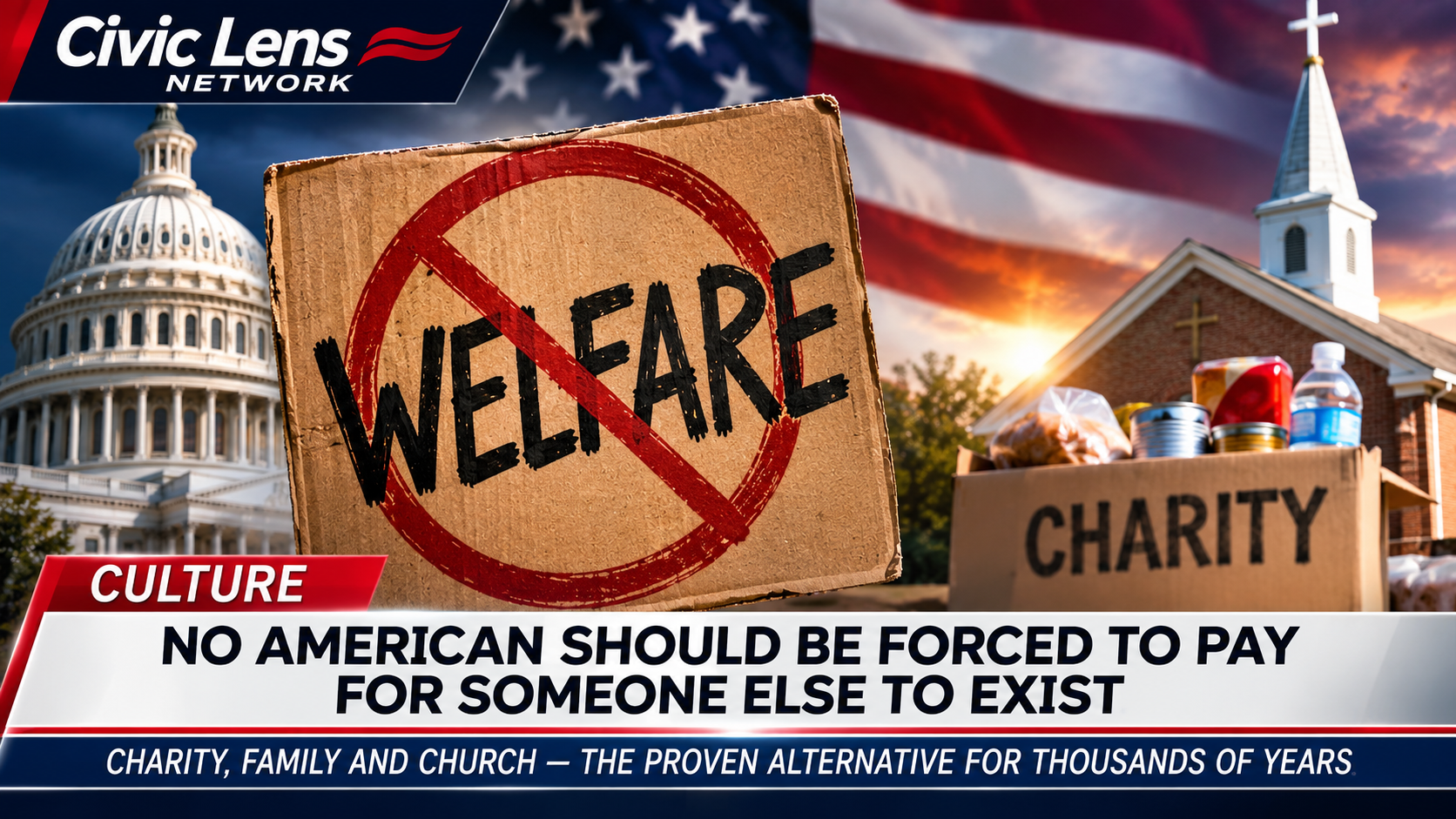
There is a fundamental principle of freedom that America desperately needs to rediscover: No human being should be legally obligated to financially support another human being simply because that person exists.
That statement may sound harsh to some. Others may call it selfish or uncompassionate. But the issue is not whether Americans should help people in need. The issue is whether the government should have the authority to force one person to surrender the fruits of their labor to support someone else.
There is an enormous difference between generosity and government-compelled redistribution.
One is an act of kindness. The other is an obligation enforced through taxation.
And somewhere along the way, America began treating the second as though it were a fundamental responsibility of citizenship.
Your Life Is Not Someone Else’s Financial Responsibility
Every American enters this world with the right to pursue happiness, build a future, earn a living and make decisions about how to spend their own money.
What Americans do not possess is an automatic moral claim to another person’s paycheck.
If someone works 50 or 60 hours a week, sacrifices time with family, builds a business or spends decades developing a career, why should the government decide that part of those earnings must support another adult?
The argument becomes especially controversial when discussing welfare programs.
Supporters of government assistance frequently point to poverty, unemployment, hunger and homelessness as justification for taxpayer-funded benefits.
But those circumstances raise a difficult question that politicians rarely want to confront.
Does another person’s suffering automatically give the government the right to take your money?
From a perspective grounded in individual liberty and personal responsibility, the answer should be no.
Even in the most heartbreaking circumstances, including someone facing starvation, the government should not automatically possess the authority to compel an unrelated citizen to finance that person’s survival.
That does not mean the suffering should be ignored. It means the responsibility to respond should come through voluntary action rather than government force.
America Had Charity Long Before the Welfare State
Long before modern welfare programs existed, communities had ways of helping people who fell on difficult times.
Churches, religious organizations, charitable institutions, neighbors and extended families provided food, shelter, clothing and other forms of assistance.
Religious traditions of charitable giving stretch back thousands of years. Christian communities have practiced organized assistance to the poor since the earliest centuries of the church.
For generations, local congregations operated food pantries, orphanages, hospitals, shelters and charitable missions.
Families took care of relatives. Neighbors helped neighbors. Communities organized assistance for those who could not provide for themselves.
These arrangements were not perfect. Poverty and hunger remained serious problems, and private charity did not always reach everyone who needed help.
Nevertheless, they demonstrate an important truth: compassion and organized assistance existed long before America’s modern federal welfare system.
The federal government did not invent generosity.
And generosity does not require a government agency to exist.
Helping Someone Should Be a Choice
If an American wants to donate $10,000 to a homeless shelter, that is admirable.
If someone wants to purchase groceries for a struggling family, pay a neighbor’s electric bill or support a church food pantry, that is their decision.
If a wealthy business owner wants to establish a foundation that feeds thousands of people, that is an extraordinary act of generosity.
But none of those actions should be mandatory.
A person who chooses not to donate should not be treated as though they have committed an offense against society.
People have their own families, financial obligations, mortgages, medical expenses and retirement plans.
They should have the freedom to decide which causes deserve their support.
A government that can compel citizens to finance another person’s basic existence has crossed a serious philosophical boundary between protecting individual rights and imposing collective financial obligations.
The Welfare State Has Changed America’s Expectations
The United States has developed an enormous system of government assistance, including food benefits, housing subsidies, cash assistance and other programs.
These programs differ significantly in their eligibility requirements and purposes. Some provide temporary help, while others support people with long-term disabilities or serious financial hardship.
But their common feature is that they rely on public funding rather than exclusively voluntary contributions.
The result is a political system in which elected officials determine how much financial support certain groups should receive and then require taxpayers to finance those decisions.
The central concern is not that every recipient is irresponsible. Many people receiving assistance have worked, paid taxes or experienced circumstances beyond their control.
The concern is the underlying principle.
Should government assistance become an enforceable financial obligation imposed on everyone else?
Those who believe strongly in limited government have every reason to answer no.
A free society should encourage independence, employment, family responsibility and private charitable giving rather than continually expanding the government’s role as a financial provider.
What About People Who Cannot Work?
The most difficult argument against eliminating welfare concerns people who genuinely cannot support themselves.
That includes individuals with severe disabilities, elderly people without sufficient resources and families experiencing catastrophic hardship.
Their circumstances deserve compassion.
But compassion does not settle the question of whether government coercion is justified.
A society committed to voluntary assistance would need strong charitable organizations, religious institutions, community networks and private foundations capable of supporting vulnerable people.
Eliminating taxpayer-funded welfare would also carry serious risks, particularly for people who currently depend on benefits for food, housing or medical care.
Those risks cannot simply be wished away.
Supporters of a voluntary system must be prepared to build and sustain alternatives rather than assume every person in need will automatically receive help.
Still, the possibility that voluntary assistance may fall short does not, by itself, resolve the larger philosophical dispute over the government’s authority to redistribute income.
Charity Should Come From the Heart, Not the IRS
There is something fundamentally different about a person voluntarily purchasing food for a hungry family and a government collecting taxes to finance a public assistance program.
Both may result in someone receiving food.
But only one involves an individual freely deciding to give.
The distinction matters.
When someone donates to a church, contributes to a food bank or helps a struggling neighbor, that person exercises personal judgment and generosity.
When government mandates financial contributions through taxation, individual choice is replaced by a legal requirement.
Americans should be free to give generously, give modestly or decline to give.
Their financial decisions should not be dictated by politicians who promise benefits using money collected from other citizens.
Freedom Includes the Right to Say No
A truly free country must recognize that individuals are not born into financial servitude to everyone around them.
Nobody should be required to spend their working life financing another person’s existence.
That position does not require hatred toward the poor, indifference toward suffering or opposition to charity.
It requires recognizing a distinction that modern political debates too often ignore.
Helping people is a moral choice. Forcing people to help is a political decision.
America should rediscover the traditions of voluntary charity, strong families, local communities, religious institutions and personal responsibility.
People should be encouraged to help those who are hungry, homeless, disabled or struggling.
They should be free to give as much as they wish.
But they should also be free to say no.
Because the moment generosity becomes compulsory, it stops being generosity and becomes another government mandate.
No American should be forced to pay for another person’s existence. Charity should remain a choice, not a legal obligation.