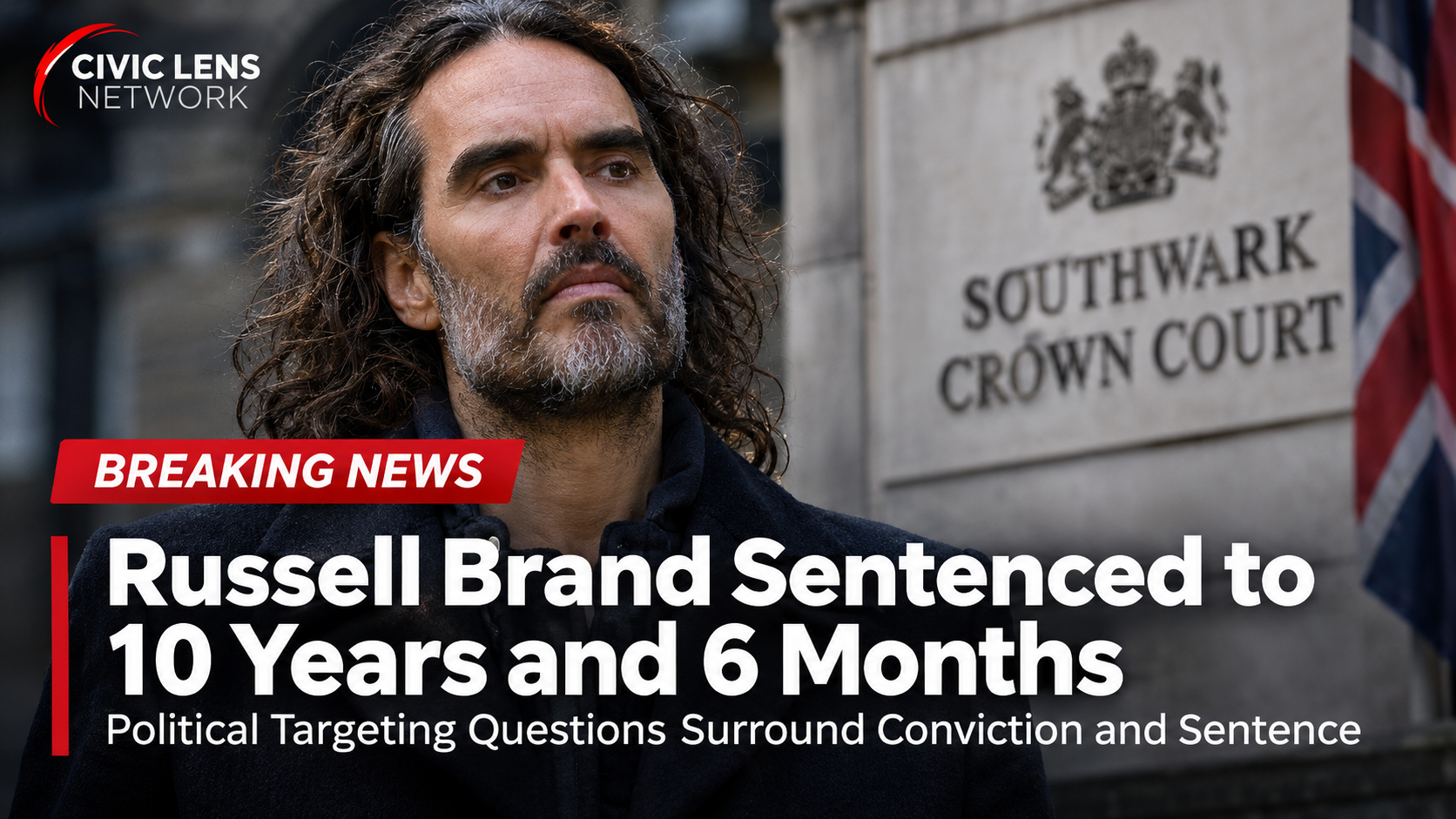
The reported sentencing of British comedian, actor and outspoken anti-establishment commentator Russell Brand to 10 years and six months in prison raises a question that deserves careful examination: Was this prosecution solely about criminal accountability, or did Brand’s increasingly confrontational relationship with powerful political and media institutions play any role in the events that brought him before a British court?
The suggestion that Brand was politically targeted remains an allegation, not an established finding. Nevertheless, the circumstances surrounding the investigation, the media campaign that preceded criminal charges, and Brand’s transformation from mainstream entertainer into a vocal critic of established institutions have made the case a subject of political controversy.
According to a reported outcome of Monday’s sentencing proceedings at Southwark Crown Court, Brand received a prison term of 10 years and six months. That precise sentence awaits independent confirmation in published court reporting.
From Hollywood Celebrity to Anti-Establishment Commentator
Brand, 51, spent years as one of Britain’s most recognizable entertainers. His career included stand-up comedy, television presenting, radio broadcasting and appearances in major Hollywood productions.
Over time, however, Brand moved away from conventional entertainment and became increasingly involved in political and social commentary.
Through online broadcasts, interviews and independent media platforms, he challenged government policies, corporate influence, pharmaceutical companies, censorship and the relationship between political institutions and major media organizations.
His commentary attracted millions of followers, including audiences who believed mainstream institutions were failing to provide honest answers about matters affecting ordinary citizens.
That transformation also placed Brand in direct conflict with some of the institutions he regularly criticized.
Whether those disagreements had any influence on the criminal investigation or prosecution has not been established. The distinction matters because political controversy alone does not prove political interference.
The Investigation That Changed Everything
The criminal case followed a major media investigation published in September 2023 involving allegations of sexual misconduct dating back many years.
The allegations concerned incidents from a period when Brand was heavily involved in Britain’s entertainment industry.
Following publication, police began investigating complaints, eventually leading to criminal charges.
Brand consistently denied engaging in nonconsensual sexual activity.
He acknowledged that his earlier lifestyle involved promiscuity and reckless behavior but maintained that his sexual encounters were consensual.
The investigation also brought consequences beyond the courtroom.
Brand’s professional relationships and ability to generate revenue through certain online platforms were affected as allegations spread publicly.
This sequence raises a broader question about the relationship between investigative journalism, public pressure and criminal justice.
When allegations against a controversial public figure become international headlines before a criminal trial, courts must still ensure that verdicts are determined by admissible evidence rather than public opinion.
What the Jury Decided
Following a four-week trial at Southwark Crown Court, a jury convicted Brand on November 5, 2026, of one count of rape and three counts of sexual assault.
The offenses involved four women and concerned incidents between 2004 and 2009.
However, the jury did not accept every allegation presented by prosecutors.
Brand was acquitted of two additional rape charges and one attempted indecent assault charge.
Those acquittals are an important part of the complete legal record.
They demonstrate that the jury distinguished between individual allegations rather than returning guilty verdicts across the entire case.
At the same time, the four convictions remain legally binding unless overturned through the appeals process.
A Prison Sentence That Could End an Era
At Monday’s sentencing hearing, prosecutors argued that Brand had exploited the fame and influence he possessed during his entertainment career.
They said his celebrity provided access to women and contributed to a sense that he could act without consequences.
The prosecution sought a substantial prison sentence, arguing that the rape conviction warranted consideration within a sentencing range of 10 to 15 years.
The court also heard statements describing the lasting emotional and psychological effects experienced by the women involved.
Brand’s defense presented a sharply different account of the man he had become.
His lawyer, Ian Winter, argued that Brand had undergone significant personal changes over the intervening years.
The defense highlighted his recovery from addiction, charitable activities, religious conversion and efforts to help others.
Winter described Brand as a fundamentally different person from the individual accused of committing the offenses.
Judge Joel Bennathan was responsible for determining the appropriate punishment under British sentencing law.
The reported prison term of 10 years and six months would represent one of the most consequential developments in Brand’s public life, potentially keeping him incarcerated for a substantial portion of the coming decade.
The precise sentence and any additional court orders should be checked against the final judicial ruling.
Was Politics Involved?
For those who believe Brand was targeted because of his political commentary, the central issue extends beyond the criminal verdict.
Brand had become a prominent critic of government power, institutional influence and mainstream media narratives.
His supporters may reasonably ask whether his public positions influenced how aggressively allegations were investigated, publicized or pursued.
But answering that question requires evidence.
A political prosecution would involve improper interference, selective enforcement or other demonstrable misuse of legal authority.
No verified evidence presented here establishes that British government officials ordered Brand’s prosecution because of his political views.
Nor does the timing of an investigation, by itself, demonstrate a coordinated effort to silence a political opponent.
The appropriate standard is the same regardless of whether a defendant is politically popular or controversial.
Government officials, investigators and prosecutors must be accountable for their decisions, and any credible evidence of misconduct should be independently examined.
Equally, criminal allegations must be evaluated on their evidence, without assuming that a defendant’s political views either establish innocence or justify prosecution.
The Role of Britain’s Media Establishment
One of the most consequential aspects of Brand’s case is the role of investigative journalism in bringing the allegations into public view.
The original investigation was followed by extensive national and international coverage.
Brand’s critics regarded that scrutiny as necessary accountability for allegations involving a powerful celebrity.
Others questioned whether the intensity of public exposure risked prejudicing perceptions before the allegations could be tested in court.
These competing concerns deserve serious attention.
Investigative journalism can uncover wrongdoing that institutions have overlooked. But the public identification of an accused person also carries profound reputational consequences, particularly before any criminal conviction.
The challenge for a democratic society is preserving both a free press and the presumption of innocence throughout criminal proceedings.
What Happens Next?
Following sentencing, attention is likely to turn toward whether Brand’s legal team pursues an appeal.
Under British law, convicted defendants may seek permission to appeal a conviction or sentence, although an appeal is not automatically granted.
An appeal would require legally relevant grounds, such as an alleged error affecting the fairness of proceedings or the lawfulness of the sentence.
Brand’s previous denials do not themselves establish grounds for overturning the jury’s findings.
Police have also indicated that separate allegations remain under investigation. Those matters must be treated independently and do not constitute additional convictions.
A Case With Questions Beyond the Courtroom
The Russell Brand case now stands at the intersection of criminal justice, celebrity influence, political dissent and public trust in British institutions.
Four criminal convictions have been returned by a jury. Three other charges resulted in acquittals. The sentencing process has brought the legal consequences into sharper focus.
Yet questions about the conduct of investigators, the relationship between the press and prosecutors, and the possibility of improper political influence remain legitimate subjects for evidence-based scrutiny.
For Civic Lens Network, accountability must apply to every institution involved, including police, prosecutors, courts, government officials and the media.
A criminal conviction should not prevent scrutiny of the justice system. Equally, allegations of political persecution should not be treated as proven without supporting evidence.
The public deserves a complete and accurate account of both the verdict and the process that produced it.
Whatever happens next, Brand’s case will remain a major test of public confidence in Britain’s criminal justice system and the principle that justice must operate independently of political power.