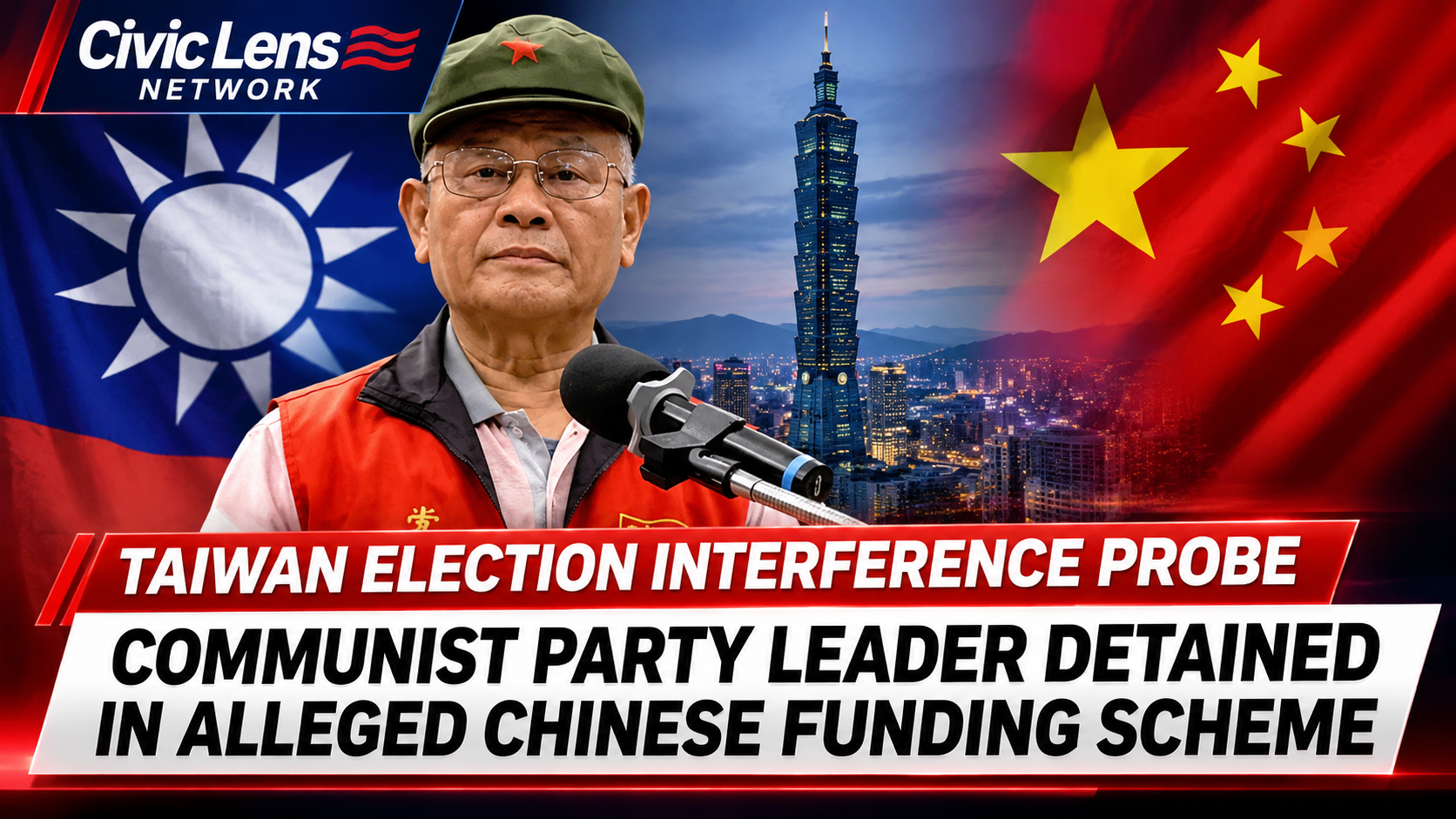
Taiwanese authorities have detained the chairman of a pro Beijing communist political party following an investigation into allegations that China’s ruling Communist Party secretly financed and directed candidates seeking public office in Taiwan.
The case has raised serious questions about foreign interference, political influence and the lengths Beijing may be willing to go to shape elections on the self governing island.
At the center of the investigation is Lin Te-wang, chairman and founder of the Taiwan People’s Communist Party, who prosecutors suspect accepted financial support and political instructions from the Chinese Communist Party to participate in Taiwan’s upcoming local elections.
Authorities allege that the suspected operation extended beyond a single candidate and included efforts to influence voters through sponsored trips to mainland China.
The investigation comes just weeks before Taiwan’s November 28 local elections, creating another flashpoint in the increasingly tense relationship between Taipei and Beijing.
Prosecutors Uncover Alleged Chinese Political Funding
According to Taiwan’s Tainan District Prosecutors Office, investigators obtained intelligence suggesting that outside forces were attempting to interfere in local elections.
Prosecutors in Tainan and Hsinchu subsequently launched a coordinated investigation.
Authorities allege that Lin received instructions and financial assistance from China’s Communist Party to run for a neighborhood chief position in Tainan City’s Xinying District.
Investigators also suspect that Lin directed another party official, Chen Zhen-zhou, to seek a similar position in Hsinchu City.
The allegations suggest a coordinated attempt to establish political influence through local government positions rather than through Taiwan’s national political leadership.
Although neighborhood chiefs hold relatively modest offices, they maintain direct relationships with residents and can exercise influence within their communities.
That makes the allegations particularly concerning for Taiwanese authorities, who have repeatedly warned that foreign influence operations can begin at the local level.
Allegations of Vote Buying Through Trips to China
One of the most significant accusations involves alleged efforts to influence voters through travel opportunities.
Prosecutors say Lin and Chen repeatedly recruited eligible Taiwanese voters to visit mainland China, where they received hospitality and travel benefits.
Investigators suspect these arrangements were intended to influence voting decisions.
Under Taiwan’s election laws, providing benefits to voters in exchange for electoral support can constitute illegal vote buying.
The allegations raise an important question about whether seemingly ordinary cultural exchanges and travel programs can be used as instruments of foreign political influence.
Authorities have not established that every person who participated in the trips knowingly took part in an illegal operation.
Nevertheless, prosecutors believe the suspected arrangements warrant criminal investigation.
Coordinated Raids and Multiple Suspects Questioned
Investigators carried out simultaneous searches on November 6 as part of the expanding case.
Authorities questioned 14 suspects and nine witnesses across the Tainan and Hsinchu jurisdictions.
Following questioning, prosecutors sought detention orders for Lin and Chen, citing concerns that they could flee, coordinate their accounts or destroy evidence.
The Tainan District Court approved Lin’s detention and prohibited outside contact while the investigation continues.
A separate court ordered Chen released on bail of NT$50,000, approximately $1,525, and imposed residence restrictions.
Other individuals questioned during the investigation were released pending further proceedings.
The investigation remains active, and the allegations have not resulted in convictions.
Previous Chinese Infiltration Case Ended in Acquittal
This is not Lin’s first encounter with Taiwan’s legal system over allegations involving China.
Lin and another party leader previously faced accusations involving Chinese infiltration and attempts to influence elections.
They were acquitted in earlier proceedings, with a Taiwanese appellate court reportedly upholding acquittals in a previous case.
Those earlier findings are important because allegations alone do not establish criminal wrongdoing.
The latest investigation involves new allegations and must be evaluated on its own evidence.
Prosecutors will need to demonstrate whether foreign instructions, financing and alleged voter inducements violated Taiwanese law.
Why China Would Care About Local Elections
China considers Taiwan part of its territory and has never renounced the possibility of using force to bring the island under Beijing’s control.
Taiwan, however, operates under its own democratic political system, with independent elections, armed forces and governing institutions.
The two sides have been governed separately since 1949.
While international attention frequently focuses on the possibility of a military confrontation across the Taiwan Strait, political influence presents a different challenge.
Foreign governments can potentially seek influence through financial relationships, political organizations, community networks and local election campaigns.
If the allegations against Lin are substantiated, the case would illustrate how foreign influence can allegedly be directed toward even the smallest elected offices.
Such activity could potentially build relationships and political networks over time.
However, investigators have not established that this particular alleged operation was part of a broader, centrally coordinated strategy to control Taiwan’s government.
A Larger Pattern of Election Interference Investigations
The Lin investigation is not the only recent case involving allegations of Chinese interference in Taiwan’s local elections.
Taiwanese prosecutors have also accused retired Major General Tsang You-hsia of helping China influence voters through organized trips and political gatherings.
Authorities allege that Chinese funding supported travel and hospitality intended to affect political preferences.
Tsang was released on bail under travel restrictions, and the accusations against him remain subject to legal proceedings.
The existence of multiple investigations underscores the attention Taiwanese authorities are giving to suspected foreign involvement in their elections.
It does not, by itself, establish that the cases are connected or that a single operation directed them.
Election Security Becomes a National Security Concern
Taiwan’s November 28 elections will determine mayors and other local officials across the island.
Although these contests primarily concern local governance, their results could also provide insight into public support for President Lai Ching-te and his Democratic Progressive Party ahead of the 2028 presidential election.
Foreign interference allegations therefore carry consequences beyond individual campaigns.
They touch on whether Taiwanese citizens can select their representatives without unlawful outside financial pressure.
For democratic governments, the challenge is identifying genuine foreign interference while ensuring that investigations remain grounded in evidence and do not become tools for suppressing legitimate political expression.
That distinction is especially important in Taiwan, where debates over relations with mainland China are a normal part of democratic politics.
Supporting closer relations with Beijing is not itself proof of illegal activity.
Accepting prohibited foreign financing or exchanging benefits for votes, however, raises separate legal questions.
Beijing Has Not Publicly Responded
As the detention became public, China’s Taiwan Affairs Office had not immediately issued a response to the allegations.
The lack of an immediate response leaves several important questions unanswered, including the precise origin of the alleged funding and the identities of any Chinese officials suspected of directing the activity.
Prosecutors have not publicly established the full financial scope of the suspected operation.
Additional evidence may emerge as investigators examine communications, financial transactions and testimony.
The Bigger Question Facing Taiwan
The case illustrates an increasingly important national security concern: foreign political influence does not necessarily begin with military threats or large scale cyberattacks.
It can also involve money, political relationships and efforts to influence voters at the community level.
If prosecutors can prove that candidates accepted instructions and financial assistance from a foreign government in violation of Taiwan’s laws, the implications could extend well beyond the two individuals currently under investigation.
For now, Lin remains detained as authorities pursue the case, while Chen has been released under restrictions.
Neither man’s guilt has been established.
With Taiwan’s local elections approaching, the investigation is likely to intensify scrutiny of foreign funding, political influence and the integrity of the island’s democratic process.
The central question is whether Taiwanese voters alone will determine their political future, or whether outside powers are attempting to influence that future through the ballot box.