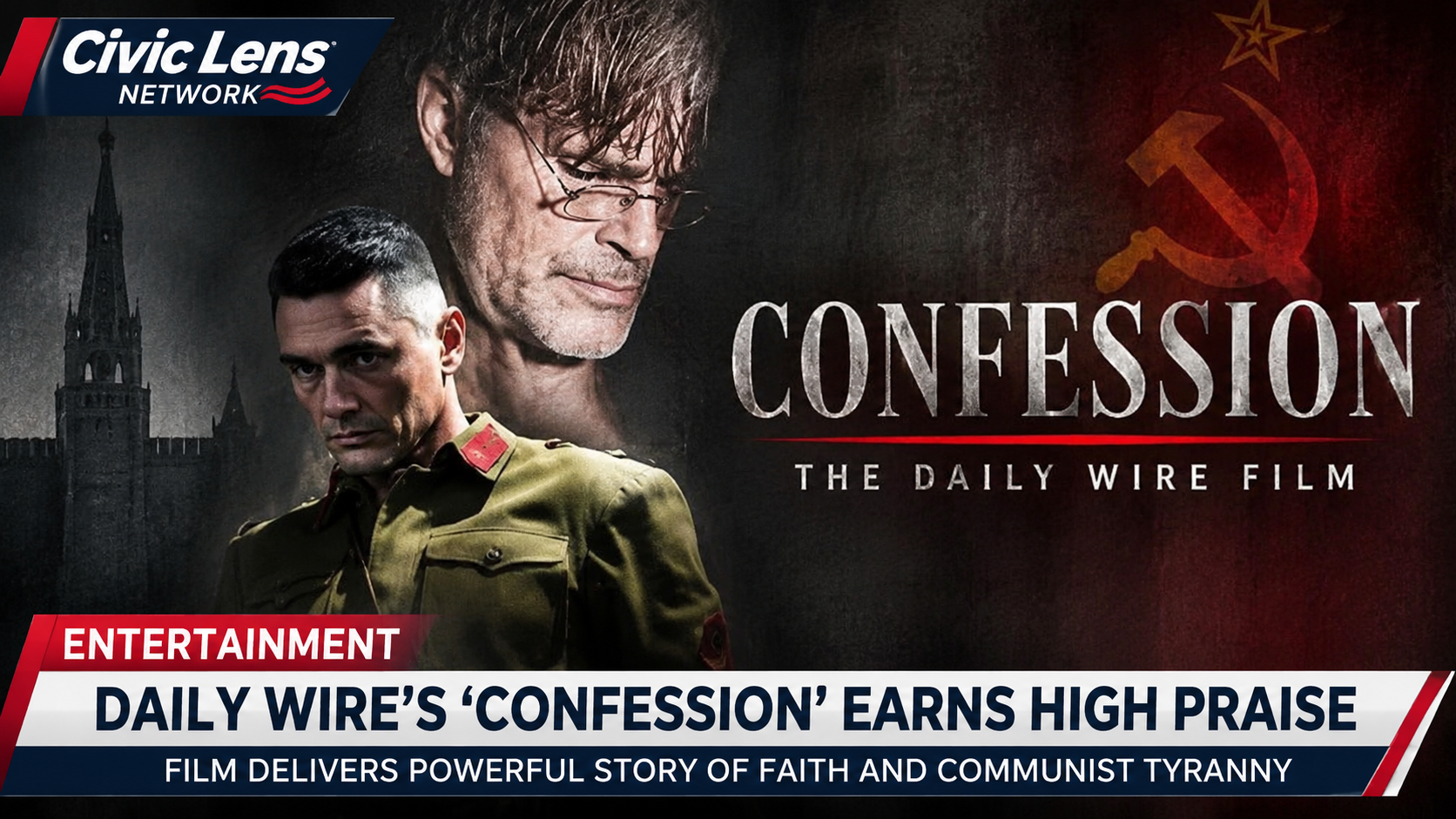
The Daily Wire has delivered what may be its most ambitious film yet, and Confession makes a compelling argument that powerful filmmaking does not have to come from Hollywood’s traditional studios.
Released November 11, 2026, the historical drama starring Rob Lowe and James Franco brings together exceptional acting talent, a disturbing chapter of world history, and an unapologetic examination of faith, morality, and the destructive nature of communist authoritarianism.
Written by Daily Wire co-founder Ben Shapiro and directed by acclaimed Czech filmmaker Václav Marhoul, Confession is a serious, intellectually challenging production that deserves attention far beyond conservative audiences.
A Powerful Story About Faith and Tyranny
Set in Moscow in 1938, during Joseph Stalin’s brutal political purges, the film follows Alexei, a former literature professor portrayed by Rob Lowe.
After being accused of conspiring with a priest who has spoken against the Soviet government, Alexei is arrested and imprisoned in the notorious Lubyanka Prison.
His interrogator, Vladimir, played by James Franco, happens to be a former student.
What follows is a psychological confrontation between two men whose beliefs about humanity, morality, and political authority have taken radically different directions.
Rather than relying on constant action sequences or elaborate special effects, Confession builds its tension through conversations, moral dilemmas, and the terrifying reality of living under a government that demands absolute obedience.
The central question is devastatingly simple: What happens when a government demands that an individual abandon everything he believes to be true?
It is precisely this question that gives the film its emotional and philosophical weight.
Rob Lowe and James Franco Deliver Remarkable Performances
One of the film’s greatest strengths is its casting.
Rob Lowe brings vulnerability and emotional complexity to Alexei, portraying a man confronted with the consequences of his convictions.
James Franco provides a chilling counterbalance as Vladimir, an interrogator whose authority over his former teacher creates a deeply unsettling reversal of their previous relationship.
Their exchanges form the foundation of the movie.
Franco’s character represents a worldview in which power becomes the ultimate authority, while Lowe’s character must confront whether moral truth exists beyond the demands of the state.
The supporting cast is equally impressive.
Jennifer Jason Leigh, Nick Nolte, Kodi Smit-McPhee, Emile Hirsch, Richard Brake, Brad Dourif, and Dean Norris contribute to an unusually accomplished ensemble for an independent political and historical drama.
The involvement of so many established performers also demonstrates that The Daily Wire is increasingly capable of attracting serious Hollywood talent to productions outside the traditional studio system.
A Film Unafraid to Confront Communism
Perhaps the most important aspect of Confession is its willingness to confront the horrors of Soviet communism without romanticizing the ideology.
Stalin’s government imprisoned, tortured, and executed enormous numbers of people during the Great Purge. Religious believers, intellectuals, political opponents, and ordinary citizens could find themselves targeted by a government that viewed independent thought as a threat.
The film places viewers inside that atmosphere of fear.
Its message is particularly relevant at a time when socialism and communism are sometimes discussed in modern political debates without sufficient acknowledgment of the historical atrocities committed by communist dictatorships.
Confession distinguishes itself by examining not merely the machinery of political repression but the moral philosophy that allows such repression to flourish.
When the government becomes the highest authority, what protects the individual from its demands?
When religious faith and personal conscience are treated as obstacles to political power, what remains to restrain those who govern?
These are difficult questions, and the film deserves credit for taking them seriously.
Christian Faith Takes Center Stage
Another distinguishing quality is the movie’s treatment of Christianity.
Rather than presenting religious belief as an embarrassing relic of the past, Confession explores faith as a source of moral strength when individuals face extraordinary suffering.
The conflict between spiritual conviction and an officially atheistic authoritarian government gives the story a significance that extends beyond its Soviet setting.
The film asks whether morality can survive when political power replaces God as the ultimate source of authority.
It also examines the courage required to defend one’s beliefs when doing so could result in imprisonment, torture, or death.
For Christian viewers, these themes may prove especially meaningful.
But the underlying struggle between conscience and coercion is universal, regardless of religious affiliation.
Hollywood Critics Are Divided, but the Praise Is Significant
The film has received sharply contrasting reviews, with some critics praising its ambition and others objecting to its deliberate pacing and dialogue-heavy structure.
Rod Dreher, writing for The Free Press, described Confession as a “masterpiece,” praising its exploration of faith, truth, and human suffering.
Sasha Stone of Awards Daily also praised the production, suggesting its screenplay and performances deserved serious awards consideration.
Other reviewers have been less enthusiastic.
The Hollywood Reporter criticized the film’s pacing, while Variety found portions of the dialogue sluggish. Even Variety, however, acknowledged the effectiveness of the performances from Lowe and Franco.
That disagreement is worth examining.
Confession is not designed as a conventional Hollywood thriller. Its emphasis on philosophical conflict, religious conviction, and psychological tension requires patience and attention.
For viewers who appreciate serious historical dramas built around ideas rather than spectacle, those characteristics may be strengths rather than weaknesses.
The film also represents a significant creative achievement for Shapiro, whose first produced feature screenplay tackles subjects considerably more demanding than the political commentary for which he is best known.
A Major Step Forward for Independent Conservative Entertainment
The broader significance of Confession extends beyond the movie itself.
For decades, Hollywood’s largest studios have dominated the production and distribution of major American films.
The Daily Wire is attempting to establish an alternative, one capable of producing entertainment that reflects values and perspectives frequently underrepresented in mainstream filmmaking.
With Confession, that ambition has taken a meaningful step forward.
The production combines an internationally recognized director, a distinguished cast, and a story rooted in profound moral questions.
Its existence challenges the assumption that politically conservative entertainment must be inexpensive, simplistic, or artistically limited.
Most importantly, the film demonstrates that an independent media company can pursue ambitious dramatic storytelling without abandoning its principles.
A Film Worth Watching
Confession is a powerful example of what can happen when filmmakers are willing to tackle uncomfortable historical truths and fundamental questions about human existence.
Its greatest achievement is not simply its condemnation of communist tyranny, but its examination of what gives individuals the courage to resist it.
The performances, historical setting, and serious treatment of Christianity combine to create a film with considerably more substance than much of today’s disposable entertainment.
Not every viewer will embrace its measured pacing or philosophical dialogue. But those willing to engage with its ideas may find an unusually rewarding experience.
For The Daily Wire, Confession represents more than another entry in its growing film catalog. It signals that independent conservative filmmaking can compete for attention through acting talent, artistic ambition, and meaningful storytelling.
Hollywood does not have a monopoly on powerful cinema.
And Confession makes a persuasive case that some of the most important stories are being told outside its traditional boundaries.
The film is now streaming on DailyWire+.