Two car bomb explosions in Russia within 24 hours have left a military serviceman dead and a former Ukrainian government adviser seriously injured, raising new concerns about targeted assassinations inside Russian territory as the war in Ukraine continues.
The attacks occurred in St. Petersburg on November 12 and Moscow on November 13. Both incidents are being investigated by Russia’s Investigative Committee, although authorities have not publicly identified those responsible.
The explosions targeted individuals with military or political connections, adding to a growing series of attacks against Russian officers and figures associated with the country’s war effort.
Military Officer Killed in St. Petersburg Explosion
The first explosion occurred Thursday morning in the Pushkinsky district of St. Petersburg, Russia’s second-largest city.
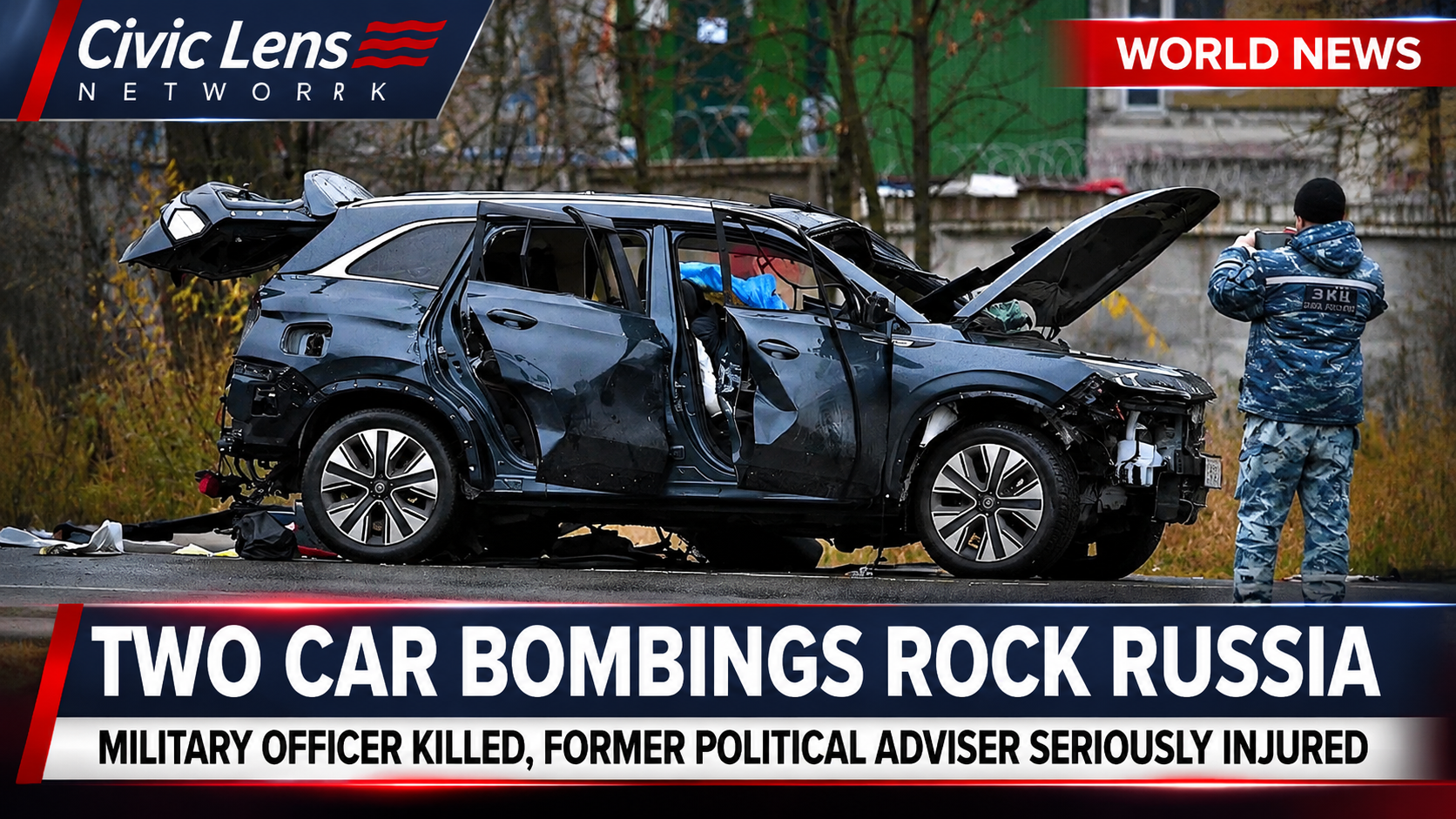
A Russian serviceman was driving through the district when an explosion tore through his vehicle, killing him.
Investigators recovered a heavily damaged dark blue SUV surrounded by debris. A nearby passenger bus also appeared to have sustained damage.
Military police secured the area while forensic investigators examined the wreckage.
Russian media outlets reported that the victim was a colonel serving in the country’s Aerospace Forces. Local broadcaster 78.ru identified his position as chief navigator of the 6th Air and Air Defense Army.
Russian authorities initially confirmed only that a member of the armed forces had been killed and that a murder investigation was underway.
Local reports suggested an explosive device had been attached beneath the vehicle and detonated after the officer left his residential area.
The exact method of detonation has not been independently established.
Reports Describe Suspect Fleeing Russia
Russian newspaper Fontanka reported that investigators were examining the activities of a 31-year-old suspect who allegedly monitored the officer’s movements before the attack.
According to the newspaper, the suspect reportedly planted an explosive device beneath the vehicle and subsequently fled Russia.
The publication also described an alleged operation involving explosives transported into the country from abroad.
Those details remain unverified, and Russian investigators have not publicly established who organized the bombing.
The incident occurred in the same general area where another Russian military serviceman was killed in a vehicle explosion in August.
Second Explosion Rocks Moscow
Less than 24 hours later, another vehicle exploded in Moscow’s southern Chertanovo district.
Russian media identified the injured driver as Sergei Zavorotniy, a 72-year-old journalist and former spokesman for Ukrainian Prime Minister Mykola Azarov.
The explosion reportedly occurred on Kirovogradskaya Street near the Yuzhnaya metro station.
Witnesses described finding an injured man near the damaged vehicle after the blast.
Russian newspaper Kommersant reported that Zavorotniy was hospitalized.
Other Russian media accounts described his injuries as severe, although the full extent of his condition has not been officially established.
Investigators opened a criminal case following the explosion.
Authorities have not publicly identified a suspect or confirmed the motive.
Who Is Sergei Zavorotniy?
Zavorotniy previously worked for Mykola Azarov, who served as Ukraine’s prime minister from 2010 until 2014 under President Viktor Yanukovych.
Azarov fled Ukraine following the political upheaval that removed Yanukovych from power in February 2014.
Zavorotniy subsequently lived in Russia, where he continued working as a journalist and political commentator.
He also co-authored a book discussing the events surrounding Yanukovych’s removal and the political struggle between Ukraine, Russia and Western governments.
His background places him among a group of former Ukrainian political figures who maintained close ties to Moscow after leaving Ukraine.
Investigators have not established whether his former government position, political activities or personal circumstances motivated the bombing.
Growing Pattern of Attacks Inside Russia
The two explosions follow several attacks against Russian military personnel since Moscow launched its full-scale invasion of Ukraine in February 2022.
In December 2024, Lieutenant General Igor Kirillov, head of Russia’s nuclear, biological and chemical protection forces, was killed by an explosive device concealed in a scooter outside a Moscow apartment building.
Ukraine’s security service claimed responsibility for that operation.
Other Russian military officers have subsequently been killed or injured in bombings and shootings.
The repeated attacks have raised questions about the ability of Russian security services to protect military personnel and politically connected individuals away from the battlefield.
Russia has accused Ukrainian intelligence agencies of involvement in several previous assassinations.
However, no verified evidence has publicly established Ukrainian responsibility for either of the November 12 and 13 explosions.
Investigations Continue
Russian authorities are examining the two incidents separately.
Investigators have not announced that the attacks were coordinated or carried out by the same organization.
The St. Petersburg investigation centers on the killing of a military serviceman, while the Moscow investigation concerns the explosion that injured a former Ukrainian political adviser.
Forensic examinations, surveillance footage and witness statements are expected to play important roles in determining how the explosives were planted and detonated.
The attacks have once again demonstrated that individuals connected to Russia’s military and political establishment can face deadly threats far from the front lines.
Whether the latest explosions represent coordinated assassinations or separate acts of violence remains an unanswered question.