Britain is undergoing one of the most significant demographic transformations in its modern history. For decades, successive governments have promised voters greater control over immigration while pursuing policies that allowed substantial numbers of people to settle in the country.
Now, official population projections reveal the scale of the transformation, raising a question that Britain’s political establishment can no longer afford to ignore: How much of this change was anticipated, and why were voters repeatedly promised something different?
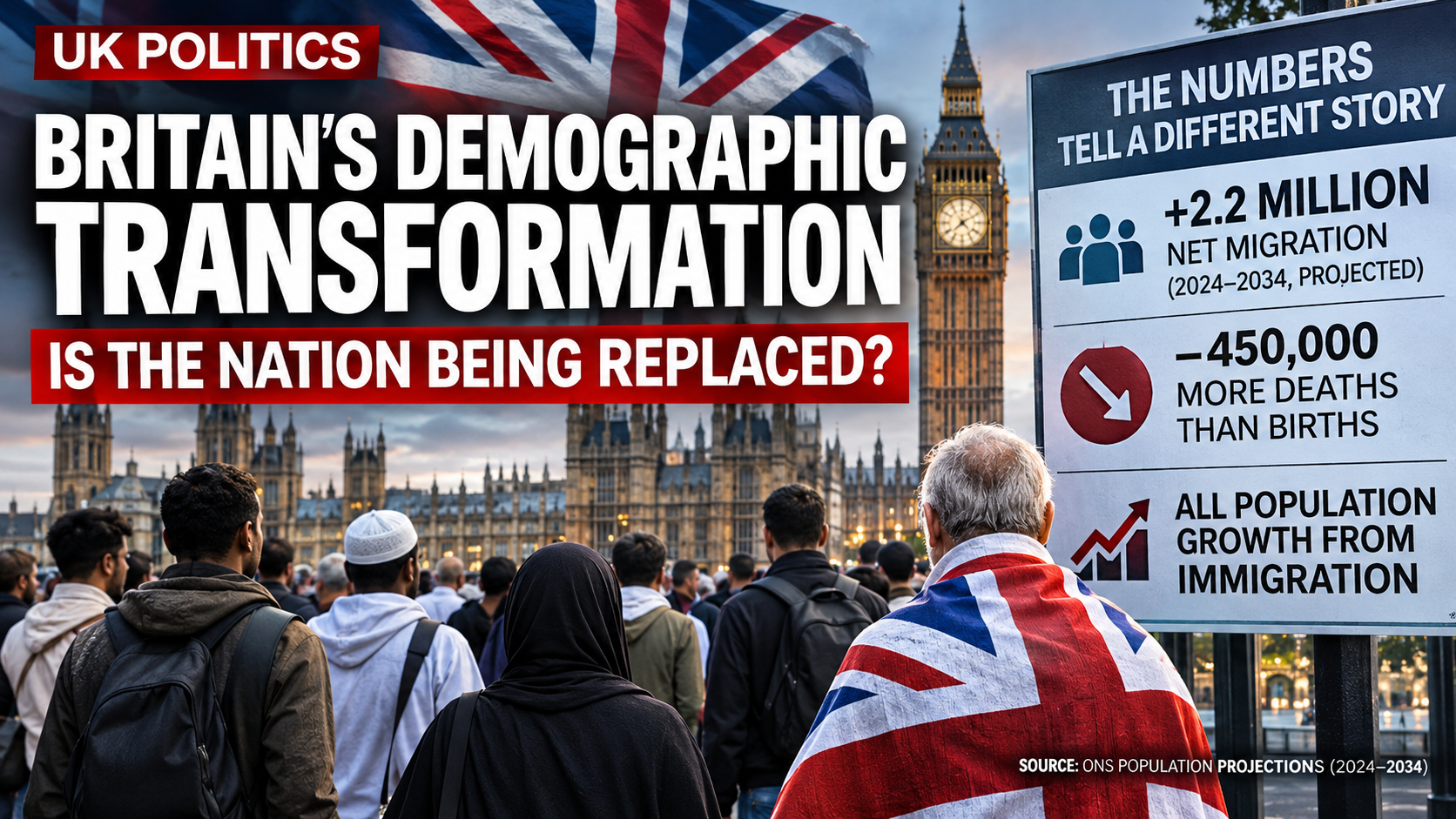
According to the Office for National Statistics, Britain’s population is projected to increase from 69.3 million in 2024 to approximately 71 million by 2034. That growth is expected to come entirely from international migration.
Over the same decade, the country is projected to record approximately 6.4 million births and 6.85 million deaths. In other words, deaths are expected to outnumber births by approximately 450,000.
Meanwhile, net international migration is projected to add approximately 2.2 million people.
These figures represent a fundamental change in how Britain’s population is expected to develop.
For generations, population growth was largely associated with births within the country. Under current projections, immigration will be responsible for preventing an overall population decline.
The political implications are enormous.
Decades of Promises and Broken Commitments
Britain’s immigration transformation did not begin with the current Labour government.
Conservative administrations oversaw substantial immigration increases, including after the country voted to leave the European Union in 2016.
Brexit was presented as an opportunity to restore national control over immigration. Yet after the United Kingdom introduced its new immigration system in 2021, arrivals from outside Europe increased dramatically.
Official figures show net migration reached approximately 944,000 in the year ending March 2023.
That was an extraordinary figure for a country whose political leaders had repeatedly promised tighter immigration controls.
The consequences of these decisions extend beyond population statistics.
More residents require housing, healthcare, transportation, education and other public services. When population growth outpaces infrastructure investment, communities can experience greater pressure on already stretched systems.
Immigration is not the sole cause of Britain’s housing shortages or public-service difficulties. Nevertheless, population growth is a legitimate consideration in government planning, and voters are entitled to demand that ministers account for it.
British Nationals Are Leaving
Another troubling development concerns the movement of British citizens themselves.
According to provisional ONS figures for 2025, approximately 246,000 British nationals left the country for long-term residence abroad, while around 110,000 arrived or returned.
That produced negative net migration of approximately 136,000 British nationals.
During the same period, net migration among non-EU nationals was approximately positive 350,000.
These figures do not mean that every departing British citizen is being directly replaced by an immigrant. They do, however, reveal contrasting migration patterns that deserve serious political scrutiny.
Why are so many British nationals living abroad? What economic opportunities are they seeking? Are housing costs, wages, taxation and living standards influencing their decisions?
The government should be examining these questions rather than treating immigration as the only available answer to Britain’s demographic and economic challenges.
The ONS also cautions that British emigration has remained broadly stable in recent years. Its improved statistical methods should not be mistaken for evidence of a sudden unprecedented exodus.
Was Demographic Change an Intended Outcome?
The most contentious question is whether Britain’s political leadership understood the demographic consequences of its immigration policies.
Government officials have long had access to population projections, migration statistics and economic forecasts.
They knew that immigration affected population growth. They knew that settlement policies could permanently alter the country’s demographic composition. They also knew that immigration decisions could affect local communities for generations.
The central issue is whether successive governments adequately disclosed those consequences to voters and sought meaningful public consent.
Critics argue that the political establishment treated large-scale immigration as an economic necessity while minimizing public concerns about cultural continuity, national identity and infrastructure.
Supporters of immigration point to the contribution migrants make through employment, taxation, entrepreneurship and public services, including the National Health Service.
Those economic contributions are real considerations. But they do not eliminate the right of British citizens to question the scale, pace and consequences of immigration.
Nor do they excuse politicians who promise restrictions during election campaigns and then pursue substantially different policies in office.
The evidence establishes that governments deliberately made immigration-policy choices with foreseeable demographic consequences. It does not establish that successive governments secretly coordinated a plan to replace the native-born population.
That distinction should not prevent serious scrutiny of their decisions.
Labour Inherits a Crisis It Did Not Create Alone
Prime Minister Keir Starmer’s Labour government inherited an immigration system shaped by decades of decisions under both major political parties.
Labour has since proposed tighter settlement requirements and restrictions intended to reduce immigration.
A November 2026 House of Commons Library briefing confirms that several changes proposed in the government’s 2025 immigration white paper have already been implemented, while important settlement reforms are scheduled for 2027.
Net migration has also declined substantially.
The latest provisional figures place overall net migration at approximately 171,000 in 2025, down from 331,000 in 2024 and far below the 2023 peak.
These reductions matter, but they do not erase the long-term consequences of previous immigration levels.
Communities must still accommodate the population already living in Britain. Housing shortages, public-service capacity and integration remain significant political questions.
A government cannot reasonably expect voters to stop asking those questions simply because annual migration numbers have begun falling.
The Question of National Identity
Britain’s national identity is rooted in centuries of history, institutions, traditions and cultural development.
Citizens are entitled to value that inheritance and expect their elected representatives to consider its preservation.
They are also entitled to debate immigration without automatically being accused of hostility toward immigrants.
A country’s population can change through immigration, births, deaths, emigration and the passage of generations. British identity itself includes people from many ethnic and ancestral backgrounds.
The political issue is not whether an immigrant can become British. It is whether governments have been honest about the pace and scale of demographic change and whether their policies reflect the wishes of the electorate.
For years, political leaders have faced criticism for dismissing immigration concerns while failing to deliver promised reductions.
That history has damaged public confidence.
Britain Deserves Answers
The British public deserves a transparent accounting of how immigration policy developed, what demographic projections ministers received, and whether their public promises accurately reflected their intentions.
Parliament should examine the long-term consequences of decisions made by both Conservative and Labour administrations.
It should also demand credible plans for housing, infrastructure, border enforcement, integration and improving opportunities for British citizens.
The evidence does not require a secret conspiracy to reveal a serious failure of political accountability.
Successive governments made consequential decisions. Those decisions helped reshape Britain’s population. Many voters were repeatedly assured that immigration would be controlled.
The question now is whether the political establishment will finally accept responsibility for the difference between what it promised and what it delivered.
Britain’s demographic future should not be determined through political promises that bear little resemblance to government policy.
It should be shaped through transparent decisions, honest debate and democratic accountability.