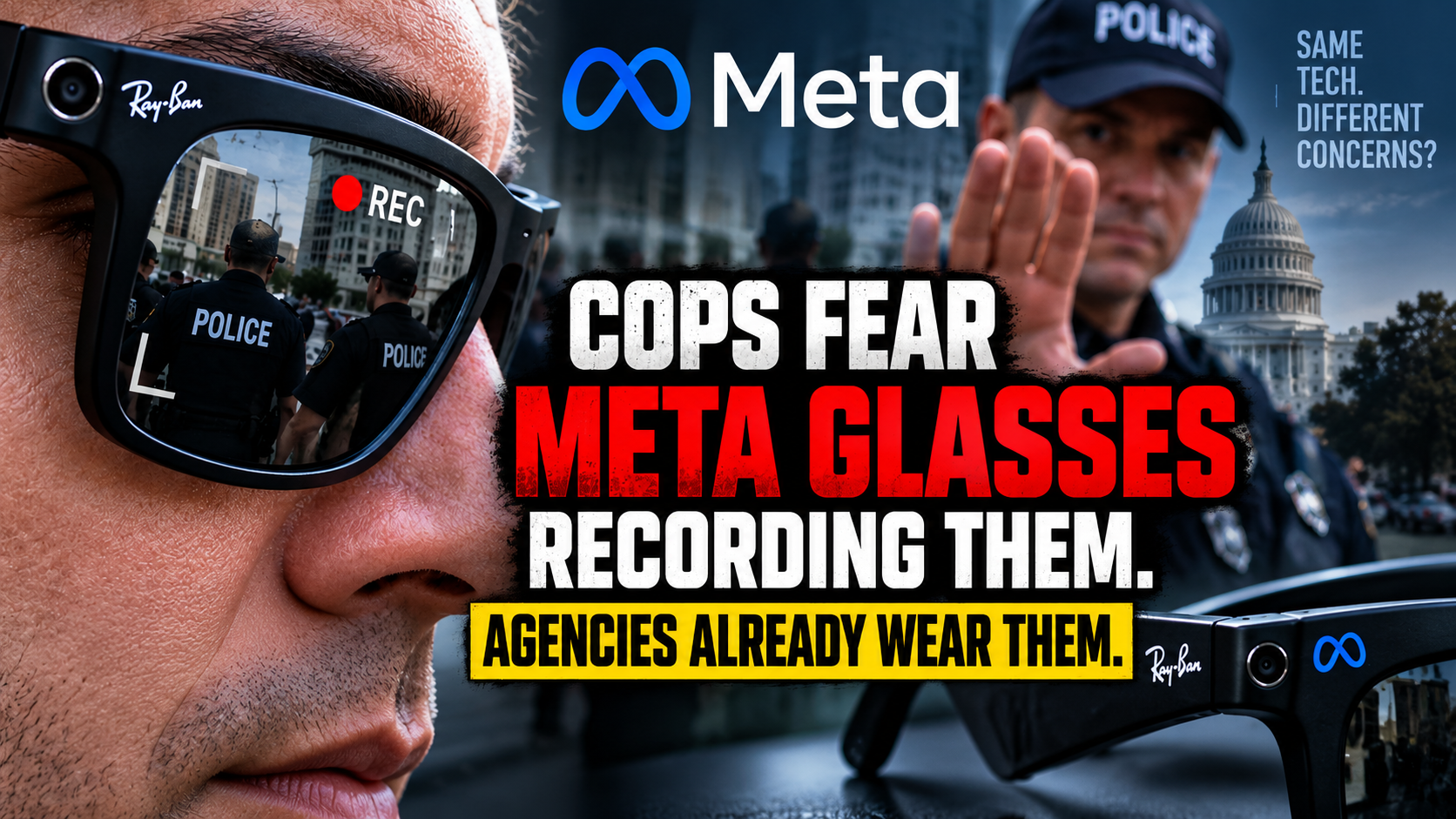
Law enforcement agencies from New York to California have begun treating Meta’s camera equipped Ray-Ban glasses as a security problem. Internal memos warn that the devices could let civilians film officers, map detention centers, or scout targets. At the same time, federal agents have been photographed wearing the same glasses on immigration operations, and some local departments have bought them for their own use.
The latest picture comes from about a dozen previously unreported law enforcement communications obtained by the transparency group Property of the People. The files include warnings from the New York Police Department, state fusion centers, and Department of Homeland Security linked units. The raw packet has not been posted as a complete public archive that could be inspected independently for this report. What can be confirmed is language quoted from those records, plus official policies and public statements that sit outside that cache.
In January 2026, the NYPD’s intelligence and counterterrorism bureau circulated a memo that labeled Ray-Ban Meta glasses a potential “security and counterintelligence” threat. Officers were told to inspect eyewear allowed in inmate cells. The concern was specific. People in custody might record inside police buildings.
The memo warned that covert recording “could result in a security risk if proprietary information about cell layouts, camera placements, or officer patrol/site protection routines are released.” It noted that the glasses “may appear as ordinary prescription eyewear.” That memo cited two social media videos. One, posted to TikTok in July 2025, showed the interior of a South Carolina detention center then under federal scrutiny for unsafe conditions.
The wearer filmed a shower, holding cells, a crowded cafeteria, and other detainees who appeared unaware they were being recorded. “People don’t know about Meta glasses,” the user said in the clip described in the law enforcement file. The original post was not independently recovered for this article. The NYPD treated it as evidence that the hardware can slip past facility rules that normally ban phones and cameras.
A June 2026 bulletin from Maine’s fusion center, a Homeland Security linked information hub, went further. It said smart glasses used by “residents and the general public” had introduced “additional risks and concerns” inside corrections and police facilities. The Maine document also raised a different fear: some models “can leverage AI software including facial recognition, which could lead to doxing of publicly available information or connections to law enforcement officers.”
Similar warnings, according to the Property of the People records, came from the DHS Joint Counterterrorism Assessment Team and fusion centers in San Diego, Tennessee, Virginia, Maine, and New York. Those are documented expressions of concern. They are not, by themselves, proof of a nationwide pattern of successful covert recording inside jails. One terrorism related case is independently established.
After the New Year’s Day 2025 truck attack on Bourbon Street in New Orleans that killed 14 people, the FBI said the attacker, Shamsud-Din Jabbar, had visited the city in October 2024 and recorded the French Quarter with Meta glasses while riding a bicycle. Agents described that footage as pre-attack reconnaissance. He wore the glasses during the attack but did not record or livestream it, the FBI said.
A January 2025 NYPD memo later told officers to watch for people “acting in a suspicious manner observed wearing what may be smart glasses.” Meta spokesperson Dina El-Kassaby later argued that the French Quarter is a tourist district and that a phone could have captured the same scenes. That is a fair point about capability. It does not erase the FBI’s finding that the glasses were used in that case.
Federal policy has moved in two directions at once. In August 2026, ICE acting director David Venturella told staff that Meta glasses count as personal body worn cameras and cannot be worn in the “federal workspace.” The memo said the devices “could unintentionally capture, record or transmit sensitive information, potentially compromising privacy and legal protections.” A DHS spokesperson framed the order as a restatement of a long standing ban on personally owned recording gear, not a brand new rule.
Meta declined to comment when the staff ban became public. A separate ICE document is public. The agency’s Facility Access Agreement Form, used for congressional visits, lists “wearable technology with a camera, audio, and/or video capabilities (e.g., Ray-Ban Meta AI glasses or similar technology)” among devices banned inside ICE facilities. If found, the form says, the devices are to be held until staff confirm that no sensitive material was captured, or until that material is deleted.
That is an official prohibition on the glasses as visitor recording tools, written into facility rules. The irony is not subtle. Customs and Border Protection has said it has no arrangement with Meta and that personal recording devices are unauthorized. Reporting by 404 Media, The Independent, and local outlets has still documented agents wearing Ray-Ban Meta glasses during operations in Los Angeles, Charlotte, Evanston, and other cities.
In some images the white capture light is on, which Meta says means recording is active. CBP has told reporters that agents may wear personally purchased sunglasses. That distinction collapses if the sunglasses contain a camera. DHS budget materials have separately sought money for agency built “operational prototypes of smart glasses,” a project distinct from the consumer product ICE just banned for its own staff.
Local police are not only the worried party. Public records obtained by researcher Dave Maass show the Broward County Sheriff’s Office bought Ray-Ban Meta glasses in 2025 for an undercover Internet Crimes Against Children unit. The Okeechobee County Sheriff’s Office bought pairs for IT staff and says they are used for remote troubleshooting. Broward declined to release a use policy, citing a surveillance techniques exemption.
Those purchases do not prove secret street recording. They do show agencies acquiring the same hardware they now describe as a civilian threat. Privacy groups have been saying the camera points both ways. Ryan Shapiro of Property of the People argued that the newly obtained memos show agencies want exclusive control of the lens.
“These agencies surveil the public incessantly, but the moment we can watch them back, it’s deemed a security threat,” Shapiro said. “When only the government is allowed to hold the camera, that’s not security. It’s impunity.” Evan Greer of Fight for the Future put it more bluntly: “There’s no such thing as Meta glasses that are only for the good guys.”
A larger coalition that includes the ACLU has separately pressed Meta not to add on-device facial recognition, a feature reported under the internal name “Name Tag” and not confirmed as publicly shipped. Meta’s public defense is the light. El-Kassaby said the glasses “are designed to be noticed,” that every pair has a bright white LED that blinks when photos or videos are saved to a gallery, that the light cannot be turned off, and that covering or tampering with it disables the camera.
Company executives have announced software updates meant to stop mid-recording light cover-ups and to brick cameras on devices with destroyed LEDs. Meta has said it disabled cameras on thousands of tampered units, a sliver of total sales. Independent testers have previously shown that workarounds existed after earlier patches. The company’s latest claims should be treated as product statements under active challenge, not as a settled guarantee that covert use is impossible.
What the record actually shows is narrower than the most dramatic warnings and sharper than a shrug. Police and fusion centers have written down fears about covert recording of officers, cells, cameras, and routines. One jailhouse video is cited in those files. One terrorist used the glasses to film a target street.
ICE has banned the consumer product for staff and named it in facility visitor rules. Federal agents have still worn the glasses in the field. Local departments have bought them. The documented problem is not a secret army of glass wearing infiltrators.
It is a consumer camera that looks like ordinary eyewear, arriving in a country where the government records the public as a matter of course and recoils when the public can record it back.