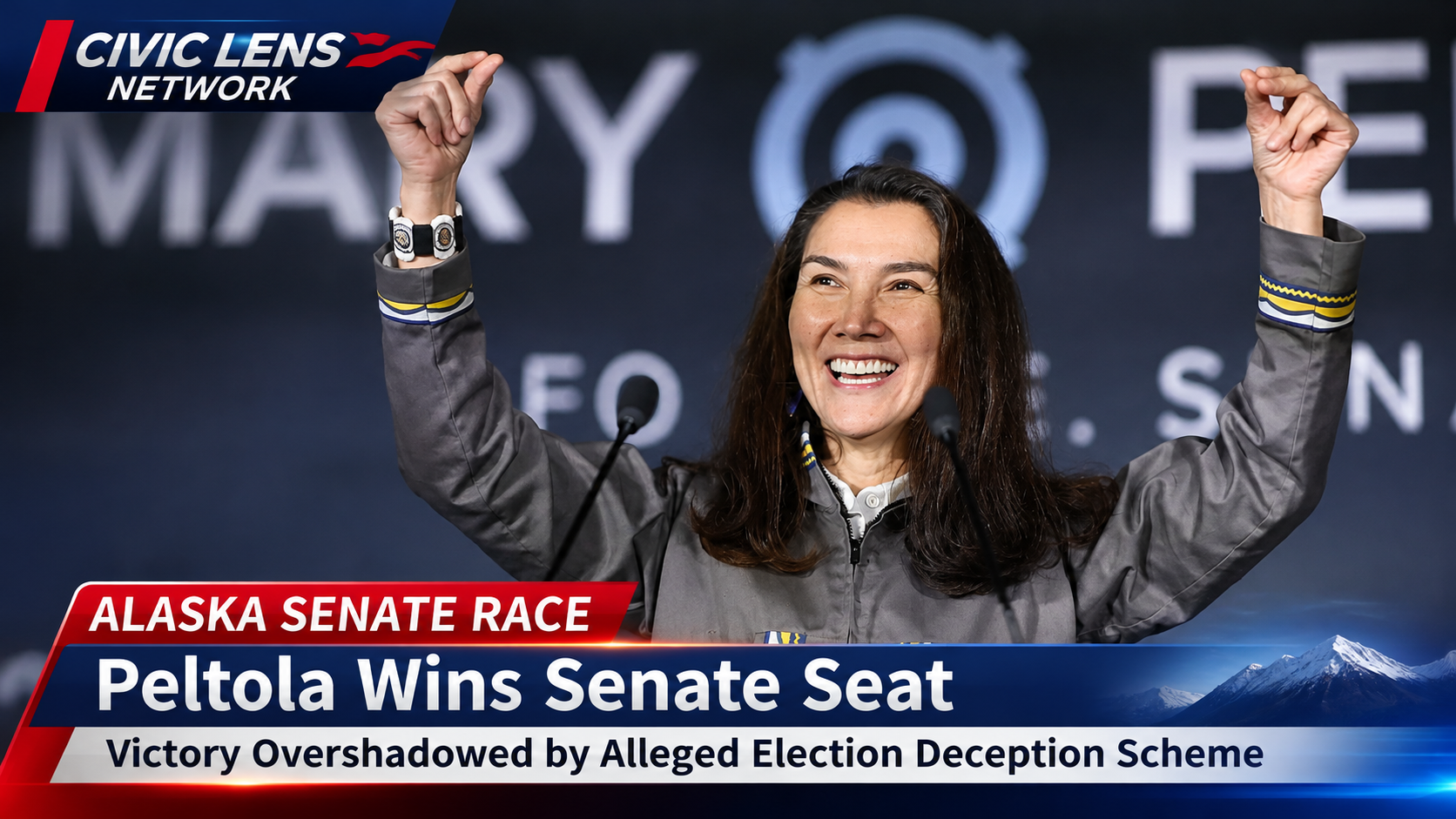
Democrat Mary Peltola has defeated Republican Senator Dan Sullivan in Alaska’s closely watched U.S. Senate race, delivering another major victory for Democrats in the 2026 midterm elections. But the result comes under a cloud of controversy involving allegations of a coordinated effort to manipulate the ballot by recruiting another candidate with the same name as the Republican incumbent.
The Associated Press called the race Tuesday, November 17, after Peltola secured approximately 50.1% of the vote, compared with 45.8% for Sullivan.
Her victory gives Democrats a commanding 56–44 majority in the incoming Senate, following an election in which Republicans lost nine seats.
However, what happened during the Alaska campaign has raised serious questions about political ethics, election integrity and whether voters were deliberately targeted by a deceptive political operation.
Two Candidates Named Dan Sullivan
The controversy centers on an unusual development: Two men named Dan Sullivan appeared on Alaska’s Senate ballot.
One was Republican Senator Dan S. Sullivan, a two-term incumbent and Marine Corps veteran seeking reelection.
The other was Daniel J. Sullivan Jr., a retired teacher from Petersburg, Alaska, who entered the race despite having little political profile and conducting almost no visible campaign.
The presence of two candidates with nearly identical names immediately raised concerns that Republican voters could mistakenly select the wrong Sullivan.
Those suspicions intensified when reporting emerged alleging that individuals connected to Peltola’s campaign and the Democratic Senatorial Campaign Committee had participated in efforts to recruit the second Sullivan.
The allegations were supported by accounts involving campaign communications, interviews and documents, although the full extent of any coordination remains disputed.
Peltola has denied knowing about or participating in the alleged recruitment effort.
The second Sullivan has also denied coordinating with Democrats.
Nevertheless, the circumstances were serious enough to trigger investigations and legal challenges before Election Day.
Federal Authorities Launch Investigation
The controversy moved beyond ordinary campaign accusations when federal authorities confirmed that criminal and civil investigations were underway.
Alaska’s top federal prosecutor acknowledged investigative activity involving groups affiliated with Peltola, although officials did not publicly identify every potential target or specify which criminal laws might have been violated.
FBI agents also contacted individuals who had contributed money to the lesser-known Sullivan’s campaign, seeking information about whether donors had been misled.
Republican Governor Mike Dunleavy separately called for an investigation into whether state laws had been broken.
President Donald Trump condemned the alleged scheme and called for Peltola to face prosecution.
The Trump administration’s Justice Department also filed a lawsuit seeking to prevent certification of the election if the Republican incumbent lost, pending an investigation into possible voter confusion.
A federal judge dismissed the lawsuit, ruling against the proposed intervention in the election process. The Justice Department appealed.
The dismissal did not resolve every factual question surrounding the alleged recruitment effort, nor did it establish that Peltola or her campaign committed a crime.
Alaska Officials Initially Tried to Remove the Second Sullivan
One of the most troubling details emerged months before the election.
Alaska election officials initially attempted to remove Daniel J. Sullivan Jr. from the ballot because they believed his candidacy was not made in good faith and was intended to mislead voters.
The retired teacher challenged that decision in court.
Alaska’s Supreme Court ultimately allowed him to remain on the ballot because state law did not provide a sufficient legal basis to disqualify a candidate over the suspected motive for running.
Election officials distinguished the candidates on the ballot, identifying the incumbent as a Republican senator while listing the other Sullivan without a party affiliation.
The legal ruling allowed the candidacy to proceed, but it did not establish whether the recruitment allegations were true or false.
Did the Second Sullivan Change the Election?
The second Sullivan received approximately 1.7% of the general-election vote, while another Republican candidate, Gerald Heikes, received about 2.1%.
Those figures are important because Peltola’s lead over the incumbent was substantially larger than the second Sullivan’s share of the vote.
Alaska also uses ranked-choice voting, allowing voters to indicate backup preferences if their first-choice candidate is eliminated.
Election specialists have argued that this system makes it more difficult for a spoiler candidate to determine the outcome.
Consequently, the available election figures do not demonstrate that the second Sullivan caused the Republican incumbent’s defeat.
But whether the alleged operation ultimately changed the result is a separate question from whether political operatives attempted to deceive voters in the first place.
If investigators establish that campaign personnel deliberately recruited a namesake candidate to create confusion, that finding would raise substantial ethical concerns regardless of the final vote margin.
Democrats Celebrate a Major Political Victory
Peltola’s victory represents a dramatic political comeback.
She previously served in the U.S. House of Representatives before losing reelection in 2024 to Republican Nick Begich.
During her Senate campaign, she emphasized affordability, energy development and the financial pressures facing Alaskans, particularly residents of remote communities where transportation and fuel costs can be exceptionally high.
She also attempted to distinguish herself from national Democratic leadership, promising to prioritize Alaska’s interests.
Her victory makes her the first Alaska Native elected to the U.S. Senate and gives Democrats another seat in a state that has supported Trump in three consecutive presidential elections.
For Republicans, the defeat represents a significant political setback.
For investigators, however, the unresolved controversy surrounding the second Dan Sullivan presents an entirely different issue.
Election Integrity Questions Remain
Americans should be able to enter a voting booth confident that candidates are competing for their support rather than attempting to exploit confusion over names on a ballot.
Political campaigns regularly use aggressive advertising, opposition research and strategic messaging. Deliberately recruiting a candidate to mislead voters, if proven, would cross a serious ethical line.
The Alaska controversy deserves a complete investigation, including a determination of who recruited the second Sullivan, whether campaign officials coordinated those efforts and whether any election laws were violated.
Peltola has won the race, and no finding of criminal wrongdoing against her has been established.
But winning an election should not prevent legitimate questions about campaign conduct from being investigated.
The American public deserves answers about what happened in Alaska, who was responsible for the alleged operation and whether the country’s election laws adequately protect voters against deliberate political deception.