For decades, video game companies have operated under a powerful business model: If consumers wanted to play certain games, they had to purchase the company’s hardware first. Nintendo built an empire around this strategy, keeping franchises such as Mario, Zelda and Pokémon closely tied to its gaming systems.
But a technological revolution is now threatening that arrangement, and artificial intelligence is helping accelerate it.
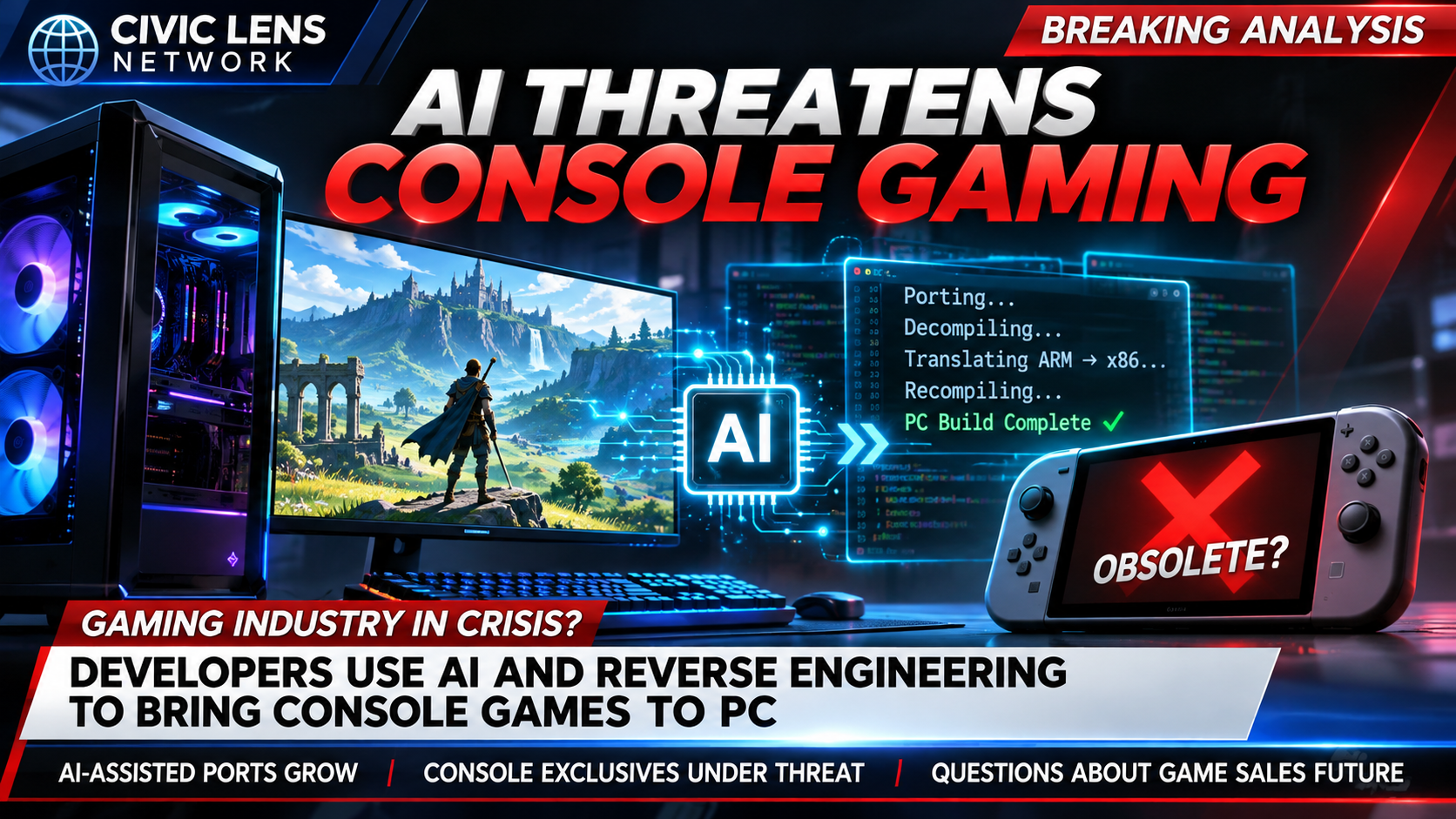
Across the internet, independent programmers are taking games originally designed for Nintendo consoles and converting them into native PC applications. Some developers are using artificial intelligence to accomplish work that previously required months or years of painstaking reverse engineering. Others are manually translating machine code, rebuilding graphics systems and reconstructing software to make console games run directly on ordinary computers.
These projects are not simply traditional emulators. They are increasingly becoming actual PC versions of games Nintendo never intended to release on the platform.
And the implications for the gaming industry could be enormous.
Nintendo Games Are Already Running Natively on PCs
One of the most significant developments arrived in October 2026, when an independent developer released a public beta of a native PC port of The Legend of Zelda: Link’s Awakening, originally released for Nintendo Switch in 2019.
The project, known as LASRecomp, uses a process called static recompilation to convert the game’s original machine instructions into software that can run on Windows, Linux and macOS.
The developer openly acknowledged that Anthropic’s Claude artificial intelligence system produced nearly all the project’s code, reverse-engineering tools and documentation, under human direction and testing.
The result was remarkable: a Nintendo Switch game running as a native computer application without requiring a Nintendo Switch emulator.
The project also introduced capabilities unavailable in the original console release, including expanded resolution options, alternative controller support and additional gameplay customization.
And Link’s Awakening is far from the only target.
Independent development projects have emerged involving Super Mario Odyssey, Super Mario Bros. Wonder, The Legend of Zelda: Tears of the Kingdom, Metroid Dread, Animal Crossing: New Horizons and other Nintendo titles.
Some remain experimental, with incomplete graphics, crashes or performance problems. Others have progressed considerably further.
The important development is not that every Nintendo game suddenly works perfectly on a PC. It is that the technical barriers preventing these conversions are being dismantled.
Programmers Are Translating Console Code by Hand
Artificial intelligence is only one part of this transformation.
Long before the recent explosion of AI-assisted programming, dedicated developers were manually reverse engineering console software, studying processor instructions and reconstructing games to run on entirely different hardware.
Nintendo Switch games were originally developed for ARM-based processors. Most conventional Windows gaming computers use x86-64 processors manufactured by companies such as Intel and AMD.
These processors do not execute the same machine instructions.
To overcome that problem, programmers can analyze a game’s ARM64 instructions and translate their behavior into code compatible with another architecture.
This process requires far more than simply changing a file extension.
Developers must account for memory management, operating-system services, graphics commands, audio processing, controller inputs and numerous hardware-specific functions.
In some projects, programmers manually reconstruct portions of the original software. In others, automated recompilation tools translate machine instructions while developers build replacement systems for the console services the game expects.
The objective is to make the game behave as though it had originally been developed for the PC.
The results are becoming increasingly impressive.
Projects such as Ship of Harkinian, a native PC adaptation of The Legend of Zelda: Ocarina of Time, and recompilation efforts involving Majora’s Mask and Banjo-Kazooie have already demonstrated how older console games can be reconstructed for modern computers.
AI is now helping extend similar techniques to considerably newer games.
Artificial Intelligence Is Changing the Speed of Development
Previously, reverse engineering a major commercial video game could require years of work from highly skilled programmers.
Artificial intelligence is changing that equation.
Modern coding systems can assist developers with analyzing assembly instructions, generating replacement functions, identifying software dependencies and producing large quantities of source code.
Tasks that once required extensive manual labor can now be partially automated.
That does not mean AI can flawlessly convert every console game with a single command. Developers still report broken features, compatibility problems and significant debugging requirements.
But even imperfect AI-generated code can dramatically accelerate experimentation.
A project that might once have been considered too difficult for a small group of hobbyists can now become a realistic undertaking.
As AI systems improve, the number of people capable of attempting these conversions could increase substantially.
That creates a problem for companies whose business models depend heavily on keeping their most valuable games exclusive to proprietary hardware.
What Happens When Consumers No Longer Need the Console?
For Nintendo, the potential consequences extend beyond software.
Nintendo has traditionally relied on exclusive games to make its hardware desirable. Consumers purchase the console because they want access to games unavailable elsewhere.
But what happens when those games can run directly on a Windows computer?
A consumer who already owns a powerful gaming PC may see little reason to purchase another device if the games they want become accessible without it.
That could weaken one of the most important advantages console manufacturers possess.
PC hardware also offers capabilities that can exceed those of dedicated gaming systems, including higher rendering resolutions, expanded graphical settings, custom modifications and support for different controllers.
For enthusiasts, a native PC version may eventually become more attractive than the original console release.
This does not mean consoles are immediately obsolete. Nintendo still offers portability, convenience, exclusive online services and a tightly integrated gaming experience.
But the argument that consumers must purchase specialized hardware simply to access certain games is becoming more difficult to sustain.
The Bigger Threat: Games Circulating Free Across the Internet
There is another issue that could prove even more disruptive.
Once software has been converted into a format that can run on ordinary computers, unauthorized copies of the original game may become more attractive to people who never purchased it.
The internet already contains unauthorized copies of commercial video games, and piracy has existed for decades.
Native PC ports potentially remove another obstacle by allowing certain games to run without a conventional console emulator.
A person who obtains an unauthorized copy of a game online could potentially use compatible porting software to play it without purchasing either the original console or the game.
That possibility raises an uncomfortable question for the industry: How much longer can publishers depend on exclusive hardware and restricted software distribution to protect their sales?
There is an important distinction, however.
Most prominent recompilation projects do not distribute Nintendo’s copyrighted game files. Instead, they require users to supply their own copies.
Creating a compatibility tool is not the same as legally obtaining a commercial game. Downloading unauthorized copies can violate copyright law, and recompilation does not automatically make piracy legal.
Nevertheless, the technical ability to separate a game from its original hardware creates an obvious challenge for manufacturers.
Nintendo Cannot Simply Ignore This
Nintendo has aggressively defended its intellectual property, pursuing legal action against unauthorized distribution, piracy tools and software it believes infringes its rights.
The company argues that piracy threatens the financial foundation supporting game development, including the work of programmers, artists, musicians and other creators.
That argument has a legitimate economic basis. Major video games can require enormous investments, and publishers need revenue to finance future projects.
But legal enforcement and technological limitations are two different things.
Nintendo may be able to pursue websites distributing copyrighted games or challenge particular software projects. It cannot necessarily prevent independent programmers from discovering new ways to make software function on different hardware.
The legal status of an individual port depends on how it was created, what copyrighted material it contains and whether protected technologies were unlawfully circumvented.
And as more developers gain access to powerful AI programming tools, enforcing hardware exclusivity could become increasingly difficult.
Could the Traditional Video Game Business Model Collapse?
The most dramatic possibility is that the traditional relationship between consoles, exclusive games and software sales eventually breaks down.
If consumers can run a growing library of console games on ordinary computers, manufacturers may face pressure to reconsider how they distribute their products.
Nintendo could eventually find that releasing games officially on PC offers greater financial benefits than attempting to maintain absolute platform exclusivity.
Other publishers have already demonstrated that console games can generate substantial revenue through official PC releases.
But the idea that game sales themselves will disappear is far less certain.
Even if every console game could technically run on a PC, developers would still own intellectual property, consumers would still need legitimate access to commercial software, and millions of players would continue paying for reliable, supported gaming experiences.
The more realistic threat is to the traditional requirement that consumers purchase a particular company’s hardware before they can enjoy its games.
Piracy could intensify that pressure, but it would not automatically eliminate the commercial market.
A Gaming Revolution That Has Already Begun
The significance of these developments should not be underestimated.
For decades, console manufacturers controlled not only the games they produced but also the hardware required to experience them.
Now, independent programmers armed with reverse-engineering knowledge, recompilation tools and increasingly powerful artificial intelligence are challenging that control.
Games that once seemed permanently locked to Nintendo hardware are appearing as native computer applications.
The technology is still developing. Many projects remain incomplete, and legal questions surrounding copyrighted software are far from settled.
But the direction is unmistakable: The technical separation between console gaming and PC gaming is narrowing.
The future may not eliminate Nintendo, PlayStation or Xbox hardware entirely. Dedicated consoles still have practical advantages and loyal audiences.
What could disappear is the assumption that buying a particular console is the only technically viable way to play its exclusive games.
And if AI continues making game conversion faster, cheaper and more accessible, the companies that built their fortunes around hardware exclusivity may face a very different gaming industry in the years ahead.