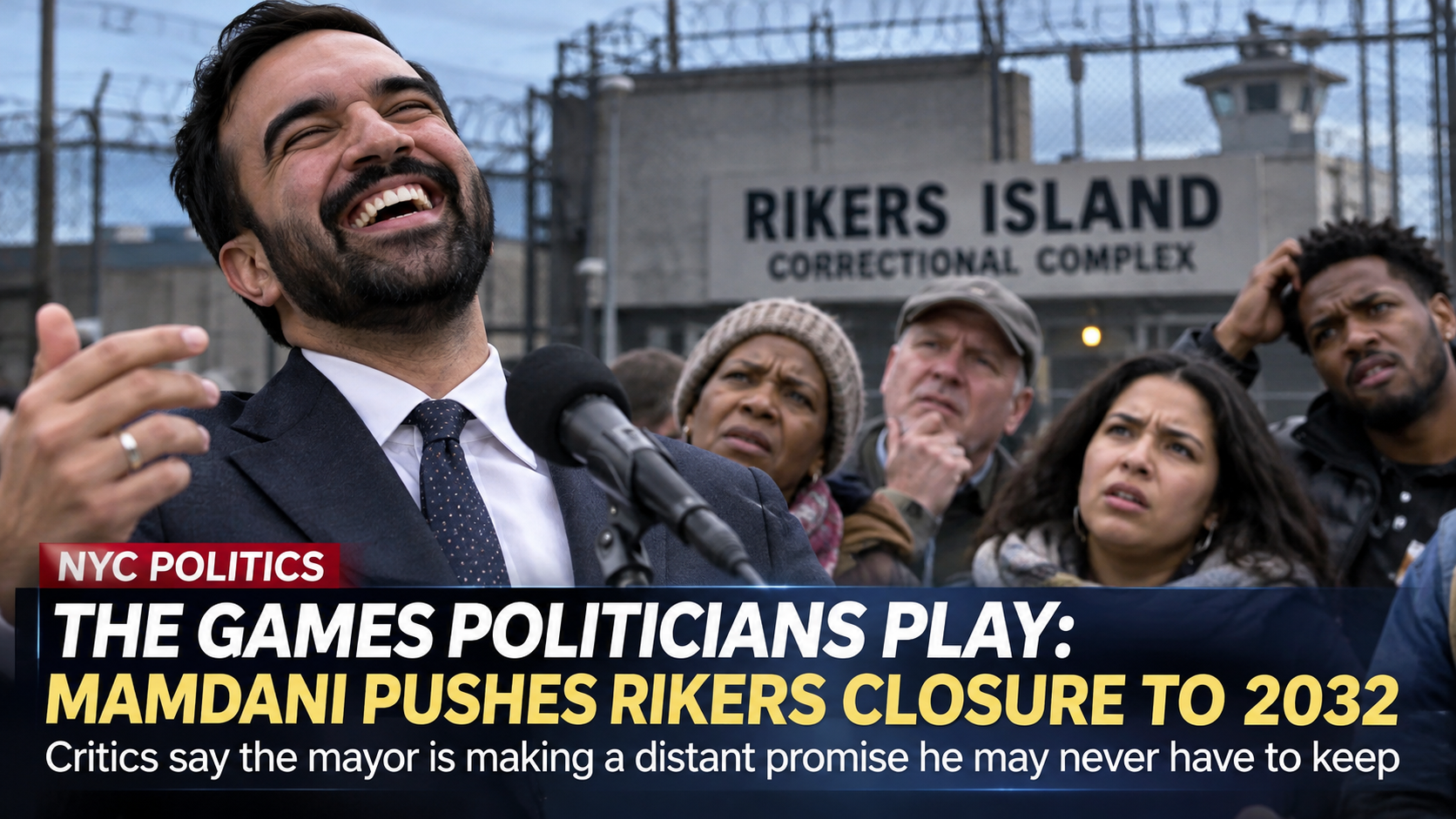
New York City Mayor Zohran Mamdani has announced a plan to close the notorious Rikers Island jail complex by 2032, presenting the proposal as a major step toward reforming the city’s troubled correctional system.
But there is one glaring problem with the announcement: New York City already had a legally mandated deadline to close Rikers Island by August 31, 2027.
Rather than meeting that obligation, Mamdani now wants to push the deadline back more than five years, to December 31, 2032.
The announcement raises a serious question about political accountability. Is the mayor delivering meaningful reform, or simply replacing an approaching deadline with a distant promise that he may never personally have to fulfill?
A Deadline That Already Existed
In 2019, New York City lawmakers approved legislation requiring the closure of Rikers Island by 2027. The decision was part of a broader effort to replace the aging jail complex with smaller facilities throughout the city’s boroughs.
That deadline was not merely a political aspiration. It was written into city law.
Now, with the original deadline less than a year away, Mamdani’s administration is proposing to change the law rather than meet its existing requirements.
City officials argue that construction delays and the need to reduce the jail population have made the original deadline impossible to achieve.
Those problems are real. The first replacement jail is not expected to open until 2029, two years after Rikers was originally supposed to close.
But that explanation does not eliminate the accountability issue.
If politicians can repeatedly move legally mandated deadlines whenever fulfilling them becomes difficult, what exactly is the purpose of establishing those deadlines in the first place?
Making Promises for Someone Else to Keep
Perhaps the most politically convenient aspect of Mamdani’s announcement is the timing.
The mayor’s current term runs through the end of 2029. His proposed closure date falls three years beyond that term.
Unless Mamdani wins reelection, someone else could be sitting in City Hall when the 2032 deadline arrives.
That means the mayor can claim credit today for announcing a historic reform while potentially leaving another administration responsible for delivering it.
It is a familiar political arrangement: announce an ambitious goal, attach a distant completion date, and enjoy the favorable publicity long before voters can determine whether the promise was kept.
The arrangement also gives Mamdani a politically useful response to critics who demand immediate action. He can point to a detailed plan and insist progress is underway, even though the central promise will not be fulfilled for years.
Whether that is his intention is impossible to establish from the announcement alone. But the political advantage of such a distant deadline is difficult to ignore.
What Is Actually Being Promised?
Under the proposal, New York City would construct four replacement jails in Brooklyn, Queens, the Bronx and Manhattan.
The Brooklyn facility is expected to open in 2029, followed by facilities in Queens and the Bronx in 2031 and Manhattan in 2032.
The administration also wants to reduce the city’s jail population from approximately 6,600 people to about 4,100 by 2032.
Mamdani has proposed $146 million in spending during the next fiscal year for mental health services, substance abuse treatment, education, job training and related programs, including support for crime victims.
Those are specific proposals that can be measured against actual spending, construction progress and changes in the jail population.
The administration has also already closed one facility on Rikers Island and taken steps toward transferring additional property out of correctional use.
But closing individual buildings and announcing future construction projects are not the same as fulfilling the original commitment to close the entire complex.
The Public Safety Question
The proposal also raises questions about what happens to New Yorkers while the city attempts to reduce its jail population.
Mamdani’s strategy includes reducing pretrial detention, accelerating criminal court proceedings and expanding alternatives to incarceration.
Reducing unnecessary delays in the court system is a legitimate objective. People should not spend excessive periods behind bars simply because the justice system cannot process their cases efficiently.
However, any effort to reduce the jail population must also account for the risks posed by defendants accused of serious or violent crimes.
New Yorkers deserve clear answers about which individuals would qualify for alternatives to detention, how those decisions would be made and what safeguards would protect the public.
The goal of closing an outdated jail complex cannot come at the expense of public safety.
Political Theater or Real Accountability?
Mamdani’s administration describes the 2032 target as a realistic path toward finally ending incarceration on Rikers Island.
But realism and accountability are not mutually exclusive.
The mayor should be expected to explain precisely what his administration will accomplish before his current term expires in 2029.
How many replacement facilities will actually be operating? How much money will have been spent? How many inmates will have been relocated? And what consequences will follow if those benchmarks are missed?
Without enforceable milestones, the new deadline risks becoming another political promise that can simply be postponed by the next administration.
The City Council must approve any change to the existing closure law, meaning Mamdani cannot unilaterally erase the 2027 requirement.
That gives lawmakers an opportunity to demand measurable progress rather than accept another distant date at face value.
New Yorkers Deserve Results, Not Another Date on a Calendar
The controversy surrounding Rikers Island has continued through multiple mayoral administrations. Each has faced pressure to improve conditions, protect correctional officers, safeguard inmates and address the enormous costs of operating the jail complex.
Mamdani did not create all the delays that brought the city to this point. But he now holds the office responsible for confronting them.
Announcing a closure date in 2032 may sound decisive. In reality, it means New Yorkers are being asked to wait more than five additional years for something their government already promised would happen in 2027.
And the politician making that announcement may no longer be mayor when the deadline finally arrives.
That is the central problem with political promises extending beyond the politician’s own term: the person receiving the applause today may never be the person answering for failure tomorrow.
New Yorkers should judge Mamdani not by what he promises will happen in 2032, but by what he actually accomplishes while he is mayor.
Because changing a deadline is easy. Delivering results is what leadership is supposed to mean.