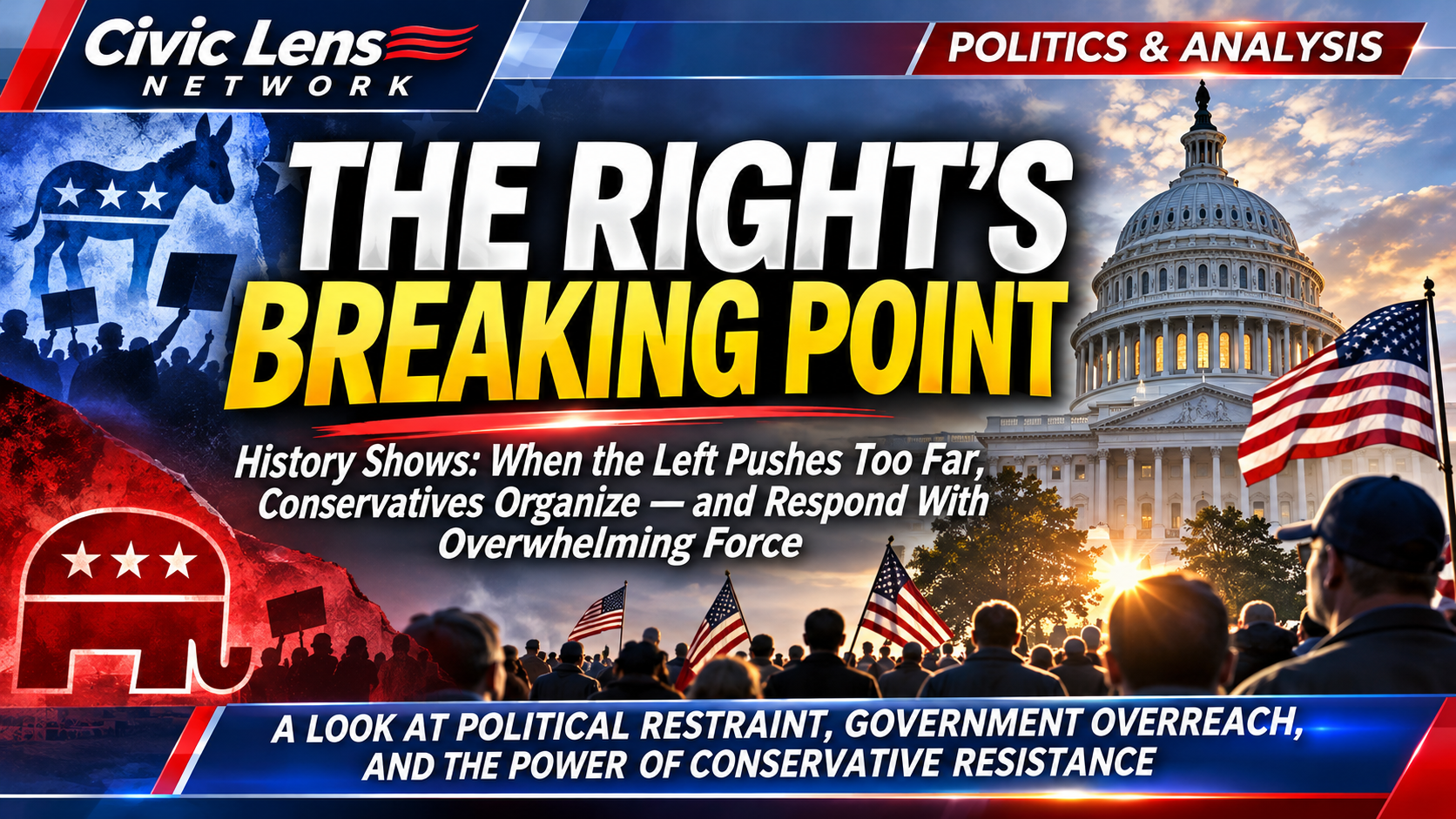
Across America, a powerful political divide has emerged over one fundamental question: How much interference should ordinary citizens tolerate from government, political activists, and institutions that claim to know what is best for them?
For many Americans on the political right, the answer is straightforward. They want to work, raise their children, worship according to their beliefs, protect their property, and live without unnecessary government interference.
They do not necessarily want a political confrontation every morning. They want control over their own lives.
Yet conservative Americans increasingly describe a political environment in which remaining quiet feels less like an option. They see progressive activism extending into schools, workplaces, religious institutions, private businesses, and family decisions.
The resulting frustration raises an important question: What happens when people who generally prefer political stability decide that their freedoms are being threatened?
History offers examples of conservative movements developing considerable political power when previously disengaged citizens begin organizing.
The Difference Between Silence and Surrender
One of the greatest mistakes political leaders can make is assuming that people who remain quiet have accepted the direction of their country.
Silence can mean many things.
It can mean someone is busy raising a family, running a business, working long hours, or simply avoiding political arguments.
It can also mean that frustration is building beneath the surface.
Conservative political philosophy has long emphasized limited government, private property, individual responsibility, religious liberty, and the preservation of established institutions.
Those principles help explain why many conservatives view expanding government authority with suspicion.
When policies begin affecting matters they consider deeply personal, political disagreements can become questions of fundamental rights.
Parents may object to decisions made by school administrators. Religious Americans may challenge restrictions they believe infringe upon their beliefs. Business owners may resist regulations they consider excessive.
Not every disagreement amounts to oppression. Nevertheless, the perception that government has crossed a legitimate boundary can be a powerful force in political organizing.
When Government Pushes Too Far
American history contains a recurring struggle between governing authorities and citizens who believe their liberties are being restricted.
The American Revolution provides one of the country’s most significant examples.
During the years preceding independence, colonial resistance developed through petitions, boycotts, organized protests, and political coordination.
British taxation and enforcement policies generated increasing opposition.
The colonies established committees of correspondence to coordinate their responses, while representatives assembled to challenge British authority.
Even after armed conflict began at Lexington and Concord in 1775, the Second Continental Congress sent the Olive Branch Petition to King George III in an effort to secure reconciliation.
The king rejected the appeal, and the conflict ultimately developed into a war for independence.
The Revolution cannot accurately be described as a modern Republican movement fighting modern Democrats. Those political identities did not exist.
However, the historical episode illustrates how disputes over political authority can produce increasingly organized resistance when reconciliation fails.
It also illustrates the enormous human cost when political disagreements escalate into war.
The Tea Party: When Conservatives Organized
A much more direct example of modern conservative mobilization emerged in 2009.
Following the financial crisis, government bailouts, increased federal spending, and debates over health care reform, conservative activists began organizing protests across the United States.
The Tea Party movement rapidly expanded from scattered demonstrations into a nationwide political force.
Many participants believed Washington had become too powerful, too expensive, and insufficiently accountable to taxpayers.
The movement brought together grassroots organizers, conservative advocacy organizations, and Americans who had previously participated only occasionally in political activism.
By the 2010 midterm elections, Republicans gained 63 seats in the House of Representatives and took control of the chamber.
The Tea Party did not accomplish every objective its supporters wanted. Its membership was also more politically diverse than a single ideological description suggests.
Nevertheless, its impact demonstrated something significant.
Citizens who believed their government had overstepped could organize, challenge established politicians, influence elections, and reshape national political debate.
They did not need violence to exercise substantial political power.
The Left’s Expanding Influence and the Conservative Backlash
Modern progressivism has pursued changes across education, economic policy, environmental regulation, workplace practices, and questions involving gender and identity.
Supporters describe many of these initiatives as efforts to expand equality, opportunity, and protection against discrimination.
Conservative critics see some of the same initiatives differently.
They argue that progressive institutions sometimes treat disagreement as intolerance, pressure individuals to accept contested ideological positions, and place collective political objectives above individual freedom.
These criticisms deserve examination rather than automatic dismissal.
A government that protects freedom of expression must protect unpopular conservative opinions just as firmly as progressive ones.
A public institution committed to religious liberty cannot treat traditional religious beliefs as inherently illegitimate.
And a political movement that claims to oppose authoritarianism must remain accountable when its own supporters engage in intimidation, censorship, or coercion.
Those standards must apply equally to the right.
Political violence, threats, and the suppression of lawful dissent are unacceptable regardless of which side commits them.
The larger conservative argument is that government should not become an instrument for imposing one political faction’s worldview upon everyone else.
Why the Right Can Be Underestimated
A political movement does not necessarily reveal its full strength through demonstrations or social media activity.
Millions of Americans participate in politics quietly.
They vote, donate to causes, attend religious services, operate businesses, volunteer in communities, and maintain relationships with people who share their values.
Those connections can become important organizational networks when political concerns intensify.
Churches, civic associations, advocacy groups, local political organizations, and community institutions have historically played roles in mobilizing conservative Americans.
When previously disconnected concerns begin to converge, a movement can grow rapidly.
An argument over taxation can become part of a broader dispute over government authority.
A disagreement involving education can develop into a campaign for school board representation.
Concerns about religious liberty can inspire legal challenges, statewide political organizations, and national advocacy campaigns.
The result can be an unexpectedly powerful response from citizens who previously appeared politically inactive.
But overwhelming political organization should not be confused with overwhelming physical force.
The ability to win elections, organize peaceful demonstrations, pursue constitutional litigation, and hold officials accountable is a far more reliable measure of democratic strength than the ability to intimidate opponents.
Political Restraint Is Not Political Weakness
One central argument made by many conservatives is that their reluctance to participate in constant political confrontation should not be mistaken for indifference.
A person may oppose government overreach without attending demonstrations.
A parent may object to school policies without immediately entering a political campaign.
A business owner may resent regulations while continuing to comply with the law.
Those frustrations can remain politically invisible until a particular event or policy creates enough urgency to produce organized action.
The Tea Party demonstrated how quickly such mobilization can occur.
Yet history also warns against assuming that the right is always peaceful until provoked or that the left is always the aggressor.
Political violence has originated from extremist movements across the ideological spectrum. Any serious examination must distinguish peaceful conservatives and progressives from individuals who resort to intimidation or violence.
That distinction does not weaken the case for conservative resistance to government overreach.
It strengthens the argument that legitimate political resistance should defend constitutional freedoms rather than destroy them.
The Danger of Mistaking Political Power for Unlimited Authority
Every political majority faces a temptation to treat electoral success as permission to impose its entire agenda.
But winning an election does not eliminate constitutional protections.
Freedom of speech does not disappear because an opinion becomes unpopular.
Religious liberty does not depend on approval from political activists.
Property rights and due process cannot simply be discarded because government officials believe their objectives are important.
These principles are not privileges granted to one political party.
They are protections designed to restrain power itself.
For conservatives who believe government has expanded beyond its proper boundaries, defending those limits is central to their political identity.
And when enough citizens share that conviction, their combined political influence can be substantial.
A Warning About the Limits of Public Patience
America’s political future should not be determined by which faction can threaten the other more effectively.
It should be determined through constitutional government, free elections, peaceful organizing, independent courts, and the protection of individual rights.
Nevertheless, elected officials would be mistaken to assume that Americans who avoid political confrontation will remain disengaged indefinitely.
History demonstrates that organized citizens can dramatically change the political landscape when they believe government has stopped listening.
The American right has already demonstrated this capacity through grassroots movements, electoral campaigns, legal advocacy, and local political organizing.
The question is not whether conservatives are capable of mobilizing.
They are.
The question is whether political leaders recognize the depth of public frustration before that frustration produces another major political realignment.
For Americans who believe their government should leave them alone, the message is simple.
Political restraint should never be mistaken for surrender.
And the strongest response to government overreach remains the organized, determined, constitutional exercise of the freedoms Americans already possess.