In 2019, political commentator Tim Pool asked ordinary Americans to invest in his vision of an independent news organization. Thousands answered that call, contributing more than $1.2 million through the crowdfunding platform Wefunder.
The promise was ambitious: a decentralized news network called Subverse that would challenge traditional media, produce original journalism, and potentially become a valuable business.
But years later, the story raises uncomfortable questions about investor accountability, the collapse of the original operation, and Pool’s growing personal media empire.
More Than $1 Million Raised From Ordinary Investors
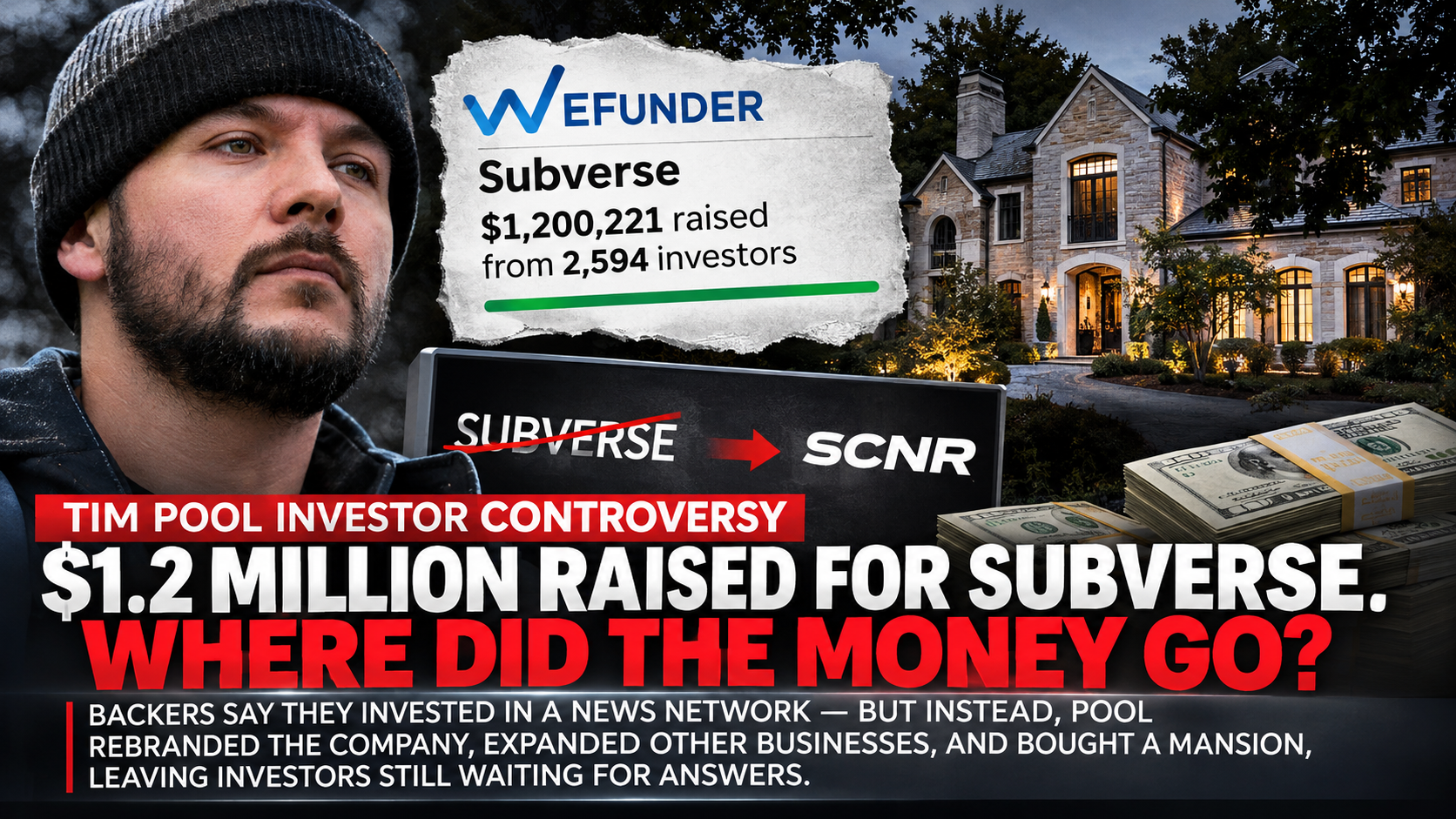
According to Wefunder’s publicly available records, Subverse raised $1,200,221 from 2,594 investors.
These were not simply charitable donations. Participants purchased investment contracts known as SAFEs, or Simple Agreements for Future Equity, anticipating the possibility of financial returns if the company achieved certain milestones.
The original pitch described a community-owned news organization that would eventually expand its journalism operations, hire reporters, and develop a network capable of competing with established media companies.
Pool’s reputation and audience were major selling points. Supporters were investing not just in a business concept but in the credibility of the man promoting it.
The News Empire That Never Materialized as Promised
Subverse eventually changed its name to SCNR, but its early ambitions were derailed by internal conflict.
By 2021, disputes involving Pool and other company executives had erupted into a serious business controversy. The original operation had failed to develop as envisioned, despite the substantial investment backing.
Instead of the rapidly expanding independent news organization investors had been encouraged to support, the company became entangled in legal disputes and disagreements over management.
Meanwhile, Pool continued expanding his separate Timcast media operations.
The distinction matters. Someone who invested in Subverse did not automatically receive an ownership interest in Timcast or any other separate business Pool operated.
That raises an obvious question: If the public helped finance one media venture, what financial benefit, if any, did those investors receive while Pool’s other businesses expanded?
A Million-Dollar Mansion and a Separate Media Operation
In 2020, Pool purchased a million-dollar property in Maryland that became associated with his podcasting operation. The property reportedly included a podcast studio and skateboarding facilities.
The timing naturally invites scrutiny. Pool had recently helped raise more than $1 million for Subverse, and his personal media operation was developing into a substantial enterprise.
However, publicly available reporting does not establish that Subverse investment proceeds financed the mansion. Nor does the existence of the property prove that investor money was improperly transferred.
The more important issue is whether investors received adequate information about how their contributions were spent, what assets belonged to Subverse, and whether the company entered into any transactions benefiting related businesses.
Those questions deserve answers supported by financial records rather than assumptions.
The Investment Terms That Could Leave Backers Waiting Indefinitely
Perhaps the most troubling aspect of the arrangement involves the investment structure itself.
Subverse investors received SAFEs, which are fundamentally different from ordinary loans. These agreements generally do not require repayment on a fixed schedule. Investors may receive equity or proceeds if specified financing or liquidity events occur.
The company’s original securities disclosures warned that investors could be left holding their contracts indefinitely if qualifying events never occurred.
In other words, someone could invest money in the expectation of future financial success without ever receiving a guaranteed return.
That is an important distinction. A business founder can continue operating other successful companies while investors in a separate venture remain exposed to losses.
Such an outcome is not automatically illegal. But it demonstrates why the difference between a public investment pitch and the actual contractual rights of investors deserves serious attention.
Pool Says Legal Disputes Delayed the Company
Pool has offered an explanation for Subverse’s difficulties.
During a November 2023 broadcast, he said litigation had effectively frozen the business and prevented it from operating normally.
He also announced that SCNR was relaunching following the resolution of legal issues.
A company report filed with the Securities and Exchange Commission described a renewed news operation, identified Pool as its sole board member, and discussed legal action involving former executives.
These developments complicate the claim that Pool simply abandoned Subverse and replaced it with another company. SCNR did return, although that does not establish whether the original investors ultimately realized any financial benefit.
Investors Deserve More Than Promises
On Wefunder’s public discussion pages, investors have questioned the company’s financing structure and asked about opportunities to recover their money.
One commenter directly called for an update or an investor buyout, pointing to Pool’s apparent financial success.
Those concerns should not be dismissed simply because startup investments involve risk.
The central issue is accountability.
How much of the original $1.2 million went toward journalism? How much was spent on operating expenses, management, and legal disputes? Were there any financial transactions between Subverse and Pool’s other businesses? Have investors received distributions, equity conversions, or buyout opportunities?
And perhaps most importantly, what is the current financial value of the investment contracts held by the thousands of people who believed in the original project?
Without a complete accounting and updated investor records, those questions cannot be conclusively answered.
The Bigger Question for Independent Media
Tim Pool has built a public reputation criticizing powerful institutions, questioning financial interests, and demanding transparency from politicians and major news organizations.
Those standards should also apply to independent media entrepreneurs who raise money from their own audiences.
There is nothing inherently wrong with purchasing an expensive home, operating multiple businesses, or launching a successful podcast network.
But when thousands of supporters contribute substantial sums to a specific investment venture, they deserve clear explanations about what happened to the business they financed.
The evidence establishes that Subverse raised $1.2 million, experienced serious internal conflict, and later relaunched as SCNR. It does not establish that Pool used those funds to buy his mansion or deliberately structured another company to evade repayment.
Still, the unanswered financial questions remain legitimate.
The people who invested in Subverse were not merely viewers clicking a subscription button. They were financial backers who accepted significant risk because they believed in a promised business.
And after years of controversy, the most important question remains remarkably simple:
What, ultimately, did those 2,594 investors get for their $1.2 million?