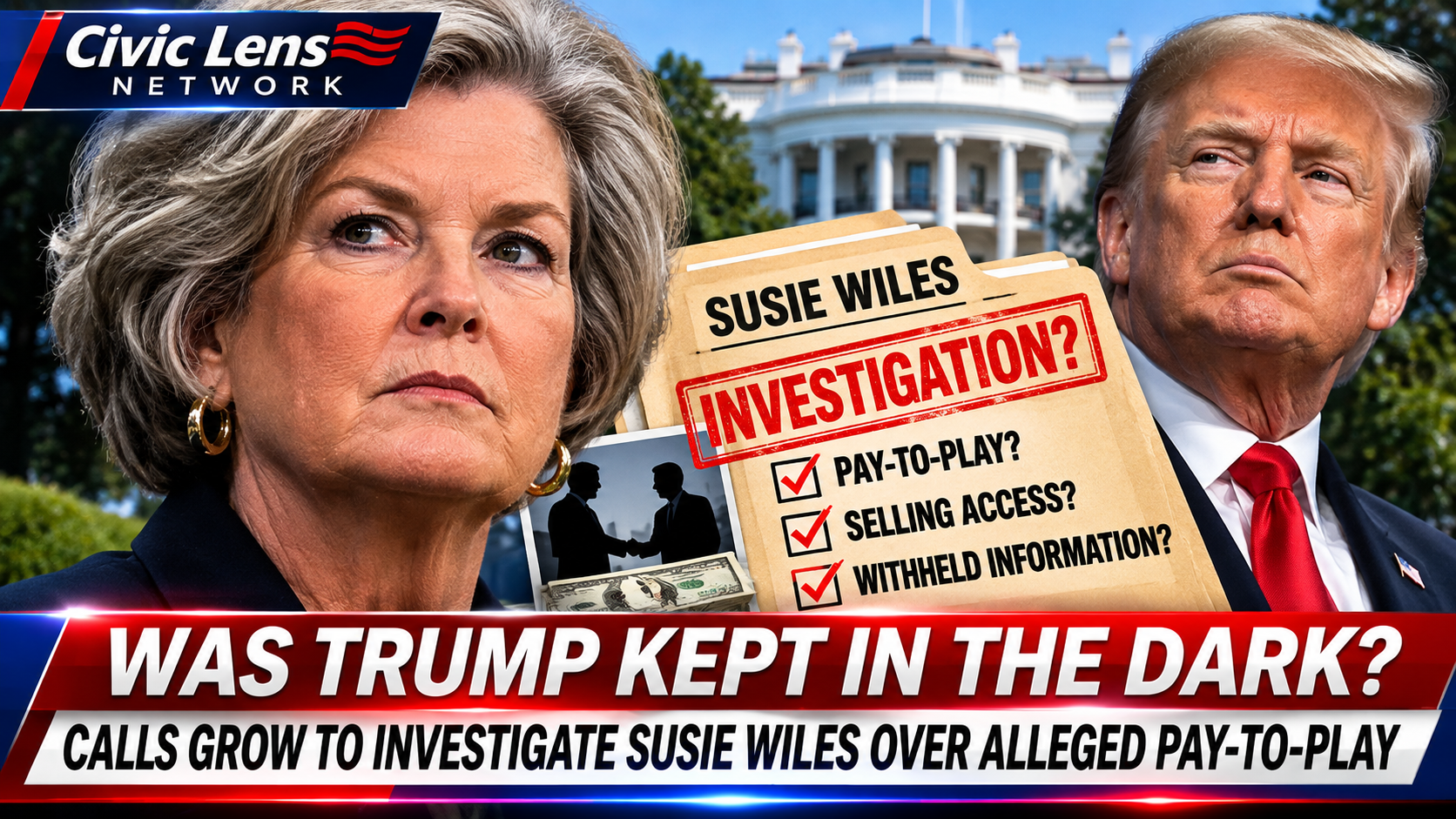
Serious allegations of political influence, corporate lobbying and possible conflicts of interest have placed former White House Chief of Staff Susie Wiles at the center of a growing controversy over what happened behind closed doors during President Donald Trump’s administration.
The accusations come from Calley Means, a former senior White House adviser who worked closely with Health and Human Services Secretary Robert F. Kennedy Jr.
During an appearance on The Joe Rogan Experience, Means alleged that powerful political operatives and corporate interests interfered with policies President Trump had promised voters he would pursue.
But perhaps the most consequential allegation was that Trump himself may not have known the full extent of what was happening inside his administration.
Means subsequently reinforced those accusations during a televised interview, alleging that officials were acting on behalf of special interests while important decisions were being made without the president’s full knowledge.
The controversy raises questions that deserve a thorough and independent examination.
Were political donors receiving favorable consideration? Did lobbyists gain influence through their relationships with senior White House officials? Were important policy proposals blocked before reaching President Trump?
And if Trump was unaware of those activities, who was responsible for controlling the information he received?
These questions do not establish criminal wrongdoing. Wiles has not been charged with corruption or pay-to-play offenses, and the allegations remain disputed.
Nevertheless, the public record and the accounts of a former administration insider provide specific issues that investigators could examine.
Calley Means Accuses White House Insiders of Serving Special Interests
Means made his allegations during an extensive interview with Joe Rogan, describing what he believed was a deeply entrenched culture of lobbying influence inside Washington.
He argued that the administration had been infiltrated by individuals whose priorities conflicted with the promises Trump made to voters.
According to Means, important policy decisions were routed through Wiles’ office, creating a system in which cabinet officials and policy advisers had to obtain approval from a small group of influential political operatives.
He alleged that this arrangement allowed initiatives to be delayed or obstructed even when they aligned with Trump’s stated political agenda.
Means specifically identified Wiles and several other senior figures as individuals whose decisions he believed were influenced by political fundraising and relationships with powerful industries.
His accusations were particularly focused on the Make America Healthy Again movement, which had promised to confront concerns about processed foods, chemicals and corporate influence over public health policy.
Means said some of those efforts encountered resistance from within the administration itself.
The allegation is significant because it came from someone who worked inside the government rather than an outside political commentator.
However, firsthand experience does not automatically establish every accusation as fact. The specific decisions, financial relationships and communications described by Means require independent examination.
Did President Trump Know What Was Happening?
One of the most important aspects of Means’ account concerns President Trump’s personal knowledge of the alleged activities.
During his Joe Rogan appearance, Means said he did not believe Trump knew about most of the conduct he was describing.
He subsequently repeated that concern in a television interview, saying he believed some advisers were accepting money from industries affected by administration policy while Trump remained unaware of the full situation.
Means alleged that certain health initiatives had been delayed without the president’s knowledge.
That possibility raises a fundamental question about the authority exercised by senior White House staff.
The chief of staff controls important aspects of presidential scheduling, communications and access. Although the president retains ultimate executive authority, senior aides can exercise considerable influence over which proposals reach his desk.
If important policy recommendations were blocked before Trump reviewed them, investigators should determine who made those decisions and whether the president was informed.
They should also examine whether officials accurately disclosed financial relationships that could have created conflicts of interest.
At present, there is no independently verified public record establishing that Wiles deliberately concealed specific decisions from Trump.
Means’ account nevertheless identifies a concrete issue for investigators to examine.
The question should not be answered through speculation about Trump’s intentions or knowledge.
It should be answered through records, testimony and a clear reconstruction of the decisions being challenged.
The Sugar Industry Allegations
Among the most specific accusations made by Means was his claim that an administration health initiative faced resistance because of concerns about political contributions from the sugar industry.
According to Means, Wiles opposed or delayed a proposal because of its potential effect on political fundraising.
If substantiated, such conduct could raise serious ethical concerns.
There is a difference between an administration considering the political implications of a policy and an official exchanging government action for financial support.
The latter could potentially implicate corruption laws, depending on the evidence and circumstances.
Investigators would need to establish whether any contribution was requested, promised or received in connection with a specific government decision.
They would also need to identify the policy proposal involved, who opposed it, and whether there were legitimate administrative or policy reasons for the decision.
Means’ allegation is not proof that such an exchange occurred.
But it provides a specific lead that could be tested against campaign finance disclosures, lobbying records, meeting calendars and internal communications.
Wiles’ Previous Lobbying Relationships Raise Additional Questions
The controversy extends beyond the allegations made on Joe Rogan.
Before becoming White House chief of staff, Wiles worked in political consulting and lobbying.
Her previous professional relationships have attracted scrutiny because of the potential for former clients to seek access to officials who later occupy powerful government positions.
Public Citizen previously identified six former Wiles clients that reported lobbying White House offices during the early months of Trump’s second administration.
Those organizations included General Motors, Swisher International, Mosaic, Kruger, Zeta Global and Citizens for Responsible Energy Solutions.
Their lobbying activity does not establish that Wiles personally intervened on their behalf.
Companies are legally permitted to lobby government officials, and previous professional relationships do not automatically constitute conflicts of interest.
The question is whether Wiles participated in decisions affecting former clients, whether appropriate safeguards were followed, and whether any financial relationship created an improper incentive.
Earlier White House statements denied that Wiles improperly participated in matters involving former clients.
An independent investigation could examine those assurances against government records.
Family Connections and the Appearance of Influence
Another area of concern involves lobbying relationships connected to members of Wiles’ family.
Her daughter, Katie Wiles, has been associated with a lobbying firm that attracted scrutiny over its relationships with individuals connected to the administration.
Means also raised questions about politically connected firms whose business increased as their relationships with influential officials became more valuable.
The growth of a lobbying firm’s revenue is not itself evidence of corruption.
Clients may hire firms because of their expertise, experience or understanding of government institutions.
However, investigators should determine whether any clients were promised privileged access or favorable treatment in exchange for payments.
They should also examine whether senior government officials took part in matters involving businesses represented by family members.
These are questions of transparency and potential conflicts of interest, not proof that any particular family member committed wrongdoing.
Foreign Lobbying and Questions About Information Reaching Trump
Means raised another potentially significant allegation involving political operatives and activities connected to Republika Srpska, the Serb-majority entity within Bosnia and Herzegovina.
During his televised interview, he alleged that politically connected individuals had received substantial payments while engaging in activities involving foreign interests.
He further suggested that Trump had not been informed about certain activities.
Those claims require careful examination because the available accounts differ on who knew about the relevant travel.
Wiles denied advance knowledge of one adviser’s trip, and another adviser also denied informing her beforehand. A separate account indicated that Wiles had been informed about another individual’s travel.
Those conflicting statements underscore the need for documentary evidence rather than assumptions.
Investigators could examine foreign lobbying disclosures, contracts, travel records, communications and the timing of any subsequent government decisions.
They should also establish whether Trump received accurate information about the activities.
No conclusion about a corrupt exchange can responsibly be reached without that evidence.
Wiles Leaves the White House Amid Controversy
Wiles’ departure as White House chief of staff added urgency to the controversy.
President Trump announced that Stephen Miller would assume the position following the administration’s political setbacks.
Means publicly welcomed the leadership change and said he hoped it would allow the administration to pursue policies he believed had previously been obstructed.
However, the timing of Wiles’ departure does not establish that she was removed because of corruption allegations.
Trump publicly praised her service, and the available record does not establish that he accepted Means’ accusations as fact.
Wiles also defended the administration’s work on the Make America Healthy Again agenda, maintaining that Trump had made substantial progress.
The conflicting accounts deserve examination rather than premature conclusions.
What an Independent Investigation Should Examine
A credible investigation should focus on evidence that can be independently verified.
Congressional investigators or appropriate federal oversight authorities could request communications concerning disputed health policy proposals, records of meetings with industry representatives, and relevant lobbying and campaign finance disclosures.
They could seek testimony from Means, Wiles and other officials involved in the decisions.
They could also examine whether any government official had a financial interest in an organization seeking favorable treatment.
Another important question concerns whether political fundraising discussions were improperly connected to particular policy outcomes.
The investigation should distinguish between legal political activity, potential ethical violations and conduct that might satisfy the elements of a criminal offense.
It should also determine whether Trump was fully briefed on the disputed decisions.
If records establish that the president approved the decisions after receiving complete information, that would materially affect the interpretation of Means’ claims.
If records establish that aides deliberately withheld important information or concealed conflicts of interest, that would raise a different set of concerns.
Either outcome would be important for public accountability.
The Larger Question of Washington’s Lobbying Culture
The allegations against Wiles also highlight a broader issue that has troubled American politics for decades.
Presidents campaign on promises to challenge entrenched interests, but once in office they depend on advisers, consultants and political organizations with extensive relationships throughout Washington.
Those relationships can provide expertise and access to information.
They can also create opportunities for conflicts of interest.
The distinction depends on transparency, enforceable ethical standards and whether government decisions are made for legitimate public purposes.
Means has argued that powerful industries retained influence over decisions despite Trump’s promises to confront special interests.
His allegations deserve serious examination because they concern specific officials, policy proposals and financial relationships.
But an investigation must be prepared to establish facts that either support or contradict his account.
Political loyalty should not determine whether allegations are examined.
Accountability Cannot Stop at the White House Door
The most consequential question raised by this controversy is whether decisions made by unelected advisers reflected the president’s instructions and the public interest.
If Trump was kept uninformed about important policy decisions, the public deserves to know how that happened.
If donors or lobbyists received improper consideration, the individuals responsible should face appropriate scrutiny.
And if the accusations prove unsupported, the evidence should establish that as well.
Wiles’ departure from the White House does not resolve those questions.
Neither do statements from political allies or critics.
The American public deserves a documented account of what occurred, who made the relevant decisions and whether financial relationships improperly influenced government policy.
The allegations made by Calley Means are serious enough to warrant examination.
Whether they ultimately reveal misconduct, ordinary political disagreements or something in between must be determined by evidence.
For an administration elected in part on promises to challenge Washington’s entrenched interests, transparency about those questions is essential.
The central issue remains unresolved: Did President Trump receive the full picture of what was happening inside his own White House, or were consequential decisions being made without his knowledge?