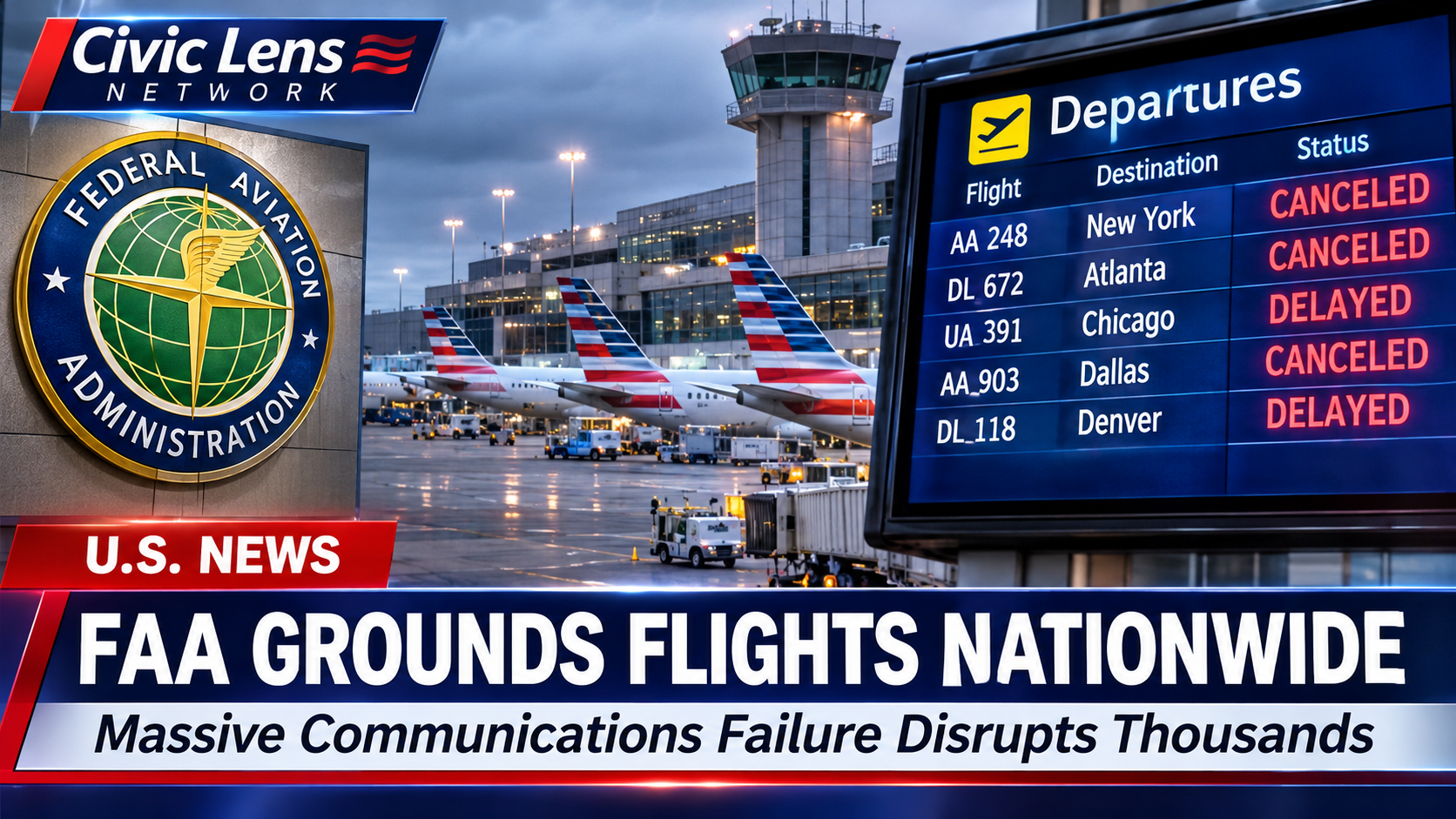
The Federal Aviation Administration ordered a nationwide halt to departing flights Friday afternoon after a major communications failure disrupted air traffic control operations across the United States, leaving thousands of travelers stranded and raising serious questions about the reliability of America’s aviation infrastructure.
The extraordinary order, issued November 13, prevented aircraft from taking off at airports nationwide while federal technicians investigated problems affecting the communications systems used by air traffic controllers.
According to flight tracking service FlightAware, nearly 7,000 flights had been delayed or canceled as the disruption spread through the nation’s aviation network.
Aircraft already airborne were permitted to continue toward their destinations and land, but planes waiting to depart were instructed to remain on the ground until further notice.
The FAA cited extraordinary circumstances and safety concerns in announcing the unprecedented nationwide restrictions.
Transportation Secretary Sean Duffy confirmed that communications problems were affecting all 22 regional Air Route Traffic Control Centers responsible for directing aircraft traveling between airports.
FAA technicians were dispatched to investigate the malfunction, but officials had not established a definitive cause or announced when normal operations would resume.
Airports Across America Brought to a Standstill
The nationwide shutdown affected major commercial airports and smaller regional facilities alike, disrupting the carefully coordinated system that manages tens of thousands of daily flights.
At Minneapolis-St. Paul International Airport, departing aircraft were halted as passengers waited aboard planes and inside terminals for information.
One pilot preparing for departure reportedly told passengers he had never witnessed anything comparable.
The disruption followed communications problems in Chicago, where the FAA had already halted traffic shortly before issuing its nationwide order.
International flights were being evaluated individually, adding uncertainty for travelers arriving from or departing for destinations outside the United States.
The immediate effects extended beyond passengers waiting to board aircraft.
Airlines faced the challenge of managing grounded planes, displaced crews and disrupted schedules. Aircraft unable to depart from one airport could not reach another location where they were scheduled to operate subsequent flights.
Such disruptions can continue affecting airline schedules even after the original technical problem is resolved.
Travelers were urged to monitor their airline’s official communications rather than assume that previously scheduled departure times remained accurate.
Federal Officials Investigate Communications Failure
The Department of Transportation confirmed that the emergency ground stop resulted from a communications issue affecting the FAA’s regional air traffic control network.
These facilities coordinate aircraft moving through large sections of American airspace, transferring responsibility between controllers as flights travel across the country.
Reliable communication between pilots and controllers is essential for maintaining safe distances between aircraft and coordinating changes in altitude, direction and flight paths.
When those communications cannot be guaranteed, allowing additional aircraft into the air creates unacceptable risks.
Former airline pilot and aviation safety expert Steve Arroyo explained that grounding aircraft is the appropriate precaution when controllers cannot reliably communicate with planes.
The Department of Homeland Security said there was no indication at that point that the communications failure resulted from a malicious act.
Officials had not publicly established whether the disruption originated from hardware, software, telecommunications infrastructure or another technical problem.
The investigation will need to determine not only what failed but also why backup systems were unable to prevent a nationwide interruption.
America’s Aging Air Traffic Control System Under Scrutiny
The shutdown has renewed concerns about the outdated equipment supporting America’s aviation network.
For years, federal officials, aviation experts and airline executives have warned that parts of the nation’s air traffic control infrastructure rely on aging communications systems and technology that urgently needs replacement.
Some facilities have continued operating with decades-old equipment while modernization efforts have struggled with funding requirements, technical complications and implementation delays.
Congress approved $12.5 billion in 2025 to help modernize air traffic control technology and expand controller hiring.
That funding was intended to support improvements to communications equipment, infrastructure and operational reliability.
However, federal officials have repeatedly warned that substantially more investment would be necessary.
On Friday, the White House and Department of Transportation urged Congress to approve another $30.1 billion for aviation modernization and airport infrastructure improvements.
The proposal included funding for upgraded air traffic control technology, improved telecommunications networks, modern controller workstations and replacement facilities.
Officials have also been working to replace aging copper communications lines with fiber optic infrastructure.
Despite those efforts, Friday’s nationwide shutdown demonstrated how vulnerable the system remains when essential communications fail.
A Rare Nationwide Aviation Shutdown
The last comparable nationwide ground stop occurred in January 2023, when a malfunction involving the FAA’s Notice to Air Missions system forced the temporary suspension of domestic departures.
That incident disrupted thousands of flights and exposed serious weaknesses in a system responsible for distributing critical safety information to pilots.
Before the 2023 incident, the previous nationwide halt followed the September 11, 2001 terrorist attacks.
Friday’s emergency differed from September 11 because aircraft already in the air were generally permitted to continue operating rather than being ordered to land immediately.
Nevertheless, the decision to halt departures across the country illustrates the severity of the communications problem.
The United States operates one of the world’s busiest and most complex aviation systems, with the FAA overseeing approximately 44,000 flights on a typical day.
Even a relatively brief nationwide interruption can affect enormous numbers of travelers and create scheduling problems that take airlines many hours to resolve.
Questions Congress Cannot Ignore
The latest failure is likely to intensify demands for congressional oversight of the FAA’s modernization efforts.
Lawmakers will face questions about how billions of dollars in previously approved funding have been spent, which infrastructure improvements remain incomplete and whether federal agencies have established adequate backup systems.
The aviation industry has long argued that modernizing air traffic control should be treated as a national priority rather than a project repeatedly delayed by budget disputes.
Friday’s shutdown gives that argument renewed urgency.
A nationwide transportation network cannot operate safely if a single communications failure can interrupt departures at airports across the entire country.
The incident also raises concerns about how quickly federal authorities can identify and isolate technical failures before they spread through interconnected systems.
Those questions will become particularly important as investigators determine whether the outage could have been prevented.
For passengers, the immediate concern remains when flights will resume and how long it will take airlines to restore their schedules.
For federal officials, the larger challenge is explaining why the country’s aviation infrastructure remains vulnerable to failures capable of bringing nationwide departures to a halt.
As the FAA continues investigating, millions of Americans who depend on air travel will be waiting for answers.
The shutdown has exposed a problem extending far beyond delayed flights. It has placed the reliability of America’s air traffic control infrastructure under a national spotlight.