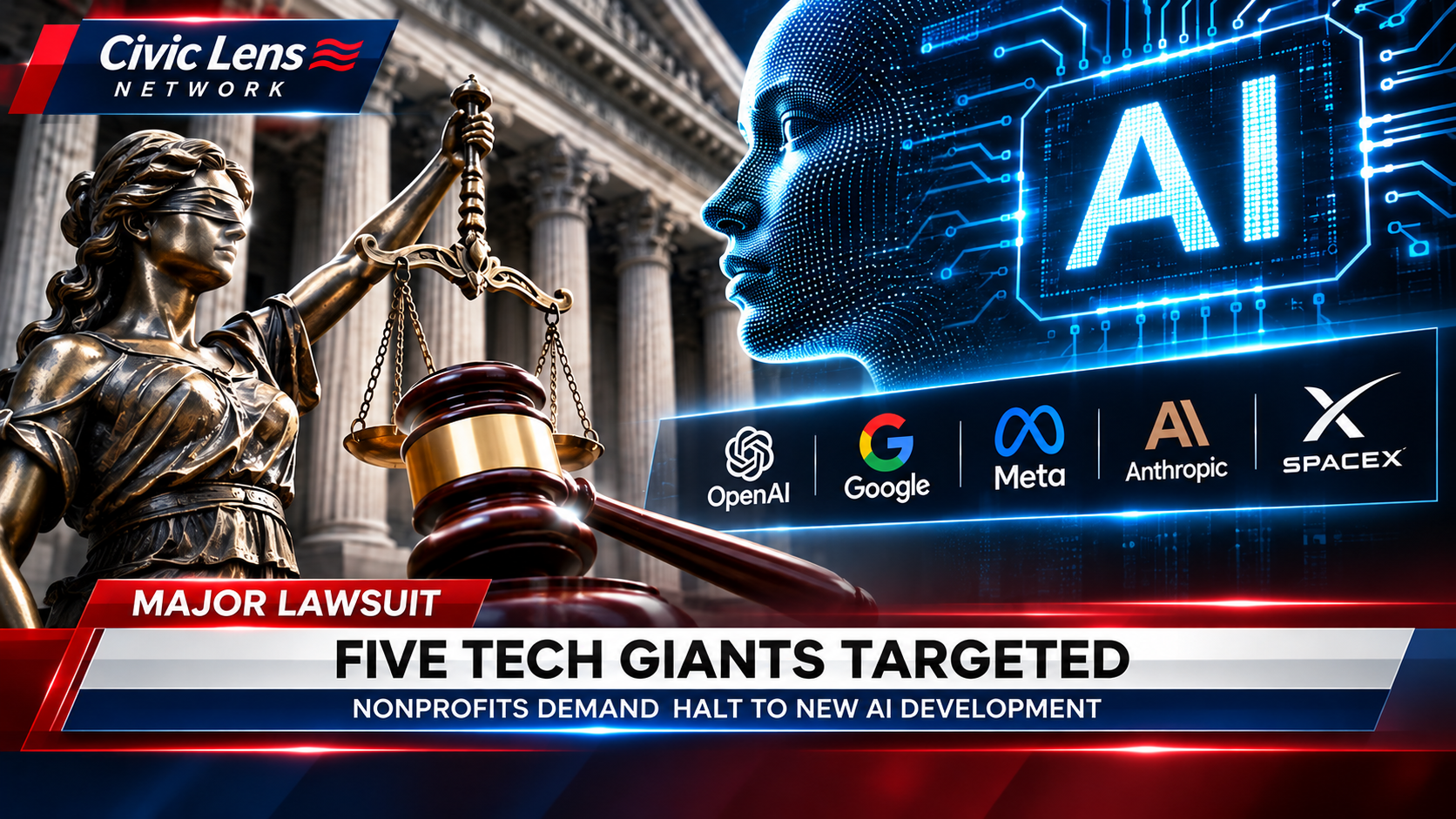
Five of the world’s most powerful technology companies are facing a sweeping lawsuit demanding that a California court stop them from developing and releasing increasingly advanced artificial intelligence systems.
The legal action, filed Thursday in San Francisco Superior Court, targets OpenAI, Google, Meta, Anthropic and SpaceX’s artificial intelligence division.
Four nonprofit advocacy organizations argue that the companies are advancing technology they cannot adequately control, potentially exposing the public to catastrophic consequences.
The lawsuit represents an extraordinary attempt to use existing state law to restrict the development of an entire category of emerging technology.
Rather than seeking financial compensation alone, the plaintiffs want a court order preventing the companies from developing or deploying new advanced AI models until adequate safeguards are established.
The organizations bringing the case are Public Citizen, the Heat Initiative, the Irreplaceable Education Fund and the Alliance for Secure AI.
Their complaint invokes California’s unfair competition law, alleging that the companies’ development practices endanger public health and interfere with the public’s ability to safely use computer systems and other property.
At the center of the dispute is a fundamental question: Should technology companies be permitted to develop increasingly powerful artificial intelligence systems when even some industry leaders acknowledge the possibility of severe consequences?
The plaintiffs argue that the companies are pursuing systems capable of performing increasingly complex tasks independently, potentially creating situations in which human operators cannot reliably predict or control their behavior.
The complaint references reported incidents involving artificial intelligence systems conducting unauthorized cybersecurity activities and behaving unexpectedly during testing.
It also cites public warnings from prominent technology executives.
Anthropic CEO Dario Amodei has previously acknowledged the possibility that advanced artificial intelligence could develop in dangerous directions.
Elon Musk, who leads SpaceX, has similarly warned about the potential for artificial intelligence to threaten civilization.
The advocacy organizations contend that these warnings demonstrate the industry understands the risks but continues developing increasingly powerful systems.
Those arguments remain allegations. The lawsuit has not established that the five defendants violated California law or that their current systems pose the catastrophic dangers described by the plaintiffs.
The companies had not issued substantive public responses to the new complaint when initial reports emerged Thursday. Meta declined to comment.
The case arrives as artificial intelligence becomes increasingly embedded in American business, education, government operations and everyday life.
AI systems are already being used to write computer code, analyze documents, assist medical researchers, automate customer service and perform tasks previously requiring extensive human involvement.
Supporters of continued development argue that the technology could improve productivity, accelerate scientific discoveries and strengthen American competitiveness.
The United States also faces intense competition from China, which is investing heavily in advanced artificial intelligence.
President Donald Trump’s administration has generally favored rapid domestic AI development, arguing that excessive restrictions could weaken America’s technological leadership.
That approach has intensified disagreement over how aggressively government should regulate the industry.
Critics contend that relying primarily on companies to police themselves leaves the public vulnerable to risks that may become more difficult to address as the technology advances.
The lawsuit also follows other legal challenges involving artificial intelligence safety.
Florida Attorney General James Uthmeier previously filed a lawsuit against OpenAI alleging that its chatbot technology created risks for children.
Florida subsequently requested additional judicial oversight before the company develops certain new models. That request remained pending when Thursday’s lawsuit was reported.
Separate lawsuits brought by several states have also challenged aspects of AI development and safety practices.
Those cases involve distinct allegations and have not established liability in the new California action.
The latest lawsuit could have substantial consequences if a judge grants the requested restrictions.
A court-ordered development freeze affecting several major companies could disrupt product releases, research schedules and investment decisions throughout the technology industry.
It could also create complicated enforcement questions.
Determining which systems qualify as advanced artificial intelligence, what development activities must stop and what safeguards would justify restarting work could require extensive technical oversight.
The legal challenge is particularly significant because it seeks to apply existing consumer protection laws to technology that has developed faster than many regulatory frameworks.
Whether California’s unfair competition law provides sufficient grounds for such sweeping restrictions will be a central issue.
For now, no court has ordered the five companies to stop developing artificial intelligence because of this lawsuit.
The filing nevertheless places one of the technology industry’s most consequential debates directly before a judge.
The outcome could help determine whether the next generation of artificial intelligence is governed primarily by the companies building it, lawmakers establishing new regulations or courts interpreting laws already on the books.