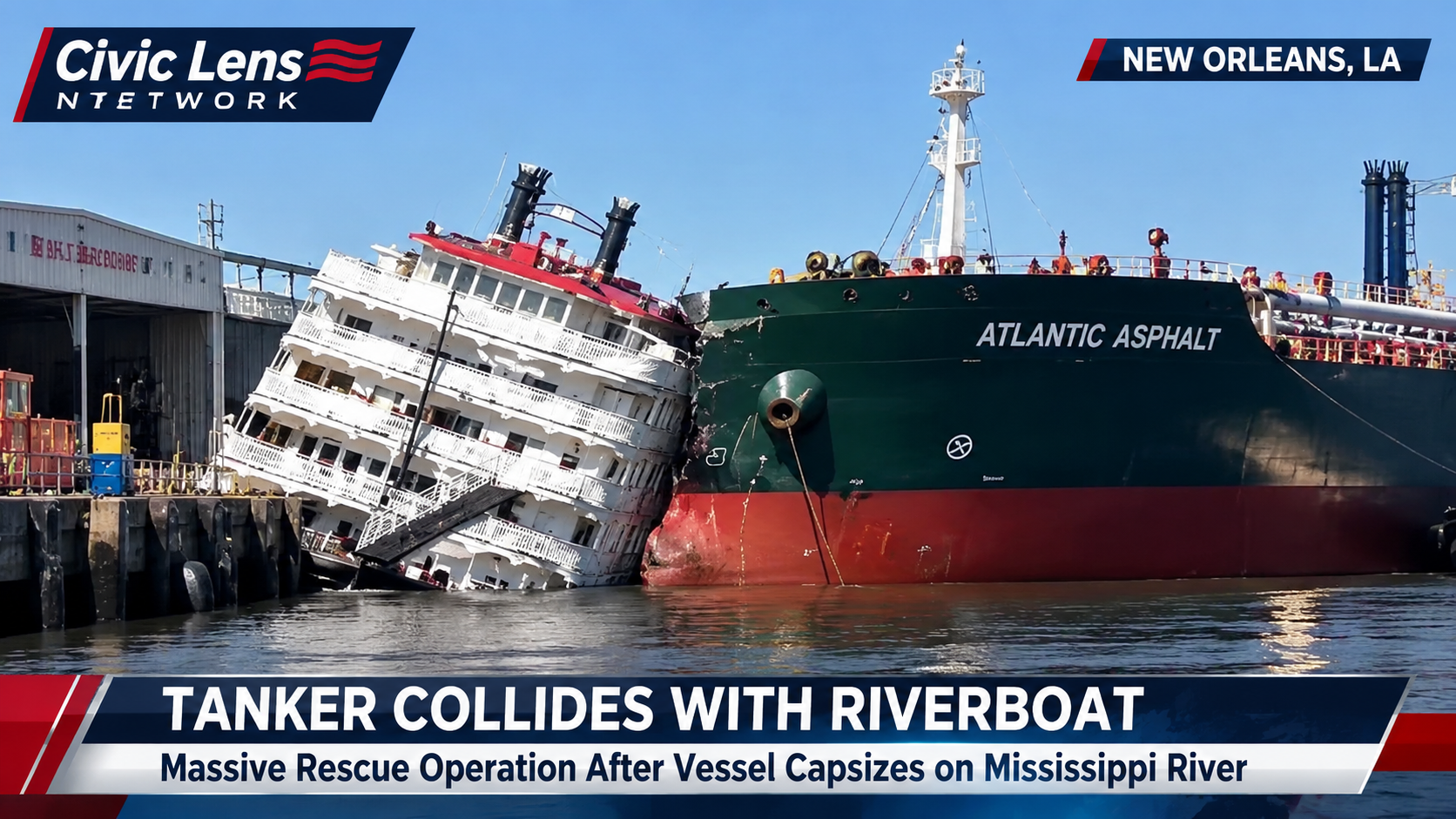
A massive emergency rescue operation unfolded on the Mississippi River in New Orleans Friday after a large commercial tanker slammed into a passenger riverboat carrying approximately 129 people, causing the smaller vessel to overturn and partially sink near the Port of New Orleans.
The collision occurred around 12:30 p.m. on November 13, 2026, when the 520-foot tanker Atlantic Asphalt struck the American Heritage, a river cruise vessel operated by American Cruise Lines.
The American Heritage was docked when the much larger tanker struck it, turning what should have been the conclusion of a scenic river cruise into a terrifying emergency.
Videos captured near the waterfront showed the riverboat leaning heavily onto its side as passengers and crew scrambled to escape. Several people could be seen in the Mississippi River wearing life jackets while emergency responders rushed to pull survivors from the water.
The force of the collision left the American Heritage partially submerged, with debris and personal belongings floating around the damaged vessel.
Passengers Thrown Into a Fight for Survival
The American Heritage had been nearing the conclusion of an eight-day cruise through Louisiana and Mississippi when the collision occurred.
The vessel, built in 2015, has accommodations for up to 150 passengers and operates sightseeing cruises along America’s inland waterways.
Witnesses described a frightening sequence of events as the riverboat began tipping following the impact.
One witness reported that the vessel rolled onto its side approximately 15 minutes after being struck, leaving passengers and crew with limited time to escape.
Rescue footage showed people clinging to parts of the damaged riverboat while others floated nearby awaiting assistance.
Emergency crews used rescue boats to reach those stranded in the water, while additional responders assembled along the riverfront to assist survivors.
The river’s temperature was approximately 66 degrees, adding another concern for passengers who had entered the water.
Emergency Crews Rush to the Scene
The U.S. Coast Guard, local emergency responders and Port of New Orleans personnel launched a coordinated rescue operation immediately following the collision.
Survivors were transported to a nearby port building, where emergency personnel established an area to evaluate their conditions and determine whether additional medical treatment was necessary.
Local television reporting indicated that more than a dozen people had been transported to hospitals, although authorities had not yet released a fully confirmed accounting of injuries or possible fatalities.
The Coast Guard also restricted vessel traffic along approximately three miles of the Mississippi River while rescue crews worked around the damaged passenger ship.
The closure temporarily disrupted commercial navigation along one of America’s most important shipping corridors.
Louisiana Governor Jeff Landry announced that he was traveling to New Orleans as the emergency response continued.
Questions Surround the Tanker’s Movements
The larger vessel involved in the collision, Atlantic Asphalt, is a commercial tanker designed to transport asphalt and bitumen.
Such cargo is often maintained at extremely high temperatures during transportation, sometimes exceeding 250 degrees Fahrenheit.
However, authorities had not confirmed whether the tanker was carrying cargo when the collision occurred.
There was also no immediate confirmation of a hazardous-material release or significant pollution resulting from the crash.
The fact that the American Heritage was docked when it was struck raises serious questions about how the tanker approached the passenger vessel and whether mechanical, navigational or operational problems contributed to the collision.
Investigators will need to examine the tanker’s movements, communications, steering systems and actions taken by its crew before the impact.
No official determination of the cause had been announced as the rescue operation continued.
A Major Shipping Corridor Disrupted
The Mississippi River serves as a critical transportation route for commercial shipping, connecting America’s agricultural and industrial heartland with international markets through the Gulf of Mexico.
Large tankers, cargo vessels, tugboats and passenger ships regularly operate in the New Orleans area, creating a busy maritime environment where safe navigation is essential.
The dramatic difference in size between the two vessels made Friday’s collision particularly dangerous.
At approximately 520 feet long, the Atlantic Asphalt was nearly twice the length of the American Heritage.
The incident also highlights the potentially devastating consequences when a large commercial vessel strikes a smaller passenger ship, particularly near crowded docking facilities.
For the passengers aboard the American Heritage, the collision transformed the final hours of their vacation into an emergency evacuation.
As rescue crews continued searching the damaged vessel and surrounding waters, the immediate priority remained accounting for everyone who had been aboard.
Authorities had not released a final casualty count or a complete passenger and crew accounting at the time of this report.
The investigation into what caused the tanker to strike the docked riverboat is expected to become a central focus once emergency operations are completed.